Padoan Andrea, Musso Giulia, Contran Nicole, Basso Daniela
Department of Medicine-DIMED, University of Padova, Via Giustiniani 2, 35128 Padova, Italy.
Curr Issues Mol Biol. 2023 Jun 30;45(7):5534-5557. doi: 10.3390/cimb45070350.
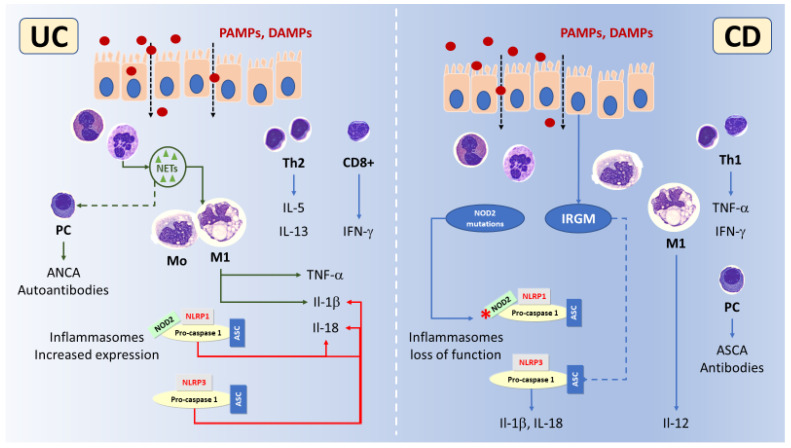
In this review, the role of innate and adaptive immunity in the pathogenesis of inflammatory bowel diseases (IBD) is reported. In IBD, an altered innate immunity is often found, with increased Th17 and decreased Treg cells infiltrating the intestinal mucosa. An associated increase in inflammatory cytokines, such as IL-1 and TNF-α, and a decrease in anti-inflammatory cytokines, such as IL-10, concur in favoring the persistent inflammation of the gut mucosa. Autoinflammation is highlighted with insights in the role of inflammasomes, which activation by exogenous or endogenous triggers might be favored by mutations of NOD and NLRP proteins. Autoimmunity mechanisms also take place in IBD pathogenesis and in this context of a persistent immune stimulation by bacterial antigens and antigens derived from intestinal cells degradation, the adaptive immune response takes place and results in antibodies and autoantibodies production, a frequent finding in these diseases. Inflammation, autoinflammation and autoimmunity concur in altering the mucus layer and enhancing intestinal permeability, which sustains the vicious cycle of further mucosal inflammation.
在本综述中,报告了固有免疫和适应性免疫在炎症性肠病(IBD)发病机制中的作用。在IBD中,常发现固有免疫改变,肠道黏膜中Th17细胞浸润增加而调节性T细胞减少。炎性细胞因子如IL-1和TNF-α相关增加,抗炎细胞因子如IL-10减少,共同促进肠道黏膜的持续炎症。炎性小体的作用突显了自身炎症,NOD和NLRP蛋白的突变可能有利于外源性或内源性触发因素激活炎性小体。自身免疫机制也在IBD发病机制中起作用,在细菌抗原和肠道细胞降解衍生抗原持续免疫刺激的背景下,适应性免疫反应发生并导致抗体和自身抗体产生,这在这些疾病中很常见。炎症、自身炎症和自身免疫共同作用改变黏液层并增强肠道通透性,维持进一步黏膜炎症的恶性循环。