Salman Mian Muhammad, Nawaz Muhammad, Yaqub Tahir, Mushtaq Muhammad Hassan
Institute of Microbiology, University of Veterinary and Animal Sciences, Lahore 54000, Pakistan.
Department of Epidemiology and Public Health, University of Veterinary and Animal Sciences, Lahore 54000, Pakistan.
Animals (Basel). 2023 Jul 13;13(14):2298. doi: 10.3390/ani13142298.
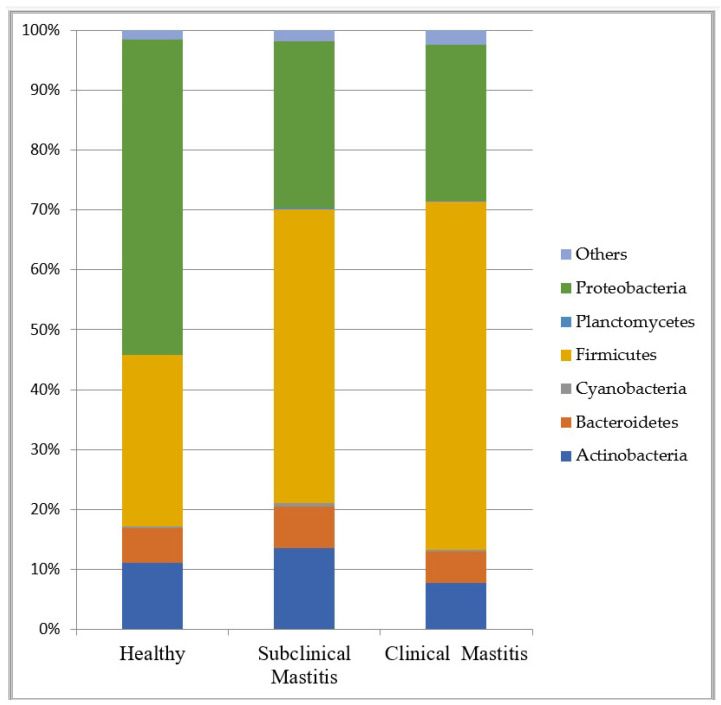
The Nili Ravi, a buffalo breed from Pakistan, significantly contributes to the dairy industry. Mastitis is one of the major challenges affecting milk production in this breed. The objective of the current study was to identify the bacterial communities and diversity in healthy and mastitic milk of this breed. Milk samples ( = 14) were collected from Nili Ravi buffaloes with different udder health statuses, i.e., healthy (5), subclinical mastitis (4), and clinical mastitis (5). The DNAs were extracted, subjected to partial amplification of 16S rDNA (V3 and V4 regions), and sequenced using the Illumina platform. The results revealed variations in the bacterial communities in the milk of animals with different udder health statuses. Proteobacteria was the predominant phylum in the healthy group, while clinical and subclinical mastitis milk had a higher abundance of Firmicutes. Dominant bacterial genera in the healthy group were (11.60%), (7.65%), and (4.70%), whereas the clinical mastitis group was dominated by (33.96%), (7.87%), and (2.68%), and the subclinical mastitis group was dominated by (15.70%), (6.70%), and (6.58%). Assignment of operational taxonomic units at the species level resulted in most species being assigned to uncultured or unknown bacteria or remaining unassigned. Alpha diversity indices indicated lower microbial diversity in the clinical mastitis group, while beta diversity indices showed a scattered pattern of sample clustering in PCA plots among different groups. It is concluded that bacterial diversity in the milk of Nili Ravi buffaloes suffering from clinical mastitis is lower compared to healthy and subclinical mastitis cases. It is concluded that the variations in the microbiota of healthy and mastitic milk may be further investigated and exploited as signature microbes associated with the udder health status of Nili Ravi buffalo.
尼里-拉菲水牛是一种来自巴基斯坦的水牛品种,对乳制品行业有重要贡献。乳腺炎是影响该品种牛奶产量的主要挑战之一。本研究的目的是确定该品种健康和患乳腺炎牛奶中的细菌群落及其多样性。从不同乳房健康状况的尼里-拉菲水牛身上采集了牛奶样本( = 14),即健康的(5份)、亚临床乳腺炎的(4份)和临床乳腺炎的(5份)。提取DNA,对16S rDNA(V3和V4区域)进行部分扩增,并使用Illumina平台进行测序。结果显示,不同乳房健康状况的动物牛奶中的细菌群落存在差异。变形菌门是健康组中的主要门类,而临床和亚临床乳腺炎牛奶中厚壁菌门的丰度更高。健康组中的优势细菌属为 (11.60%)、 (7.65%)和 (4.70%),而临床乳腺炎组以 (33.96%)、 (7.87%)和 (2.68%)为主,亚临床乳腺炎组以 (15.70%)、 (6.70%)和 (6.58%)为主。在物种水平上对操作分类单元进行归类,结果显示大多数物种被归类为未培养或未知细菌,或仍未归类。α多样性指数表明临床乳腺炎组的微生物多样性较低,而β多样性指数显示在主成分分析图中不同组之间的样本聚类呈分散模式。得出的结论是,与健康和亚临床乳腺炎病例相比,患临床乳腺炎的尼里-拉菲水牛牛奶中的细菌多样性较低。得出的结论是,可以进一步研究和利用健康和患乳腺炎牛奶中微生物群的差异,作为与尼里-拉菲水牛乳房健康状况相关的标志性微生物。