Quirant-Sánchez Bibiana, Plans-Galván Oriol, Lucas Ester, Argudo Eduard, Martinez-Cáceres Eva María, Arméstar Fernando
Immunology Division, LCMN, Germans Trias i Pujol University Hospital and Research Institute, FOCIS Center of Excellence UAB, 08916 Barcelona, Spain.
Department of Cell Biology, Physiology and Immunology, Universitat Autònoma de Barcelona, 08193 Bellaterra, Spain.
Biomedicines. 2023 Jun 26;11(7):1836. doi: 10.3390/biomedicines11071836.
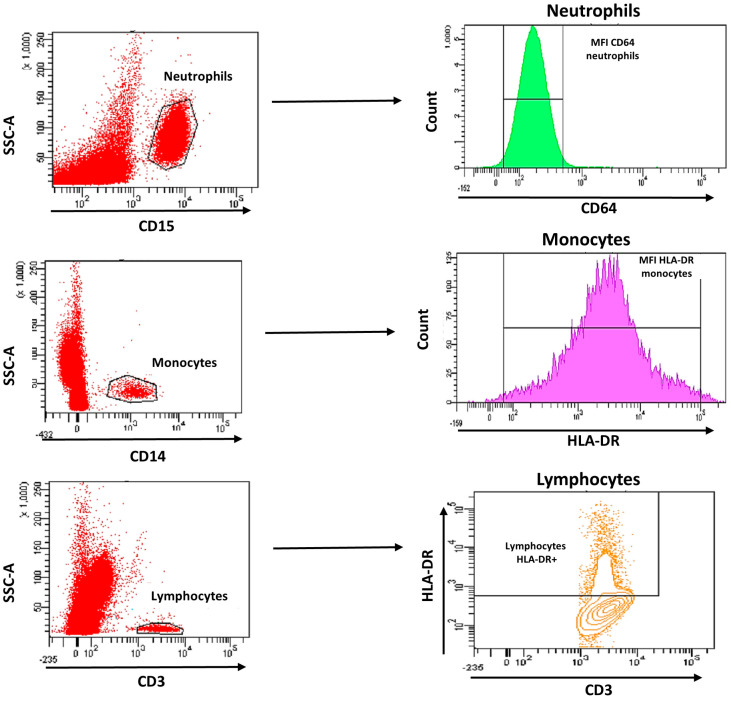
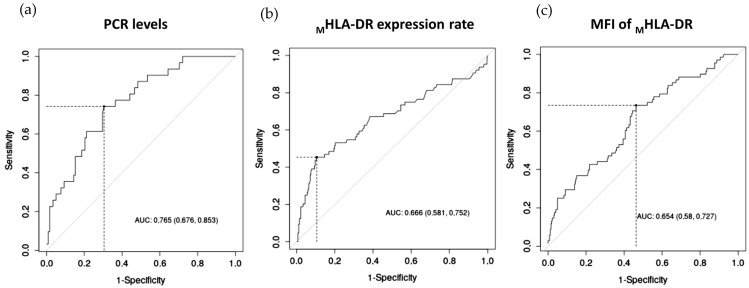
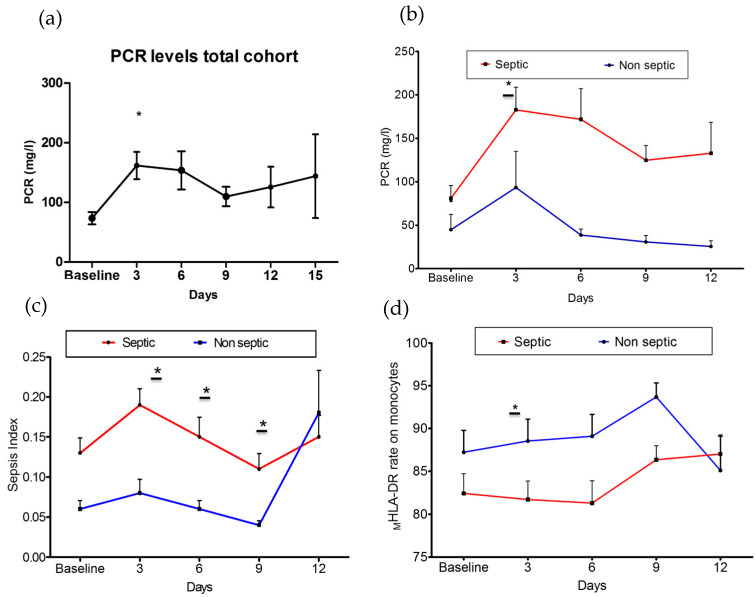
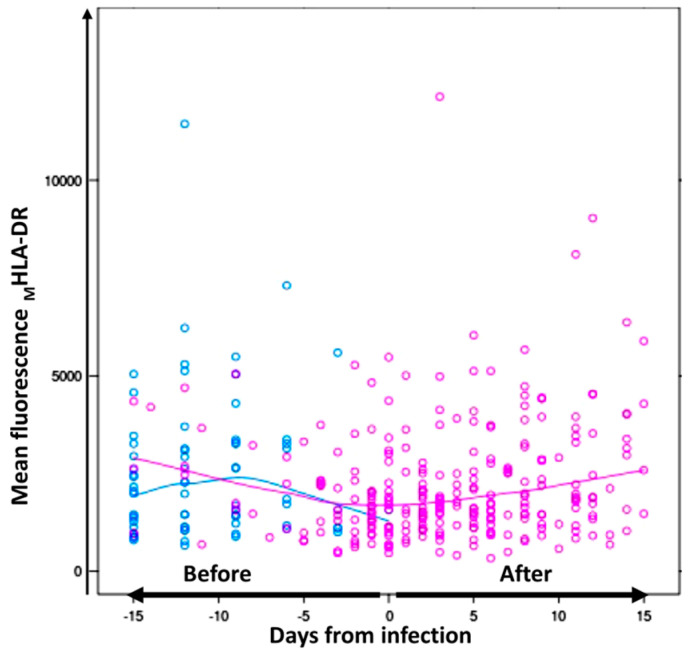
The reduction of mortality in patients with sepsis depends on the early identification and treatment of at-risk patients. The aim was to evaluate the HLA-DR expression on the surface of monocytes (HLA-DR ratio), the sepsis index (CD64 expression on neutrophils/HLA-DR ratio), and C-reactive protein (CRP) with the development of sepsis. We prospectively enrolled 77 critically ill patients, 59 with stroke and 18 with traumatic brain injuries. The biomarkers were tested at the baseline and 3, 6, 9, 12, and 15 days later. Most patients (71%) developed sepsis (4.2 ± 1.3 days after admission). On day 3, those subsequently developing sepsis had lower levels of HLA-DR+ (81.7 ± 16.2% vs. 88.5 ± 12.1%, < 0.05) and higher sepsis indexes (0.19 ± 0.19 vs. 0.08 ± 0.08, < 0.01) than those not developing sepsis. The HLA-DR ratio slowly recovered before day 6, while the sepsis index remained raised in septic patients up to day 9 ( < 0.05). To predict the development of sepsis, optimal cut-offs were CRP levels > 106.90 mg/mL (74.19% sensitivity, 69.49 specificity) and HLA-DR expression rate < 72.80% (45.31% sensitivity, 89.47% specificity). The periodic monitoring of the HLA-DR expression together with CRP and sepsis index may help to identify patients in the ICU at increased risk of developing sepsis.
脓毒症患者死亡率的降低取决于对高危患者的早期识别和治疗。目的是评估单核细胞表面HLA-DR表达(HLA-DR比率)、脓毒症指数(中性粒细胞上CD64表达/HLA-DR比率)和C反应蛋白(CRP)与脓毒症发生发展的关系。我们前瞻性纳入了77例危重症患者,其中59例为中风患者,18例为创伤性脑损伤患者。在基线及之后第3、6、9、12和15天对生物标志物进行检测。大多数患者(71%)发生了脓毒症(入院后4.2±1.3天)。在第3天,随后发生脓毒症的患者HLA-DR+水平较低(81.7±16.2%对88.5±12.1%,P<0.05),脓毒症指数较高(0.19±0.19对0.08±0.08,P<0.01),高于未发生脓毒症的患者。HLA-DR比率在第6天前缓慢恢复,而脓毒症患者的脓毒症指数在第9天前一直升高(P<0.05)。为预测脓毒症的发生,最佳临界值为CRP水平>106.90mg/mL(敏感性74.19%,特异性69.49%)和HLA-DR表达率<72.80%(敏感性45.31%,特异性89.47%)。定期监测HLA-DR表达以及CRP和脓毒症指数可能有助于识别重症监护病房中发生脓毒症风险增加的患者。