Rossi Esther Diana, Bruno Carmine, Tralongo Pietro, Policardo Federica, Vegni Federica, Feraco Angela, Zhang Qianqian, Pontecorvi Alfredo, Fadda Guido, Lombardi Celestino Pio, Raffaelli Marco, Mulè Antonino, Larocca Luigi Maria
Division of Anatomic Pathology and Histology, Università Cattolica del Sacro Cuore, "Agostino Gemelli" School of Medicine, 00168 Rome, Italy.
Division of Endocrinology, Università Cattolica del Sacro Cuore, "Agostino Gemelli" School of Medicine, 00168 Rome, Italy.
Diagnostics (Basel). 2023 Jul 17;13(14):2388. doi: 10.3390/diagnostics13142388.
Thyroid metastases (TMs) are a rare entity, ranging between 0 and 24% in the autopsy series. In the assessment of the best management, the discrimination between a primary and a metastatic thyroid lesion is crucial. In this regard, fine needle aspiration cytology (FNAC) is likely to play a crucial role especially when ancillary techniques (i.e., immunocytochemistry (ICC) and molecular testing) are carried out.
We searched for all the TMs diagnosed using FNAC and analyzed between 2014 and 2023. The cases were processed with liquid-based (LBC) and ICC and molecular testing performed on LBC-stored material.
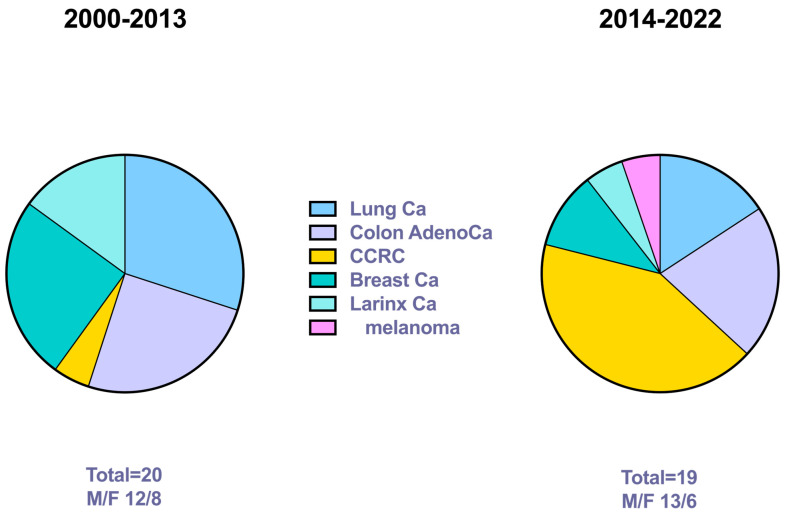
We reported 2.2% (19 cases) of TMs out of 1022 malignancies. TMs included: 1 larynx carcinoma (LX-Ca), 1 melanoma, 2 breast carcinomas (B-Ca), 3 lung carcinomas (LG-Ca), 4 gastro-intestinal carcinomas (GI-Ca), and 8 clear cell renal carcinomas (CCRC). All patients had a previous cancer history, between 300 and 2 months from the primary cancers. The morphological features were supported by ICC, which were contributive in 100% of cases. All TMs cases were characterized by multiple thyroid nodules except the melanoma case. Four cases underwent total thyroidectomy (1 B, 1 LX, 1 melanoma, and 1 CCRC) whilst 15 TMs were treated with radio-chemotherapy.
FNAC empowered the diagnostic workup of patients with TMs avoiding useless surgery. The low sensitivity of cytology might be reinforced by the application of ancillary techniques. We found a predominant rate of kidney metastatic carcinomas, followed by lung and breast. TMs are frequently multifocal and in a context of a systemic disease so a tailored therapy seems to be the best treatment.
甲状腺转移瘤(TMs)是一种罕见的疾病,在尸检系列中的发生率在0%至24%之间。在评估最佳治疗方案时,区分原发性和转移性甲状腺病变至关重要。在这方面,细针穿刺细胞学检查(FNAC)可能发挥关键作用,尤其是在进行辅助技术(即免疫细胞化学(ICC)和分子检测)时。
我们检索了2014年至2023年间所有通过FNAC诊断的TMs病例并进行分析。这些病例采用液基制片(LBC)处理,并对LBC保存的材料进行ICC和分子检测。
在1022例恶性肿瘤中,我们报告了2.2%(19例)的TMs。TMs包括:1例喉癌(LX-Ca)、1例黑色素瘤、2例乳腺癌(B-Ca)、3例肺癌(LG-Ca)、4例胃肠道癌(GI-Ca)和8例透明细胞肾癌(CCRC)。所有患者都有既往癌症病史,距离原发性癌症的时间在300天至2个月之间。形态学特征得到了ICC的支持,在100%的病例中都有帮助。除黑色素瘤病例外,所有TMs病例均表现为多个甲状腺结节。4例患者接受了全甲状腺切除术(1例B-Ca、1例LX-Ca、1例黑色素瘤和1例CCRC),而15例TMs接受了放化疗。
FNAC增强了TMs患者的诊断检查,避免了不必要的手术。细胞学检查的低敏感性可能通过应用辅助技术得到加强。我们发现肾转移性癌的比例最高,其次是肺和乳腺。TMs通常是多灶性的,且处于全身性疾病的背景下,因此量身定制的治疗似乎是最佳治疗方法。