Shenzhen Branch, Guangdong Laboratory for Lingnan Modern Agriculture, Genome Analysis Laboratory of the Ministry of Agriculture, Agricultural Genomics Institute at Shenzhen, Chinese Academy of Agricultural Sciences, Shenzhen 518120, China.
Center for Genomics and Biotechnology, Haixia Institute of Science and Technology, Fujian Agriculture and Forestry University, Fuzhou 350002, China.
Genes (Basel). 2023 Jul 8;14(7):1417. doi: 10.3390/genes14071417.
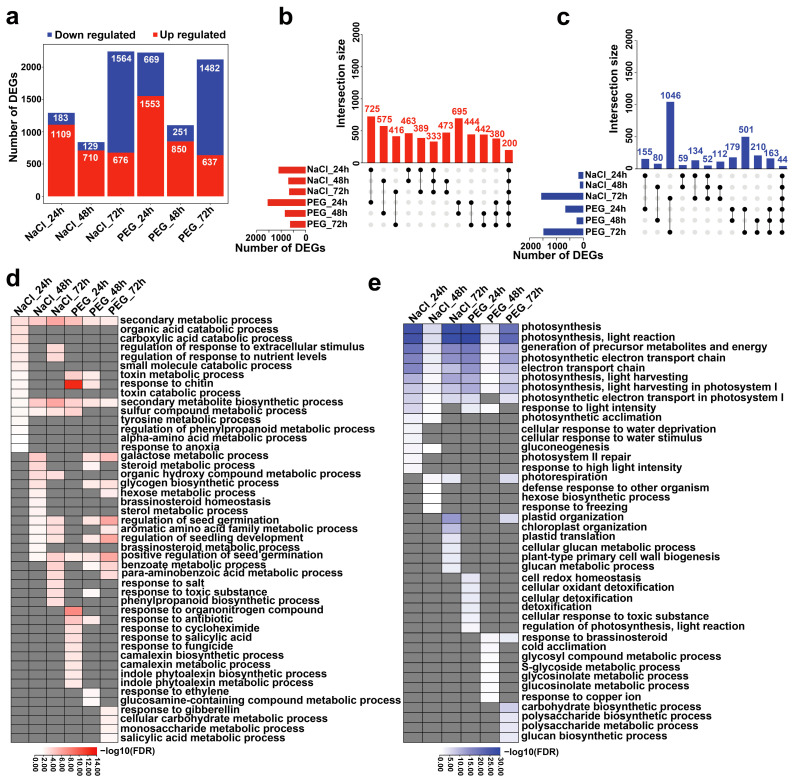
The tea plant, (L.) O. Kuntze, is one of the most important beverage crops with significant economic and cultural value. Global climate change and population growth have led to increased salt and drought stress, negatively affecting tea yield and quality. The response mechanism of tea plants to these stresses remains poorly understood due to the lack of reference genome-based transcriptional descriptions. This study presents a high-quality genome-based transcriptome dynamic analysis of ' response to salt and drought stress. A total of 2244 upregulated and 2164 downregulated genes were identified under salt and drought stress compared to the control sample. Most of the differentially expression genes (DEGs) were found to involve divergent regulation processes at different time points under stress. Some shared up- and downregulated DEGs related to secondary metabolic and photosynthetic processes, respectively. Weighted gene co-expression network analysis (WGCNA) revealed six co-expression modules significantly positively correlated with response to salt or drought stress. The MEpurple module indicated crosstalk between the two stresses related to ubiquitination and the phenylpropanoid metabolic regulation process. We identified 1969 salt-responsive and 1887 drought-responsive allele-specific expression (ASE) genes in . Further comparison between these ASE genes and tea plant heterosis-related genes suggests that heterosis likely contributes to the adversity and stress resistance of . This work offers new insight into the underlying mechanisms of response to salt and drought stress and supports the improved breeding of tea plants with enhanced salt and drought tolerance.
茶树(L.)O. Kuntze 是最重要的饮料作物之一,具有重要的经济和文化价值。全球气候变化和人口增长导致盐度和干旱胁迫增加,对茶叶产量和质量产生负面影响。由于缺乏基于参考基因组的转录描述,茶树对这些胁迫的响应机制仍知之甚少。本研究对‘响应盐度和干旱胁迫的高分辨率基于基因组的转录组动态分析’进行了研究。与对照样品相比,盐度和干旱胁迫下共鉴定出 2244 个上调基因和 2164 个下调基因。大多数差异表达基因(DEGs)在不同时间点受到胁迫时,被发现涉及不同的调控过程。一些共享的上调和下调 DEGs 分别与次生代谢和光合作用过程有关。加权基因共表达网络分析(WGCNA)显示,有六个共表达模块与响应盐度或干旱胁迫呈显著正相关。MEpurple 模块表明两种胁迫之间与泛素化和苯丙烷代谢调节过程有关的串扰。我们在 中鉴定出 1969 个盐响应和 1887 个干旱响应等位基因特异性表达(ASE)基因。进一步比较这些 ASE 基因和茶树杂种优势相关基因表明,杂种优势可能有助于茶树的逆境和抗逆性。这项工作为茶树响应盐度和干旱胁迫的潜在机制提供了新的见解,并支持了具有增强耐盐和耐旱性的茶树改良育种。