Yen Chiahui, Lin Chia-Li, Chiang Ming-Chang
Department of International Business, Ming Chuan University, Taipei 111, Taiwan.
Department of Life Science, College of Science and Engineering, Fu Jen Catholic University, New Taipei City 242, Taiwan.
Life (Basel). 2023 Jun 29;13(7):1472. doi: 10.3390/life13071472.
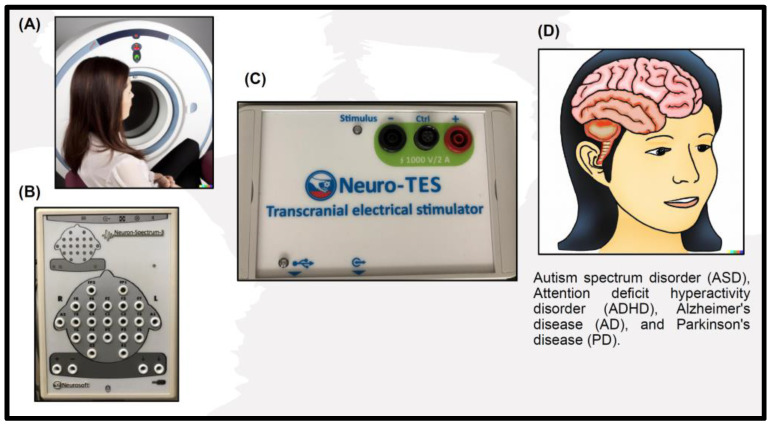
Neuroimaging has revolutionized our understanding of brain function and has become an essential tool for researchers studying neurological disorders. Functional magnetic resonance imaging (fMRI) and electroencephalography (EEG) are two widely used neuroimaging techniques to review changes in brain activity. fMRI is a noninvasive technique that uses magnetic fields and radio waves to produce detailed brain images. An EEG is a noninvasive technique that records the brain's electrical activity through electrodes placed on the scalp. This review overviews recent developments in noninvasive functional neuroimaging methods, including fMRI and EEG. Recent advances in fMRI technology, its application to studying brain function, and the impact of neuroimaging techniques on neuroscience research are discussed. Advances in EEG technology and its applications to analyzing brain function and neural oscillations are also highlighted. In addition, advanced courses in neuroimaging, such as diffusion tensor imaging (DTI) and transcranial electrical stimulation (TES), are described, along with their role in studying brain connectivity, white matter tracts, and potential treatments for schizophrenia and chronic pain. Application. The review concludes by examining neuroimaging studies of neurodevelopmental and neurological disorders such as autism spectrum disorder (ASD), attention deficit hyperactivity disorder (ADHD), Alzheimer's disease (AD), and Parkinson's disease (PD). We also described the role of transcranial direct current stimulation (tDCS) in ASD, ADHD, AD, and PD. Neuroimaging techniques have significantly advanced our understanding of brain function and provided essential insights into neurological disorders. However, further research into noninvasive treatments such as EEG, MRI, and TES is necessary to continue to develop new diagnostic and therapeutic strategies for neurological disorders.
神经影像学彻底改变了我们对大脑功能的理解,已成为研究神经疾病的研究人员的重要工具。功能磁共振成像(fMRI)和脑电图(EEG)是两种广泛用于检查大脑活动变化的神经影像学技术。fMRI是一种非侵入性技术,利用磁场和无线电波生成详细的大脑图像。EEG是一种非侵入性技术,通过放置在头皮上的电极记录大脑的电活动。本综述概述了非侵入性功能神经影像学方法的最新进展,包括fMRI和EEG。讨论了fMRI技术的最新进展、其在研究大脑功能中的应用以及神经影像学技术对神经科学研究的影响。还强调了EEG技术的进展及其在分析大脑功能和神经振荡方面的应用。此外,还描述了神经影像学的高级课程,如扩散张量成像(DTI)和经颅电刺激(TES),以及它们在研究大脑连接性、白质束以及精神分裂症和慢性疼痛的潜在治疗方法中的作用。应用。综述最后考察了对神经发育和神经疾病的神经影像学研究,如自闭症谱系障碍(ASD)、注意力缺陷多动障碍(ADHD)、阿尔茨海默病(AD)和帕金森病(PD)。我们还描述了经颅直流电刺激(tDCS)在ASD、ADHD、AD和PD中的作用。神经影像学技术极大地推进了我们对大脑功能的理解,并为神经疾病提供了重要的见解。然而,有必要进一步研究诸如EEG、MRI和TES等非侵入性治疗方法,以继续开发针对神经疾病的新诊断和治疗策略。