Anwar Tauseef, Qureshi Huma, Fatima Arooj, Sattar Kanwal, Albasher Gadah, Kamal Asif, Ayaz Asma, Zaman Wajid
Department of Botany, The Islamia University of Bahawalpur (Baghdad ul Jadeed Campus), Bahawalpur 63100, Pakistan.
Department of Botany, University of Chakwal, Chakwal 48800, Pakistan.
Microorganisms. 2023 Jun 26;11(7):1662. doi: 10.3390/microorganisms11071662.
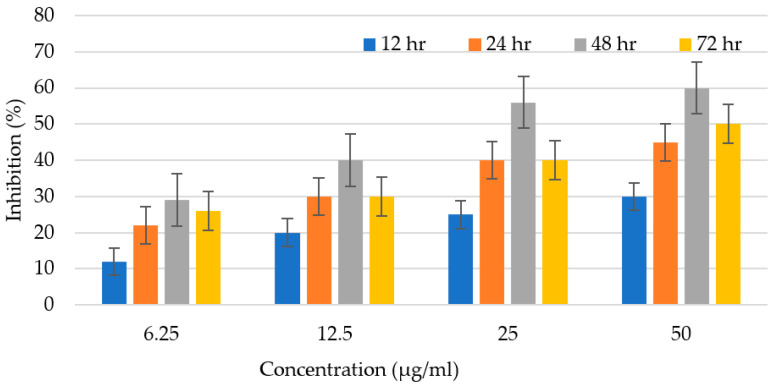
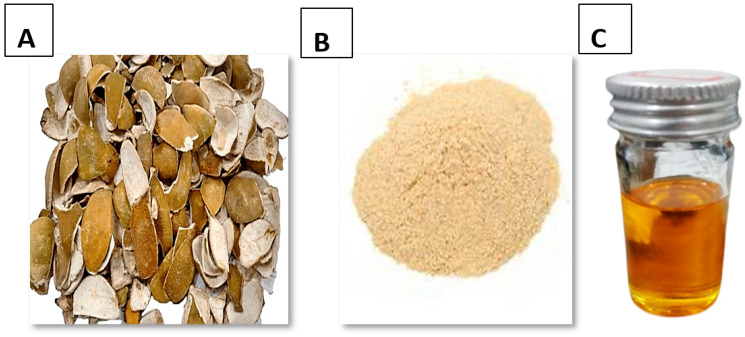
Throughout the tropical and subtropical climates, the genus Citrus can be found. The current study was conducted to extract the peel oil and evaluate its antibacterial, antifungal and antiparasitic potential. Petroleum ether was used to extract the peel oil through a Soxhlet apparatus. The antimicrobial and antifungal potential was determined via agar well diffusion method and minimum inhibitory concentrations (MIC) were calculated (test bacterial strains: , and ; test fungal strains: , , ). Antiparasitic activity against was determined following standard protocol using amphotericin-B as positive and Dimethyl Sulfoxide (DMSO) as a negative control and the percentage inhibition was calculated. The oil extracted was brownish yellow with a tangy smell, water-insoluble, density (0.778 g/cm) and specific gravity (0.843 g/cm). In antibacterial activity, the diameter of the zone of inhibition was maximum against (14 mm) and minimum for (10 mm). While in antifungal activity diameter of the zone of inhibition was maximum against (12.5 mm) and minimum for (8.6 mm). exhibited the minimum MIC value (6 mg/mL) and in fungal strains exhibited the minimum value (2 mm). peel oil displayed antileishmanial efficiency of 60% at 50 μg/mL concentration after 48 h of incubation. peel oil demonstrated antimicrobial capabilities, implying that it could be used as a natural preservative in food or as an effective treatment against a variety of pathogenic organisms. Industries should extract oil from the waste of citrus fruits which will be beneficial from an economic point of view.
在热带和亚热带气候地区均能发现柑橘属植物。本研究旨在提取果皮油并评估其抗菌、抗真菌和抗寄生虫潜力。采用石油醚通过索氏提取器提取果皮油。通过琼脂扩散法测定抗菌和抗真菌潜力,并计算最低抑菌浓度(测试细菌菌株: 、 和 ;测试真菌菌株: 、 、 )。按照标准方案,以两性霉素 -B 作为阳性对照、二甲基亚砜(DMSO)作为阴性对照,测定对 的抗寄生虫活性,并计算抑制百分比。提取的油呈棕黄色,有刺鼻气味,不溶于水,密度为(0.778 g/cm),比重为(0.843 g/cm)。在抗菌活性方面,抑菌圈直径对 最大(14 mm),对 最小(10 mm)。而在抗真菌活性方面,抑菌圈直径对 最大(12.5 mm),对 最小(8.6 mm)。 在细菌菌株中表现出最低的 MIC 值(6 mg/mL),在真菌菌株中 表现出最小值(2 mm)。 在 50 μg/mL 浓度下孵育 48 小时后显示出 60% 的抗利什曼原虫效率。 果皮油具有抗菌能力,这意味着它可作为食品中的天然防腐剂或用于有效对抗多种致病生物。企业应从柑橘类水果废弃物中提取油,这在经济方面将是有益的。