Mallem Siva Pratap Reddy, Puneetha Peddathimula, Lee Dong-Yeon, Kim Yoonkap, Kim Han-Jung, Im Ki-Sik, An Sung-Jin
Advanced Material Research Center, Kumoh National Institute of Technology, Gumi 39177, Republic of Korea.
Department of Robotics and Intelligent Machine Engineering, College of Mechanical and IT Engineering, Yeungnam University, Gyeongsan 38541, Republic of Korea.
Nanomaterials (Basel). 2023 Jul 22;13(14):2132. doi: 10.3390/nano13142132.
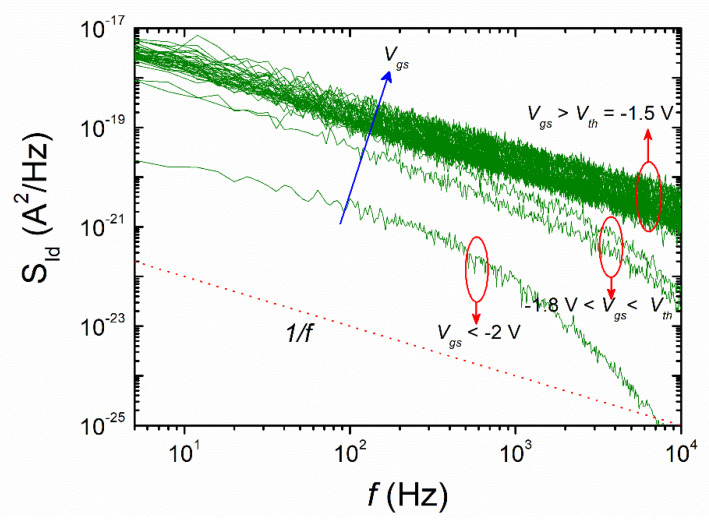
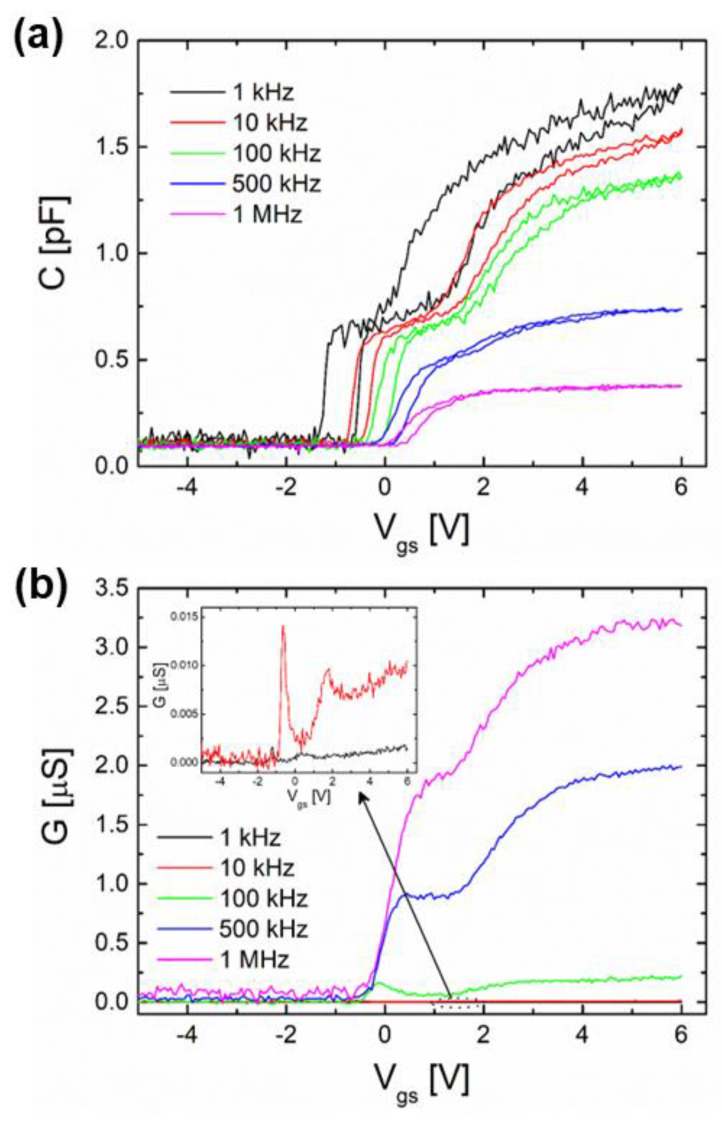
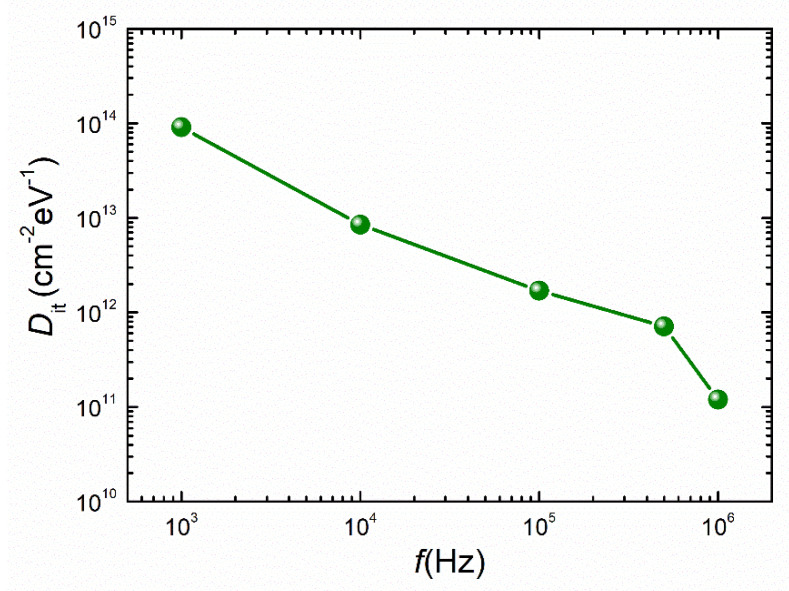
We used capacitance-voltage (-), conductance-voltage (-), and noise measurements to examine the carrier trap mechanisms at the surface/core of an AlGaN/GaN nanowire wrap-gate transistor (WGT). When the frequency is increased, the predicted surface trap density promptly drops, with values ranging from 9.1 × 10 eV∙cm at 1 kHz to 1.2 × 10 eV∙cm at 1 MHz. The power spectral density exhibits 1/-noise behavior in the barrier accumulation area and rises with gate bias, according to the 1/-noise features. At lower frequencies, the device exhibits 1/-noise behavior, while beyond 1 kHz, it exhibits 1/-noise behavior. Additionally, when the fabricated device governs in the deep-subthreshold regime, the cutoff frequency for the 1/-noise features moves to the subordinated frequency (~10 Hz) side.
我们使用电容 - 电压(-)、电导 - 电压(-)和噪声测量来研究AlGaN/GaN纳米线环绕栅晶体管(WGT)表面/核心处的载流子陷阱机制。当频率增加时,预测的表面陷阱密度迅速下降,其值范围从1 kHz时的9.1×10 eV∙cm到1 MHz时的1.2×10 eV∙cm。根据1/-噪声特征,功率谱密度在势垒积累区域呈现1/-噪声行为,并随栅极偏置而上升。在较低频率下,该器件呈现1/-噪声行为,而在超过1 kHz时,它呈现1/-噪声行为。此外,当制造的器件在深亚阈值区域工作时,1/-噪声特征的截止频率移向从属频率(~10 Hz)一侧。