Nutrition and Mental Health (NUTRISAM) Research Group, Universitat Rovira i Virgili, 43204 Reus, Spain.
Institut d'Investigació Sanitaria Pere Virgili (IISPV), 43204 Reus, Spain.
Nutrients. 2023 Jul 20;15(14):3225. doi: 10.3390/nu15143225.
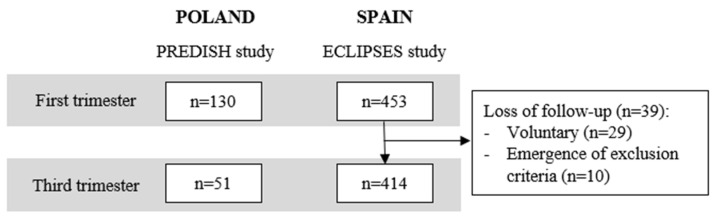
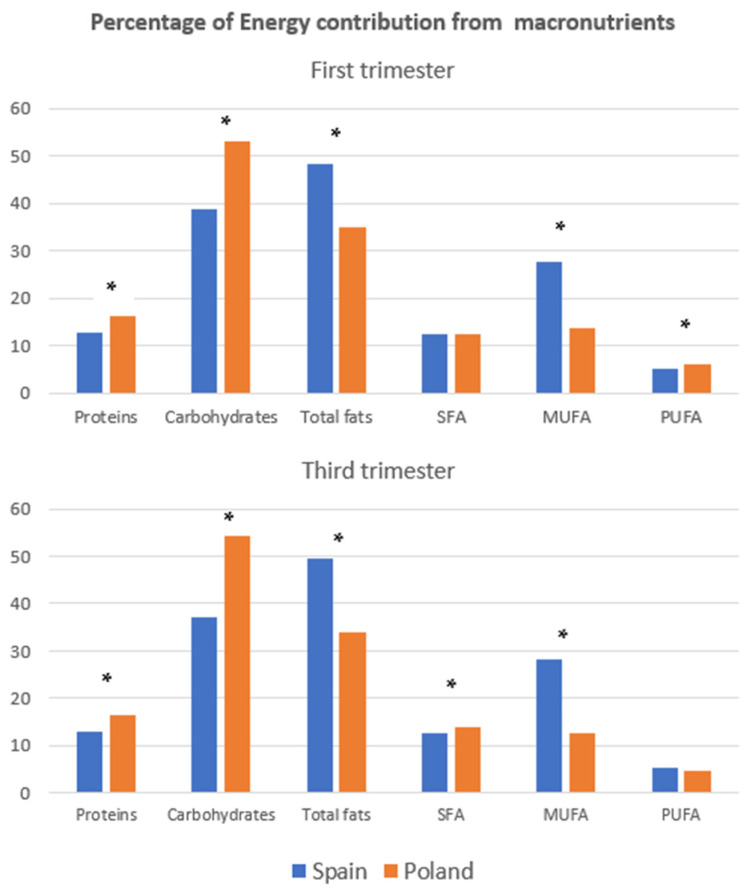
Prenatal nutrition plays a crucial role in maternal and child health. This study aims to compare nutrient intake and its adequacy to recommendations among pregnant women in Spain and Poland. The ECLIPSES study in Spain utilized a self-administered food frequency questionnaire, while the PREDISH study in Poland employed a 3-day interview method. We assessed energy and nutrient intake against recommended dietary allowances. The analysis included 583 participants in the first trimester and 465 participants in the third trimester from both countries. Our findings revealed insufficient intake of iron, vitamin D, and vitamin B9 among pregnant women in both Spain and Poland. Significant differences were observed in the intake of energy, carbohydrates, fiber, calcium, iron, and vitamins D, E, C, B6, B9, and B12. Notably, 81.6% and 21.5% of participants did not meet the recommended minimum carbohydrate intake, while 99.8% and 43.8% exceeded the limit for total fat, particularly monounsaturated fatty acids (MUFAs). Tailored dietary guidance based on regional differences is crucial for pregnant women. Although variations in dietary intake were observed, both Spain and Poland faced similar risks of nutritional deficiencies, particularly for iron, vitamin D, and vitamin B9. These findings emphasize the need for enhanced efforts in preventing these deficiencies and promoting optimal prenatal nutrition.
产前营养在母婴健康中起着至关重要的作用。本研究旨在比较西班牙和波兰孕妇的营养摄入量及其与推荐摄入量的符合程度。西班牙的 ECLIPSES 研究采用了自我管理的食物频率问卷,而波兰的 PREDISH 研究则采用了 3 天访谈方法。我们根据推荐的膳食允许量评估了能量和营养素的摄入量。该分析包括来自两国的 583 名初产妇和 465 名孕晚期妇女。我们的研究结果表明,西班牙和波兰的孕妇铁、维生素 D 和维生素 B9 的摄入量均不足。在能量、碳水化合物、纤维、钙、铁和维生素 D、E、C、B6、B9 和 B12 的摄入量方面观察到显著差异。值得注意的是,81.6%和 21.5%的参与者没有达到推荐的最低碳水化合物摄入量,而 99.8%和 43.8%的参与者总脂肪摄入量超标,尤其是单不饱和脂肪酸(MUFAs)。基于区域差异的定制膳食指导对孕妇至关重要。尽管观察到饮食摄入存在差异,但西班牙和波兰都面临着类似的营养缺乏风险,尤其是铁、维生素 D 和维生素 B9。这些发现强调了加强预防这些缺乏症和促进最佳产前营养的必要性。