Alabsi Basim Ahmad, Anbar Mohammed, Rihan Shaza Dawood Ahmed
Applied College, Najran University, Kind Abdulaziz Street, Najran P.O. Box 1988, Saudi Arabia.
National Advanced IPv6 (NAv6) Centre, Universiti Sains Malaysia, Gelugor 11800, Malaysia.
Sensors (Basel). 2023 Jul 19;23(14):6507. doi: 10.3390/s23146507.
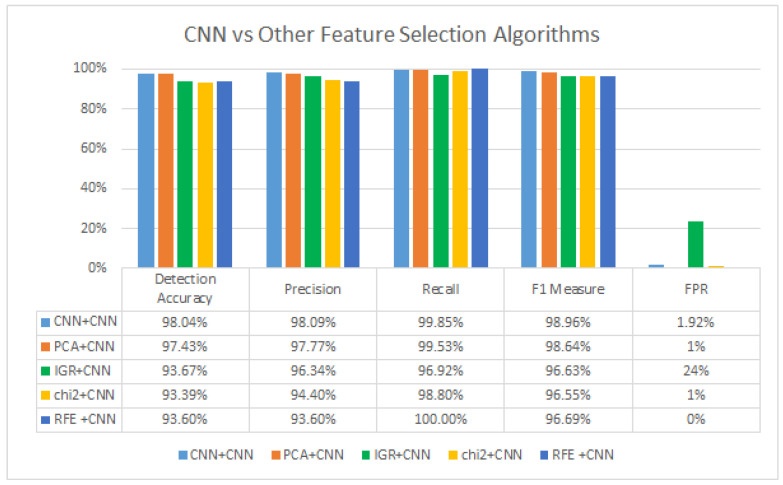
The Internet of Things (IoT) has brought significant advancements that have connected our world more closely than ever before. However, the growing number of connected devices has also increased the vulnerability of IoT networks to several types of attacks. In this paper, we present an approach for detecting attacks on IoT networks using a combination of two convolutional neural networks (CNN-CNN). The first CNN model is leveraged to select the significant features that contribute to IoT attack detection from the raw data on network traffic. The second CNN utilizes the features identified by the first CNN to build a robust detection model that accurately detects IoT attacks. The proposed approach is evaluated using the BoT IoT 2020 dataset. The results reveal that the proposed approach achieves 98.04% detection accuracy, 98.09% precision, 99.85% recall, 98.96% recall, and a 1.93% false positive rate (FPR). Furthermore, the proposed approach is compared with other deep learning algorithms and feature selection methods; the results show that it outperforms these algorithms.
物联网(IoT)带来了重大进展,以前所未有的紧密程度连接了我们的世界。然而,连接设备数量的不断增加也增加了物联网网络遭受多种攻击的脆弱性。在本文中,我们提出了一种使用两个卷积神经网络相结合的方法来检测物联网网络上的攻击(CNN-CNN)。第一个CNN模型用于从网络流量的原始数据中选择有助于物联网攻击检测的重要特征。第二个CNN利用第一个CNN识别的特征来构建一个强大的检测模型,该模型能够准确检测物联网攻击。所提出的方法使用BoT IoT 2020数据集进行评估。结果表明,所提出的方法实现了98.04%的检测准确率、98.09%的精确率、99.85%的召回率、98.96%的召回率以及1.93%的误报率(FPR)。此外,将所提出的方法与其他深度学习算法和特征选择方法进行了比较;结果表明它优于这些算法。