
使用优化算法的(物联网)网络入侵检测系统
(IoT) Network intrusion detection system using optimization algorithms.
作者信息
Shan Luo
机构信息
Department of Physics and Electronic Information Engineering, LYU Liang University, LV Liang, 033001, Shanxi, China.
出版信息
Sci Rep. 2025 Jul 1;15(1):21706. doi: 10.1038/s41598-025-04638-5.
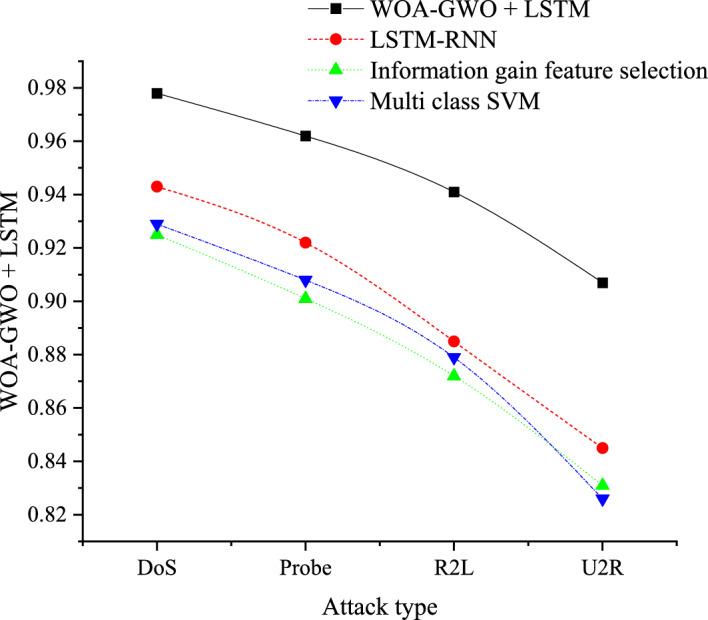
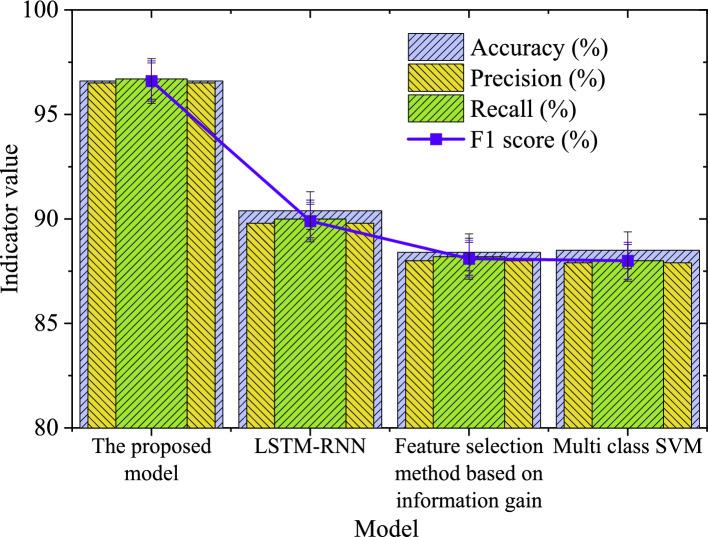
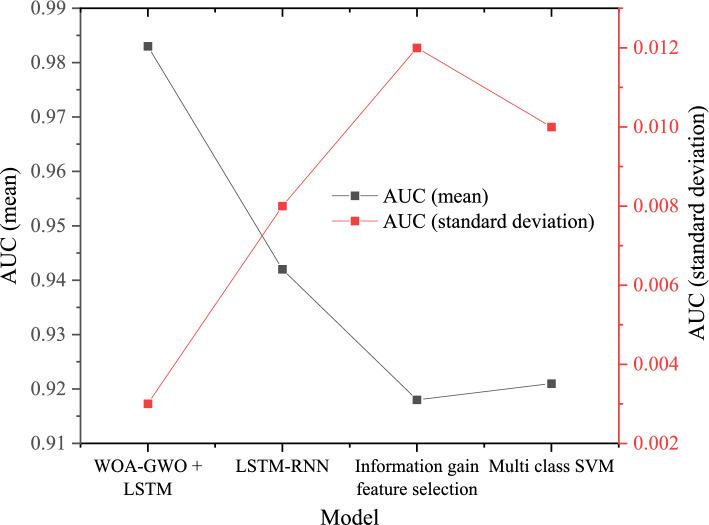
To address the complex requirements of network intrusion detection in IoT environments, this study proposes a hybrid intelligent framework that integrates the Whale Optimization Algorithm (WOA) and the Grey Wolf Optimization (GWO) algorithm-referred to as WOA-GWO. This framework leverages a cooperative mechanism to balance global exploration and local exploitation capabilities. WOA's spiral bubble-net search strategy endows the model with efficient global optimization in large-scale feature spaces, while GWO's hunting behavior, based on a social hierarchy, enhances fine-tuned optimization in key feature regions. The complementary design of the two algorithms effectively overcomes the limitations of single-algorithm approaches, such as susceptibility to local optima and slow convergence speed. Compared with traditional models like the Long Short-Term Memory Recurrent Neural Network (LSTM-RNN) and Support Vector Machine (SVM), the proposed framework significantly improves the sensitivity and generalization ability for detecting various types of attacks through dynamic feature selection and parameter optimization. Experimental results demonstrate that the hybrid algorithm exhibits superior real-time responsiveness in binary classification tasks, thanks to its lightweight design that reduces dependency on computational resources. In multi-class attack identification scenarios, the framework mitigates feature confusion between rare attacks (e.g., user-to-root attacks) and normal traffic through adaptive feature weight allocation. This study further validates the potential of swarm intelligence algorithms in the field of IoT security, offering a novel methodological foundation for efficient threat detection in resource-constrained environments.
为了满足物联网环境中网络入侵检测的复杂需求,本研究提出了一种混合智能框架,该框架集成了鲸鱼优化算法(WOA)和灰狼优化(GWO)算法,称为WOA - GWO。该框架利用一种协作机制来平衡全局探索和局部开发能力。WOA的螺旋气泡网搜索策略使模型在大规模特征空间中具有高效的全局优化能力,而GWO基于社会等级制度的狩猎行为则增强了关键特征区域的微调优化能力。两种算法的互补设计有效地克服了单算法方法的局限性,如易陷入局部最优和收敛速度慢等问题。与长短期记忆循环神经网络(LSTM - RNN)和支持向量机(SVM)等传统模型相比,所提出的框架通过动态特征选择和参数优化,显著提高了检测各种类型攻击的灵敏度和泛化能力。实验结果表明,该混合算法在二分类任务中表现出卓越的实时响应能力,这得益于其轻量级设计,减少了对计算资源的依赖。在多类攻击识别场景中,该框架通过自适应特征权重分配减轻了罕见攻击(如用户到根攻击)与正常流量之间的特征混淆。本研究进一步验证了群体智能算法在物联网安全领域的潜力,为资源受限环境下的高效威胁检测提供了新的方法基础。




 Zotero 插件