Holmes Niall, Bowtell Richard, Brookes Matthew J, Taulu Samu
Sir Peter Mansfield Imaging Centre, School of Physics and Astronomy, University of Nottingham, University Park, Nottingham NG7 2RD, UK.
Cerca Magnetics Limited, Unit 2 Castlebridge Office Village, Kirtley Drive, Nottingham NG7 1LD, UK.
Sensors (Basel). 2023 Jul 20;23(14):6537. doi: 10.3390/s23146537.
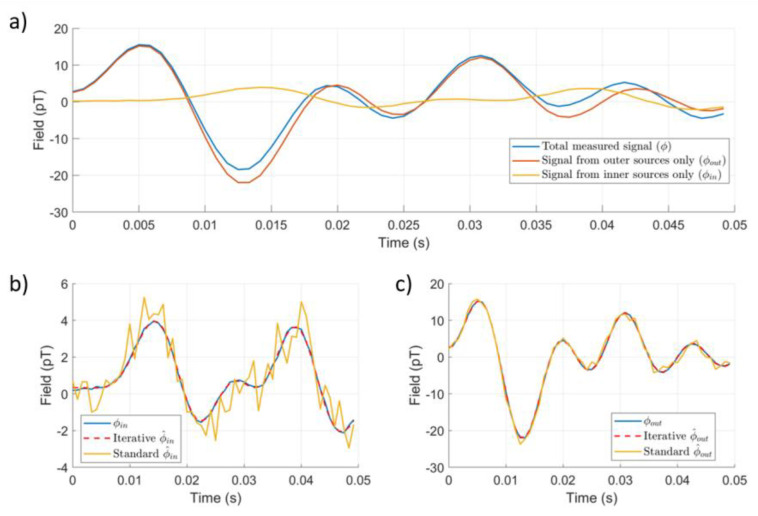
The signal space separation (SSS) method is routinely employed in the analysis of multichannel magnetic field recordings (such as magnetoencephalography (MEG) data). In the SSS method, signal vectors are posed as a multipole expansion of the magnetic field, allowing contributions from sources internal and external to a sensor array to be separated via computation of the pseudo-inverse of a matrix of the basis vectors. Although powerful, the standard implementation of the SSS method on MEG systems based on optically pumped magnetometers (OPMs) is unstable due to the approximate parity of the required number of dimensions of the SSS basis and the number of channels in the data. Here we exploit the hierarchical nature of the multipole expansion to perform a stable, iterative implementation of the SSS method. We describe the method and investigate its performance via a simulation study on a 192-channel OPM-MEG helmet. We assess performance for different levels of truncation of the SSS basis and a varying number of iterations. Results show that the iterative method provides stable performance, with a clear separation of internal and external sources.
信号空间分离(SSS)方法通常用于多通道磁场记录(如脑磁图(MEG)数据)的分析。在SSS方法中,信号向量被表示为磁场的多极展开,通过计算基向量矩阵的伪逆,可以分离传感器阵列内部和外部源的贡献。尽管SSS方法很强大,但基于光泵磁力计(OPM)的MEG系统上的标准SSS方法实现由于SSS基所需维度数与数据通道数的近似奇偶性而不稳定。在这里,我们利用多极展开的分层性质来实现SSS方法的稳定迭代实现。我们描述了该方法,并通过在192通道OPM-MEG头盔上的模拟研究来研究其性能。我们评估了不同SSS基截断水平和不同迭代次数下的性能。结果表明,迭代方法提供了稳定的性能,能够清晰地分离内部和外部源。