Instituto de Biomecánica (IBV), Universitat Politècnica de València, Edificio 9C, Camino de Vera S/N, 46022 Valencia, Spain.
Unidad de Biomecánica Clínica (UBIC), Department of Physiotherapy, Faculty of Physiotherapy, Universitat de València, Carrer Gascó Oliag 5, 46010 Valencia, Spain.
Sensors (Basel). 2023 Jul 20;23(14):6567. doi: 10.3390/s23146567.
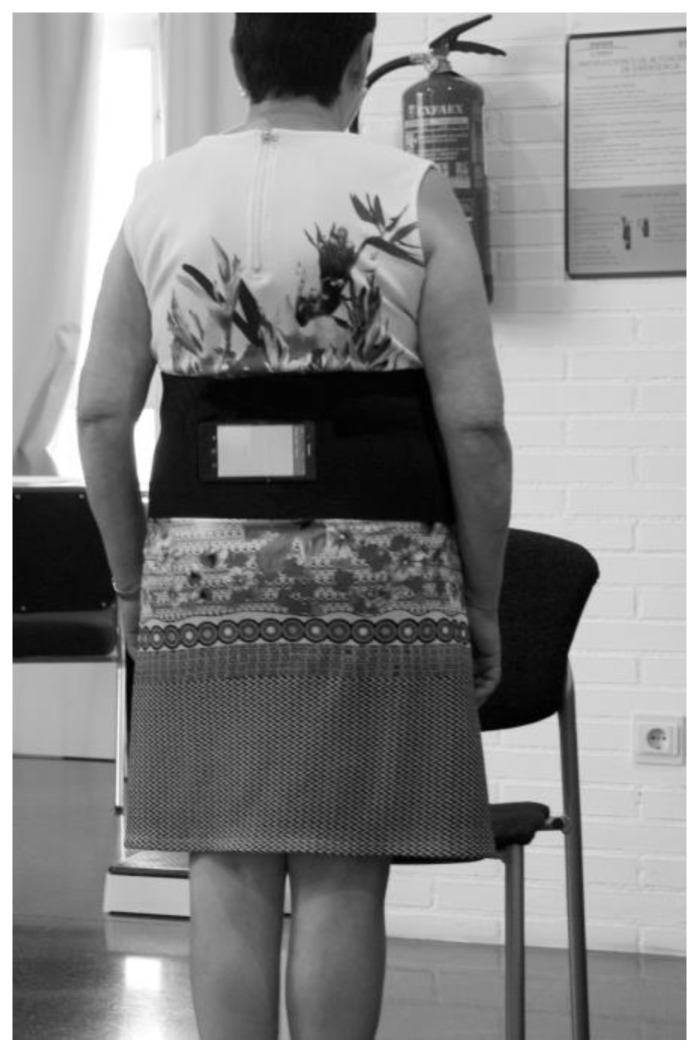
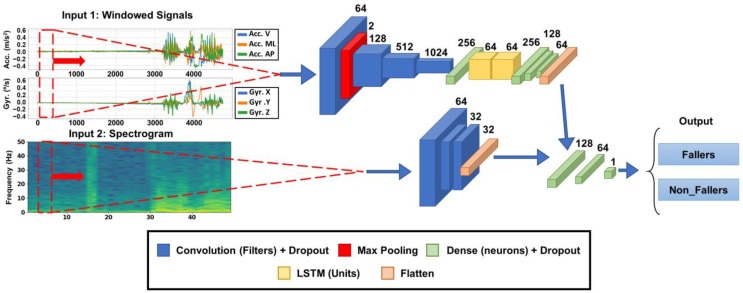
Falls in older people are a major health concern as the leading cause of disability and the second most common cause of accidental death. We developed a rapid fall risk assessment based on a combination of physical performance measurements made with an inertial sensor embedded in a smartphone. This study aimed to evaluate and validate the reliability and accuracy of an easy-to-use smartphone fall risk assessment by comparing it with the Physiological Profile Assessment (PPA) results. Sixty-five participants older than 55 performed a variation of the Timed Up and Go test using smartphone sensors. Balance and gait parameters were calculated, and their reliability was assessed by the (ICC) and compared with the PPAs. Since the PPA allows classification into six levels of fall risk, the data obtained from the smartphone assessment were categorised into six equivalent levels using different parametric and nonparametric classifier models with neural networks. The F1 score and geometric mean of each model were also calculated. All selected parameters showed ICCs around 0.9. The best classifier, in terms of accuracy, was the nonparametric mixed input data model with a 100% success rate in the classification category. In conclusion, fall risk can be reliably assessed using a simple, fast smartphone protocol that allows accurate fall risk classification among older people and can be a useful screening tool in clinical settings.
老年人跌倒问题是一个重大的健康关注点,是导致残疾的主要原因,也是第二大常见的意外死亡原因。我们开发了一种基于智能手机中嵌入的惯性传感器的物理性能测量组合的快速跌倒风险评估方法。本研究旨在通过与生理概况评估(PPA)结果进行比较,评估和验证一种易于使用的智能手机跌倒风险评估的可靠性和准确性。 65 名年龄在 55 岁以上的参与者使用智能手机传感器进行了不同的定时起身和行走测试。计算了平衡和步态参数,并通过(ICC)评估了其可靠性,并与 PPAs 进行了比较。由于 PPA 允许将跌倒风险分为六个等级,因此使用不同的参数和非参数分类器模型(包括神经网络),将从智能手机评估中获得的数据分为六个等效等级。还计算了每个模型的 F1 分数和几何平均值。所有选定的参数的 ICC 均接近 0.9。就准确性而言,最好的分类器是非参数混合输入数据模型,在分类类别中成功率为 100%。总之,使用简单,快速的智能手机协议可以可靠地评估跌倒风险,并且可以成为临床环境中有用的筛选工具。