Department of Psychiatry, Clinical and Experimental Psychopathology Laboratory, University Hospital Geneva, Thônex, Switzerland.
Department of Psychiatry and Neurosciences, Charité-Universitätsmedizin Berlin, Berlin, Germany.
Schizophr Bull. 2024 Jul 27;50(4):733-746. doi: 10.1093/schbul/sbae046.
Ventral striatal hypoactivation during reward anticipation has consistently been observed in patients with schizophrenia. In addition, that hypoactivation has been shown to correlate negatively with negative symptoms, and in particular with apathy. However, little is known about the stability of these results over time and their reliability across different centers.
In total, 67 patients with schizophrenia (15 females) and 55 healthy controls (13 females) were recruited in 2 centers in Switzerland and Germany. To assess the neural bases of reward anticipation, all participants performed a variant of the Monetary Incentive Delay task while undergoing event-related functional magnetic resonance imaging at baseline and after 3 months. Stability over time was measured using intra-class correlation (ICC(A,1)) and stability between centers was measured with mixed models.
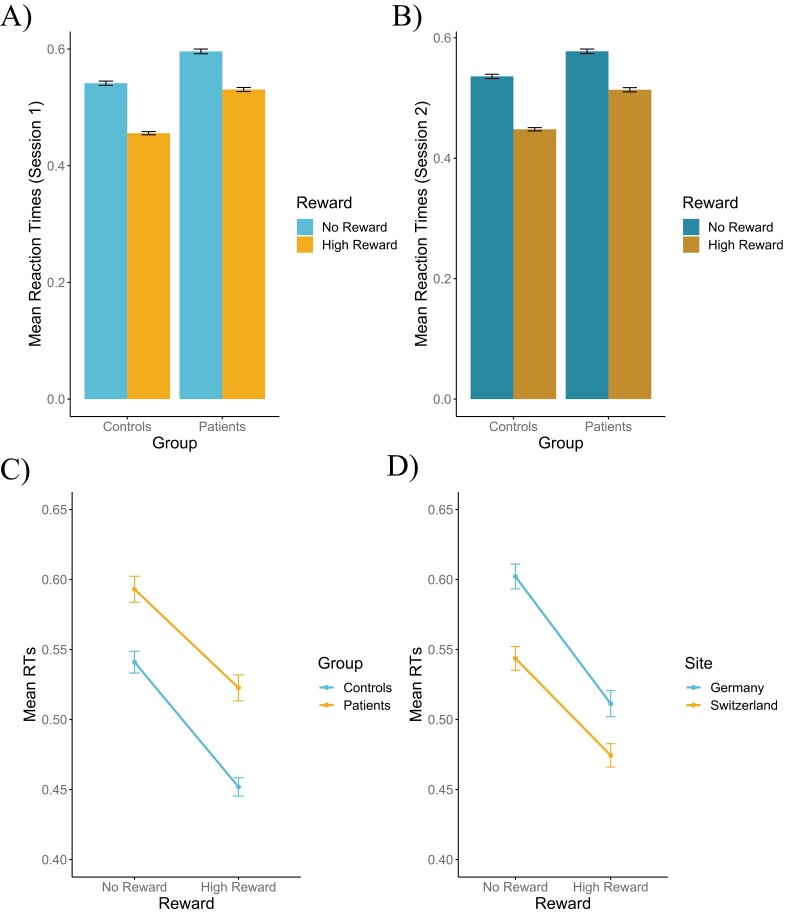
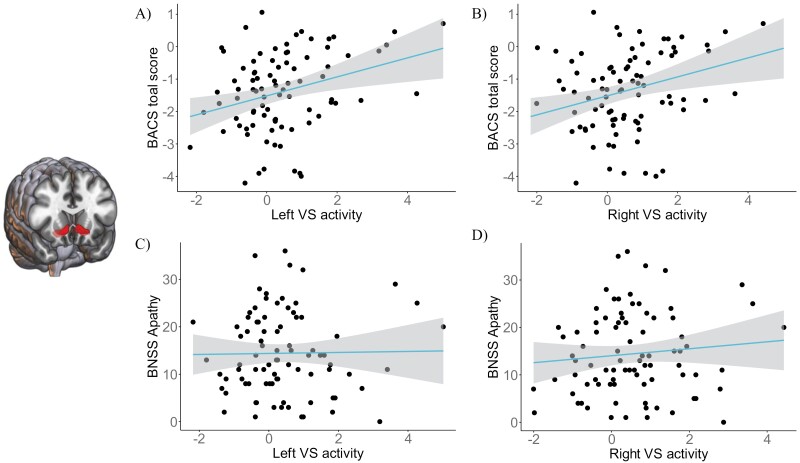
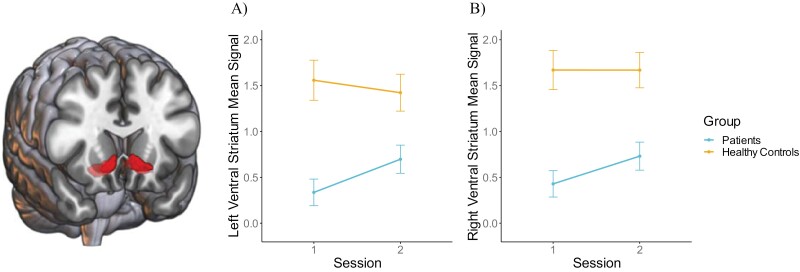
Results showed the expected ventral striatal hypoactivation in patients compared to controls during reward anticipation. We showed that these results were stable across centers. The primary analysis did not reveal an effect of time. Test-retest reliability was moderate for controls, and poor for patients. We did not find an association between ventral striatal hypoactivation and negative symptoms in patients.
Our results align with the hypothesis that ventral striatal activation is related to modulation of motivational saliency during reward anticipation. They also confirm that patients with schizophrenia show impaired reward anticipation. However, the poor test-retest reliability and the absence of an association with symptoms suggests that further research is needed before ventral striatal activity can be used as a biomarker on the individual patient level.
在精神分裂症患者中,在奖励预期期间观察到腹侧纹状体的激活不足。此外,这种激活不足与阴性症状呈负相关,尤其是与淡漠有关。然而,关于这些结果随时间的稳定性及其在不同中心的可靠性知之甚少。
总共招募了来自瑞士和德国的 2 个中心的 67 名精神分裂症患者(15 名女性)和 55 名健康对照组(13 名女性)。为了评估奖励预期的神经基础,所有参与者在基线和 3 个月后进行了货币激励延迟任务的变体,同时进行了事件相关功能磁共振成像。使用组内相关系数(ICC(A,1))来衡量时间的稳定性,使用混合模型来衡量中心之间的稳定性。
结果显示,与对照组相比,患者在奖励预期期间出现了预期的腹侧纹状体激活不足。我们表明这些结果在中心之间是稳定的。主要分析没有显示时间的影响。对于对照组,测试-重测信度中等,对于患者,测试-重测信度较差。我们没有发现患者腹侧纹状体激活不足与阴性症状之间存在关联。
我们的结果与腹侧纹状体激活与奖励预期期间动机显著性的调节有关的假设一致。它们还证实了精神分裂症患者存在奖励预期受损。然而,较差的测试-重测信度和与症状无关的缺乏表明,在个体患者水平上,腹侧纹状体活动可以作为生物标志物使用之前,需要进一步研究。