Nilsson Anton, Strömberg Ulf, Björk Jonas, Forsberg Anna, Fritzell Kaisa, Kemp Gudmundsdottir Katrin Ragna, Engdahl Johan, Bonander Carl
Epidemiology, Population Studies and Infrastructures (EPI@LUND), Lund University, Lund, Sweden.
Region Halland, Halmstad, Sweden.
Prev Med Rep. 2023 Jul 13;35:102317. doi: 10.1016/j.pmedr.2023.102317. eCollection 2023 Oct.
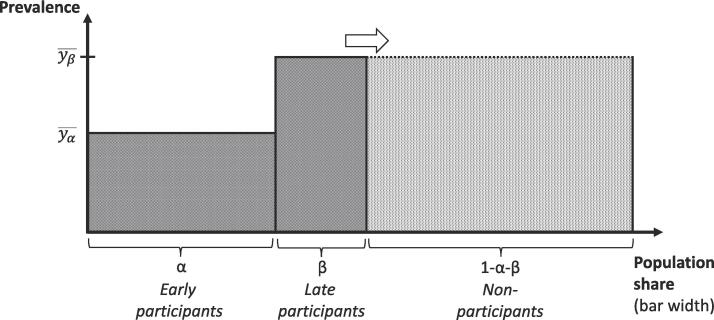
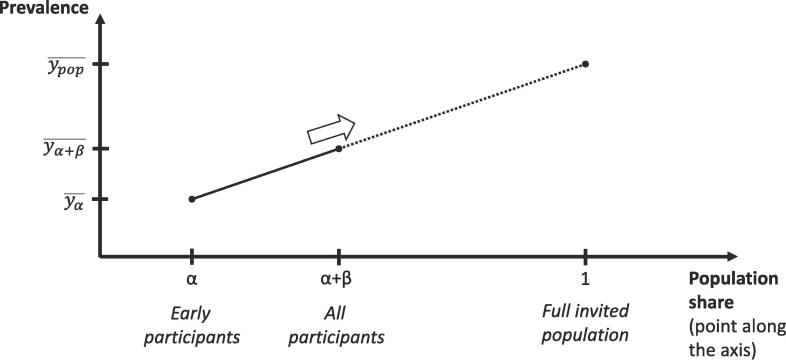
In studies recruited on a voluntary basis, lack of representativity may impair the ability to generalize findings to the target population. Previous studies, primarily based on surveys, have suggested that generalizability may be improved by exploiting data on individuals who agreed to participate only after receiving one or several reminders, as such individuals may be more similar to non-participants than what early participants are. Assessing this idea in the context of screenings, we compared sociodemographic characteristics and health across early, late, and non-participants in two large population-based screening studies in Sweden: STROKESTOP II (screening for atrial fibrillation; 6,867 participants) and SCREESCO (screening for colorectal cancer; 39,363 participants). We also explored the opportunities to reproduce the distributions of characteristics in the full invited populations, either by assuming that the non-participants were similar to the late participants, or by applying a linear extrapolation model based on both early and late participants. Findings showed that early and late participants exhibited similar characteristics along most dimensions, including civil status, education, income, and health examination results. Both these types of participants in turn differed from the non-participants, with fewer married, lower educational attainments, and lower incomes. Compared to early participants, late participants were more likely to be born outside of Sweden and to have comorbidities, with non-participants similar or even more so. The two empirical models improved representativity in some cases, but not always. Overall, we found mixed support that data on late participation may be useful for improving representativeness of screening studies.
在基于自愿招募的研究中,缺乏代表性可能会削弱将研究结果推广至目标人群的能力。以往主要基于调查的研究表明,利用那些仅在收到一次或多次提醒后才同意参与的个体的数据,可提高研究结果的可推广性,因为这类个体可能比早期参与者更类似于未参与者。在筛查背景下评估这一观点时,我们比较了瑞典两项大型基于人群的筛查研究(STROKESTOP II,房颤筛查,6867名参与者;SCREESCO,结直肠癌筛查,39363名参与者)中早期、晚期参与者以及未参与者的社会人口学特征和健康状况。我们还探讨了通过假设未参与者与晚期参与者相似,或者应用基于早期和晚期参与者的线性外推模型,来重现全部受邀人群特征分布的机会。研究结果显示,早期和晚期参与者在大多数维度上表现出相似的特征,包括婚姻状况、教育程度、收入和健康检查结果。这两类参与者又都与未参与者不同,已婚者较少、教育程度较低且收入较低。与早期参与者相比,晚期参与者更有可能出生在瑞典境外且患有合并症,未参与者的情况与之相似甚至更甚。这两种实证模型在某些情况下提高了代表性,但并非总是如此。总体而言,我们发现对于晚期参与的数据可能有助于提高筛查研究的代表性这一观点,支持意见不一。