Sharma Jyoti, Yennapu Madhavi, Priyanka Yamini
Council of Scientific and Industrial Research-National Institute of Science Communication and Policy Research (CSIR-NIScPR), Academy of Scientific and Innovative Research (AcSIR), New Delhi, IND.
Division of Non-Communicable Diseases, Indian Council of Medical Research, New Delhi, IND.
Cureus. 2023 Jun 28;15(6):e41098. doi: 10.7759/cureus.41098. eCollection 2023 Jun.
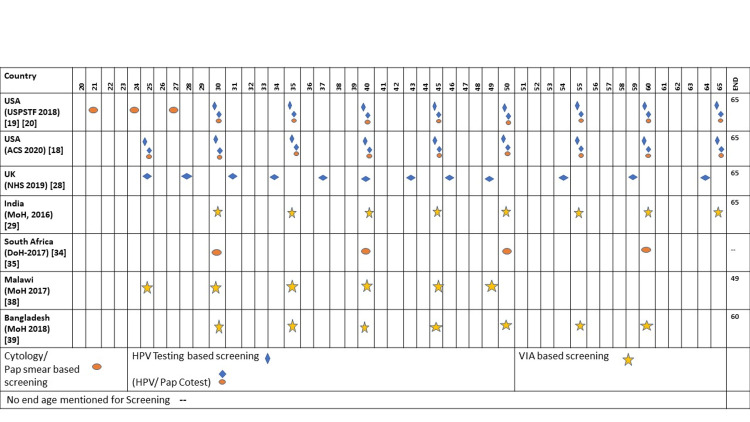
Screening guidelines and practices differ according to resource availability and continually update as scientific developments take place. In this article, we have reviewed screening guidelines and programs for cervical cancer prevention in selected countries belonging to different economic groups viz high income, middle income, and low income. We have selected six countries - the United States of America (USA), the United Kingdom (UK), India, South Africa, Bangladesh, and Malawi. Considerable differences are observed across the health systems. Countries with established screening guidelines complemented by organised nationwide programs or insurance practices have much better screening rates. Human Papilloma Virus (HPV) DNA testing is currently the test of choice in the majority of settings for cervical cancer screening due to its higher sensitivity (up to 90-100%) and longer screening intervals (three to five years). It is also cost-effective, less dependent on operator expertise, and suitable for all settings as compared to a Pap smear test or visual inspection with acetic acid (VIA). Self-sampling of HPV can further help to improve screening coverage by increasing opportunities of reaching to women who would otherwise not participate in screening programs. Resource-constrained countries recommend VIA-based screening in their national programs due to its low cost. The share of cervical cancer is higher in middle and low-income countries as they have lower screening coverage, compared to high-income countries. The main barriers faced in the implementation of the program in low-income countries (LICs) are pertaining to the health system, patient-specific challenges, and healthcare provider-specific challenges.
筛查指南和实践因资源可及性而异,并随着科学发展不断更新。在本文中,我们回顾了不同经济组别的部分国家(即高收入、中等收入和低收入国家)预防宫颈癌的筛查指南和项目。我们选取了六个国家——美国、英国、印度、南非、孟加拉国和马拉维。不同卫生系统之间存在显著差异。拥有既定筛查指南并辅以全国性组织项目或保险实践的国家,其筛查率要高得多。人乳头瘤病毒(HPV)DNA检测目前在大多数宫颈癌筛查环境中是首选检测方法,因为它具有更高的灵敏度(高达90%-100%)和更长的筛查间隔(三至五年)。与巴氏涂片检测或醋酸目视检查(VIA)相比,它还具有成本效益,对操作人员专业知识的依赖性较小,并且适用于所有环境。HPV自我采样可以通过增加接触那些原本不会参与筛查项目的女性的机会,进一步有助于提高筛查覆盖率。资源有限的国家在其国家项目中推荐基于VIA的筛查,因为其成本较低。与高收入国家相比,中低收入国家宫颈癌的占比更高,因为它们的筛查覆盖率较低。低收入国家在实施该项目时面临的主要障碍涉及卫生系统、患者特定挑战和医疗服务提供者特定挑战。