Gao Lijing, Yuan Chao, Fu Jinming, Tian Tian, Huang Hao, Zhang Lei, Li Dapeng, Liu Yupeng, Meng Shuhan, Liu Ying, Zhang Yuanyuan, Xu Jing, Jia Chenyang, Zhang Ding, Zheng Ting, Fu Qingzhen, Tan Shiheng, Lan Li, Yang Chao, Zhao Yashuang, Liu Yanlong
Department of Epidemiology, School of Public Health, NHC Key Laboratory of Etiology and Epidemiology (23618504), Harbin Medical University, Harbin, Heilongjiang, China.
Department of Colorectal Surgery, Harbin Medical University Cancer Hospital, Harbin, Heilongjiang, China.
Front Oncol. 2023 Jul 14;13:1182944. doi: 10.3389/fonc.2023.1182944. eCollection 2023.
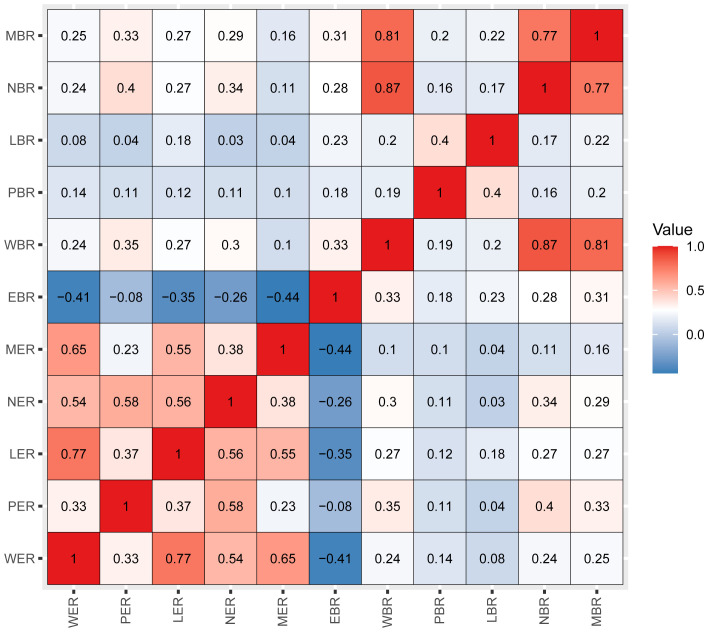
Systemic inflammation is associated with the prognosis of colorectal cancer (CRC). The current study aimed to construct a comprehensively inflammatory prognostic scoring system named risk score (RS) based on eosinophil- and basophil-related markers and assess its prognostic value in patients with stage II and stage III CRC.
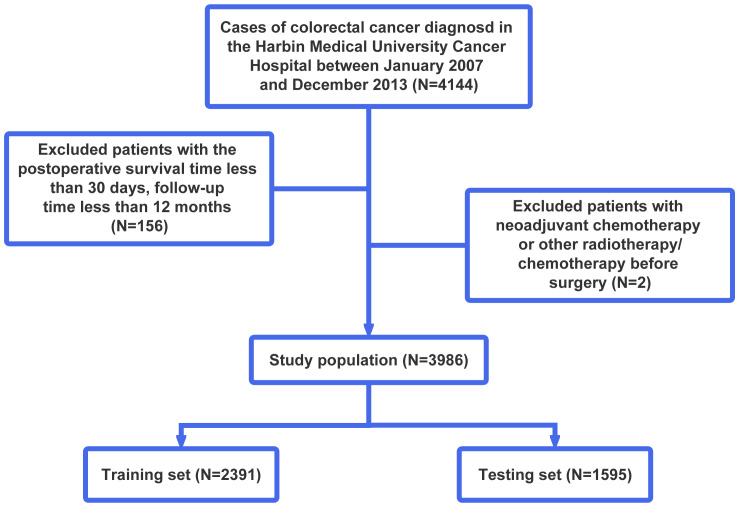
A total of 3,986 patients were enrolled from January 2007 to December 2013. The last follow-up time was January 2019. They were randomly assigned to the training set and testing set in a 3:2 split ratio. Least absolute shrinkage and selection operator (LASSO)-Cox regression analysis was performed to select the optimal prognostic factors in the construction of RS. The Kaplan-Meier curve, time-dependent receiver operating characteristic (ROC), and Cox analysis were used to evaluate the association between RS and overall survival (OS).
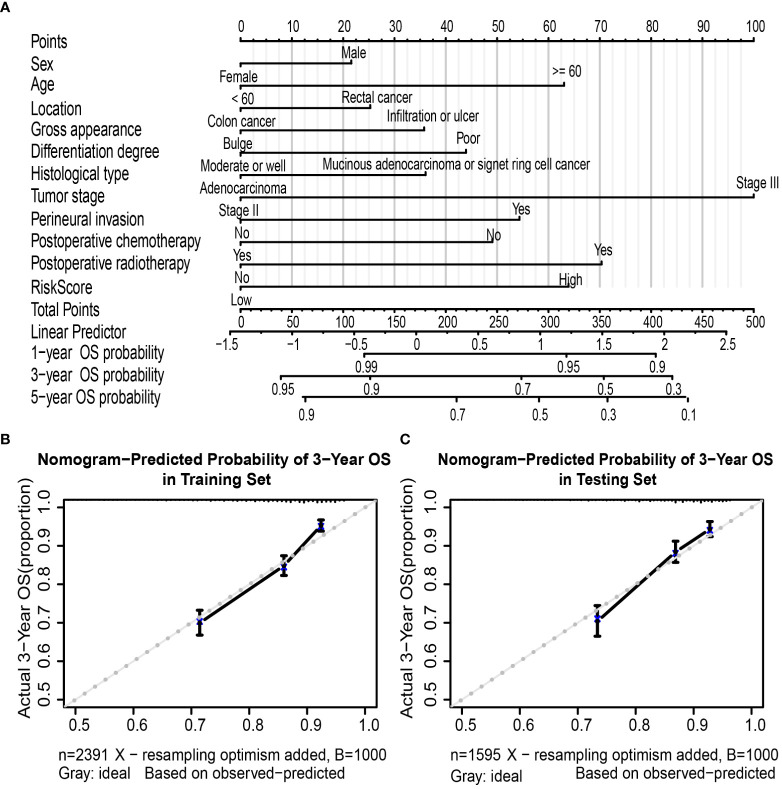
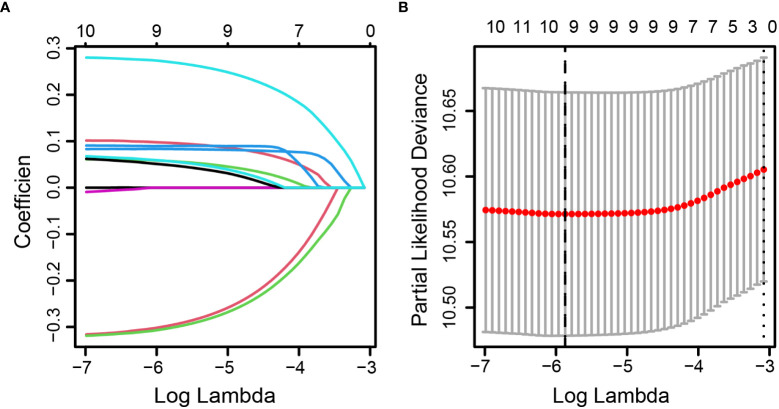
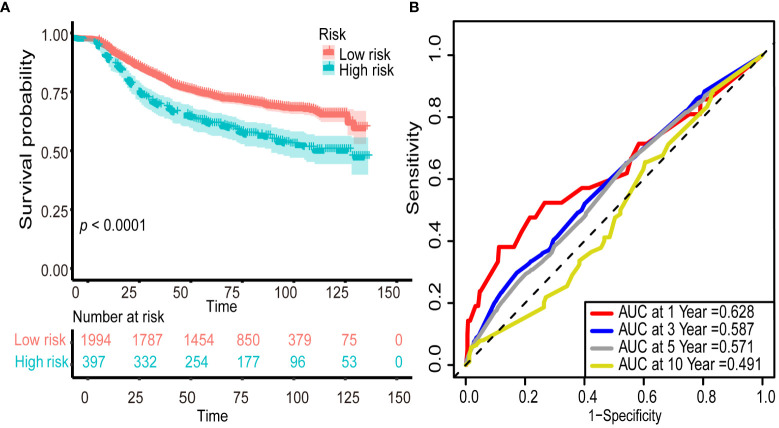
In the training set, all inflammatory markers showed certain prognostic values. Based on LASSO-Cox analysis, nine markers were integrated to construct RS. The Kaplan-Meier curve showed that a higher RS (RS > 0) had a significantly worse prognosis (log-rank < 0.0001). RS (>0) remained an independent prognostic factor for OS (hazard ratio (HR): 1.70, 95% confidence interval (CI), 1.43-2.03, < 0.001). The prognostic value of RS was validated in the entire cohort. Time-dependent ROC analysis showed that RS had a stable prognostic effect throughout the follow-up times and could enhance the prognostic ability of the stage by combination. Nomogram was established based on RS and clinicopathological factors for predicting OS in the training set and validated in the testing set. The area under the curve (AUC) values of the 3-year OS in the training and testing sets were 0.748 and 0.720, respectively. The nomogram had a satisfactory predictive accuracy and had better clinical application value than the tumor stage alone.
RS might be an independent prognostic factor for OS in patients with stage II and III CRC, which is helpful for risk stratification of patients. Additionally, the nomogram might be used for personalized prediction and might contribute to formulating a better clinical treatment plan.
全身炎症与结直肠癌(CRC)的预后相关。本研究旨在构建一种基于嗜酸性粒细胞和嗜碱性粒细胞相关标志物的综合炎症预后评分系统,即风险评分(RS),并评估其在II期和III期CRC患者中的预后价值。
2007年1月至2013年12月共纳入3986例患者。最后随访时间为2019年1月。他们以3:2的比例随机分配到训练集和测试集。采用最小绝对收缩和选择算子(LASSO)-Cox回归分析来选择构建RS的最佳预后因素。采用Kaplan-Meier曲线、时间依赖性受试者工作特征(ROC)曲线和Cox分析来评估RS与总生存期(OS)之间的关联。
在训练集中,所有炎症标志物均显示出一定的预后价值。基于LASSO-Cox分析,整合了9个标志物来构建RS。Kaplan-Meier曲线显示,较高的RS(RS>0)预后明显较差(对数秩检验<0.0001)。RS(>0)仍然是OS的独立预后因素(风险比(HR):1.70,95%置信区间(CI),1.43 - 2.03,<0.001)。RS的预后价值在整个队列中得到验证。时间依赖性ROC分析表明,RS在整个随访期间具有稳定的预后作用,并且通过联合可以提高分期的预后能力。基于RS和临床病理因素建立了列线图,用于预测训练集中的OS,并在测试集中进行验证。训练集和测试集中3年OS的曲线下面积(AUC)值分别为0.748和0.720。该列线图具有令人满意的预测准确性,并且比单独的肿瘤分期具有更好的临床应用价值。
RS可能是II期和III期CRC患者OS的独立预后因素,有助于对患者进行风险分层。此外,列线图可用于个性化预测,并可能有助于制定更好的临床治疗方案。