Hwangbo Song, Lee Jin Young, Han Gyule, Chun Min Young, Jang Hyemin, Seo Sang Won, Na Duk L, Won Sungho, Kim Hee Jin, Lim Dong Hui
Department of Neurology, Samsung Medical Center, Sungkyunkwan University School of Medicine, Seoul, Republic of Korea.
Alzheimer's Disease Convergence Research Center, Samsung Medical Center, Seoul, Republic of Korea.
Front Aging Neurosci. 2023 Jul 13;15:1126587. doi: 10.3389/fnagi.2023.1126587. eCollection 2023.
We aimed to investigate the incidence of dementia by age and year as well as the population-attributable fractions (PAFs) for known dementia risk factors in Republic of Korea.
A 12-year, nationwide, population-based, retrospective cohort study was conducted. We used customized health information from the National Health Insurance Service (NHIS) data from 2002 to 2017. We analyzed age- and sex-adjusted incidence rates and PAF of dementia for each risk factor such as depression, diabetes, hemorrhagic stroke, ischemic stroke, hypertension, osteoporosis and physical inactivity using Levin's formula.
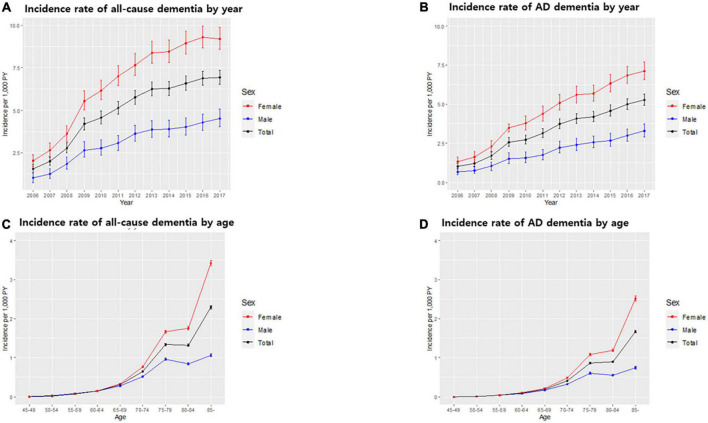
Of the 794,448 subjects in the dementia-free cohort, 49,524 (6.2%) developed dementia. Dementia incidence showed annual growth from 1.56 per 1,000 person-years in 2006 to 6.94 per 1,000 person-years in 2017. Of all dementia cases, 34,544 subjects (69.8%) were female and 2,479 subjects (5.0%) were early onset dementia. AD dementia accounted for 66.5% of the total dementia incidence. Considering relative risk and prevalence, physical inactivity attributed the greatest to dementia (PAF, 8.1%), followed by diabetes (PAF, 4.2%), and hypertension (PAF, 2.9%). Altogether, the significant risk factors increased the risk of dementia by 18.0% (overall PAF).
We provided the incidence of dementia and PAFs for dementia risk factors in Republic of Korea using a 12-year, nationwide cohort. Encouraging lifestyle modifications and more aggressive control of risk factors may effectively prevent dementia.
我们旨在调查韩国痴呆症按年龄和年份划分的发病率,以及已知痴呆症风险因素的人群归因分数(PAF)。
进行了一项为期12年、基于全国人口的回顾性队列研究。我们使用了2002年至2017年国家健康保险服务(NHIS)数据中的定制健康信息。我们使用莱文公式分析了年龄和性别调整后的痴呆症发病率以及每个风险因素(如抑郁症、糖尿病、出血性中风、缺血性中风、高血压、骨质疏松症和身体活动不足)的PAF。
在无痴呆症队列的794,448名受试者中,49,524名(6.2%)患上了痴呆症。痴呆症发病率从2006年的每1000人年1.56例逐年增长至2017年的每1000人年6.94例。在所有痴呆症病例中,34,544名受试者(69.8%)为女性,2,479名受试者(5.0%)为早发性痴呆症。阿尔茨海默病性痴呆症占痴呆症总发病率的66.5%。考虑到相对风险和患病率,身体活动不足对痴呆症的影响最大(PAF,8.1%),其次是糖尿病(PAF,4.2%)和高血压(PAF,2.9%)。总体而言,这些显著的风险因素使痴呆症风险增加了18.0%(总体PAF)。
我们利用一项为期12年的全国性队列研究,提供了韩国痴呆症的发病率以及痴呆症风险因素的PAF。鼓励改变生活方式并更积极地控制风险因素可能有效预防痴呆症。