Chinese PLA General Hospital, Beijing, China.
First Medical Center of Chinese People's Liberation Army (PLA) General Hospital, Beijing, China.
PeerJ. 2023 Jul 26;11:e15589. doi: 10.7717/peerj.15589. eCollection 2023.
To investigate the potential microbiome profile of a mouse model with heart failure (HF) during dapagliflozin treatment.
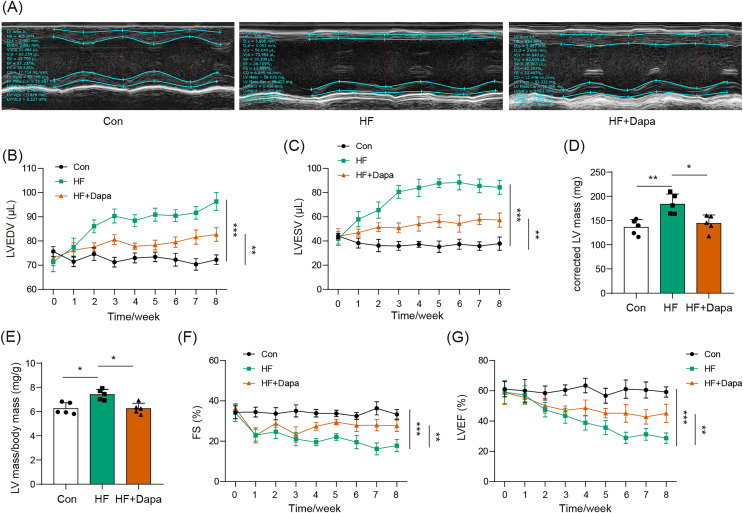
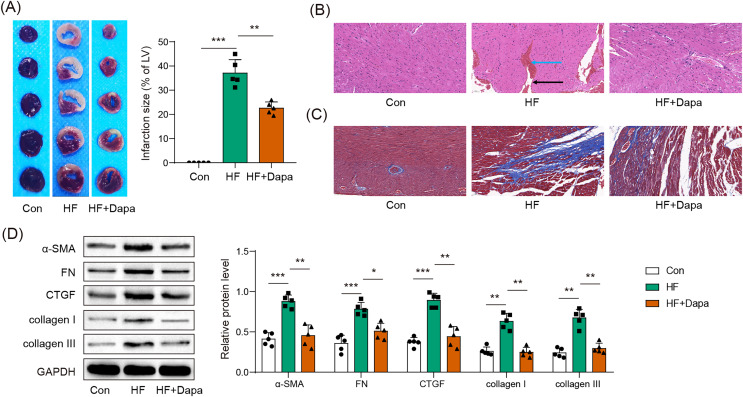
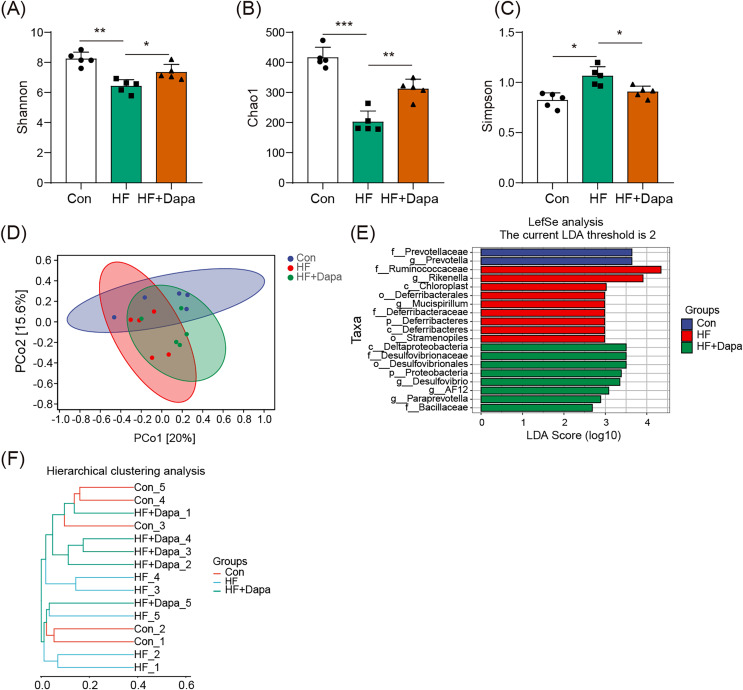
An HF model was constructed in 8-week-old male mice, and cardiac tissues were analyzed using histological staining. Hemodynamic indexes were measured, and fecal samples were collected for 16S rDNA sequencing. Chao1, Shannon, and Simpson were used for α-diversity analysis. b-Diversity analysis was conducted using principal coordinate analysis (PCoA) and non-metric multidimensional scaling (NMDS) based on the Bray-Curtis distance. Linear discriminant analysis coupled with effect size measurements (LEfSe) was used to identify signature gut microbiota, and phylogenetic investigation of communities by reconstruction of unobserved states (PICRUSt) was used to predict the function of altered gut microbiota.
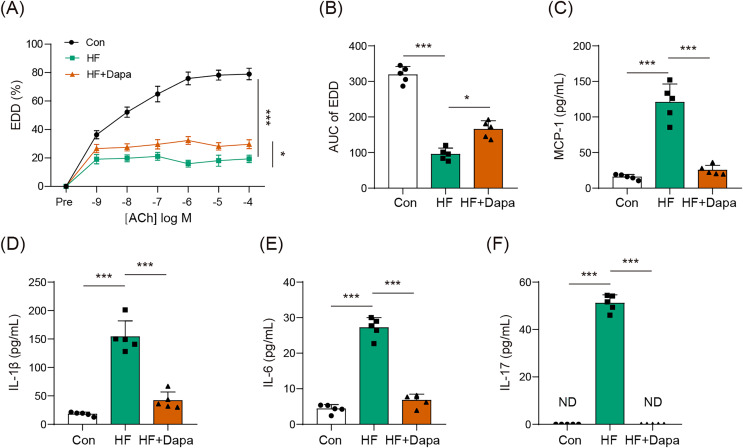
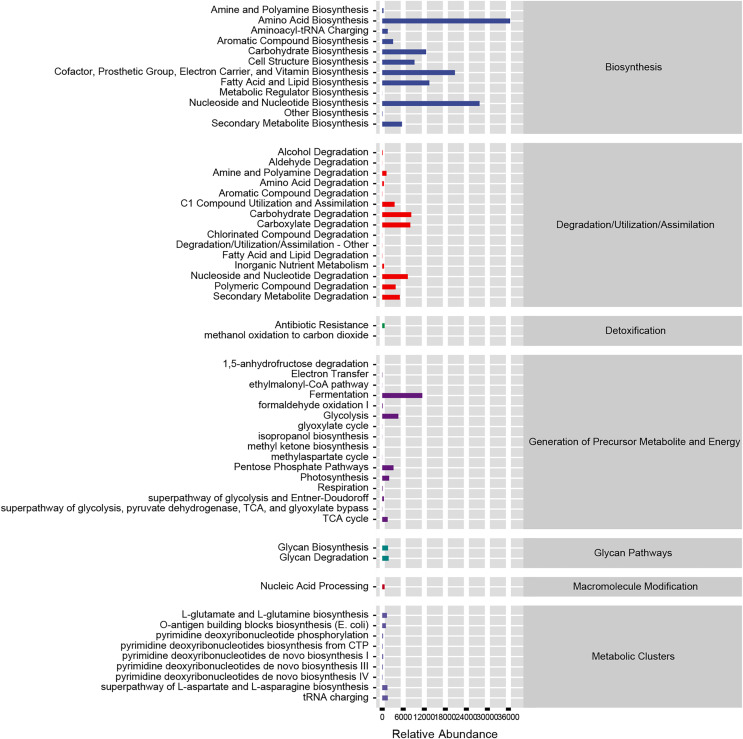
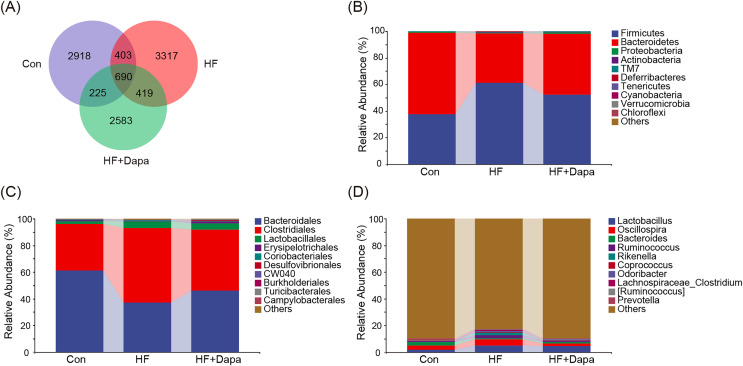
Dapagliflozin treatment reduced inflammation, infarction area, and cardiac fibrosis in HF mice. It also increased endothelial-dependent dilation and inflammation in mice with HF. Dapagliflozin decreased the ratio of Firmicutes/Bacteroidetes, which was increased in HF mice. There was no significant statistical difference in α-diversity among the control, HF, and HF+dapagliflozin groups. , , and were enriched in HF+dapagliflozin, while and were enriched in HF based on LEfSe. KEGG analysis revealed that altered gut microbiota was associated with fermentation, amino acid biosynthesis, nucleoside and nucleotide biosynthesis/degradation, fatty acid and lipid biosynthesis, carbohydrate biosynthesis/degradation, and cofactor/prosthetic group/electron carrier/vitamin biosynthesis.
Understanding the microbiome profile helps elucidate the mechanism of dapagliflozin for HF. The signature genera identified in this study could be used as a convenient method to distinguish between HF patients and healthy individuals.
研究心力衰竭(HF)小鼠模型在达格列净治疗过程中的潜在微生物组特征。
构建 8 周龄雄性小鼠 HF 模型,采用组织学染色分析心脏组织。测量血液动力学指标,收集粪便样本进行 16S rDNA 测序。使用 Chao1、Shannon 和 Simpson 进行 α 多样性分析。基于 Bray-Curtis 距离进行主坐标分析(PCoA)和非度量多维尺度分析(NMDS)进行 b 多样性分析。采用线性判别分析结合效应量测量(LEfSe)识别特征肠道微生物群,采用群落重建未观测状态的系统发育分析(PICRUSt)预测改变的肠道微生物群的功能。
达格列净治疗可减轻 HF 小鼠的炎症、梗死面积和心肌纤维化。它还增加了 HF 小鼠的内皮依赖性扩张和炎症。达格列净降低了 HF 小鼠中增加的厚壁菌门/拟杆菌门比例。在对照组、HF 组和 HF+达格列净组之间,α 多样性没有显著统计学差异。基于 LEfSe,在 HF+dapagliflozin 组中富集了、、,在 HF 组中富集了、。KEGG 分析表明,改变的肠道微生物群与发酵、氨基酸生物合成、核苷和核苷酸生物合成/降解、脂肪酸和脂质生物合成、碳水化合物生物合成/降解以及辅助因子/辅基/电子载体/维生素生物合成有关。
了解微生物组特征有助于阐明达格列净治疗 HF 的机制。本研究中鉴定的特征属可作为区分 HF 患者和健康个体的简便方法。