Chaganti Chandrakala, Phule Amol Sarjerao, Chandran Latha P, Sonth Bandeppa, Kavuru Venkat Prasad Babu, Govindannagari Rajani, Sundaram Raman Meenakshi
ICAR-Indian Institute of Rice Research, Hyderabad, Telangana, India.
Front Microbiol. 2023 Jul 13;14:1168415. doi: 10.3389/fmicb.2023.1168415. eCollection 2023.
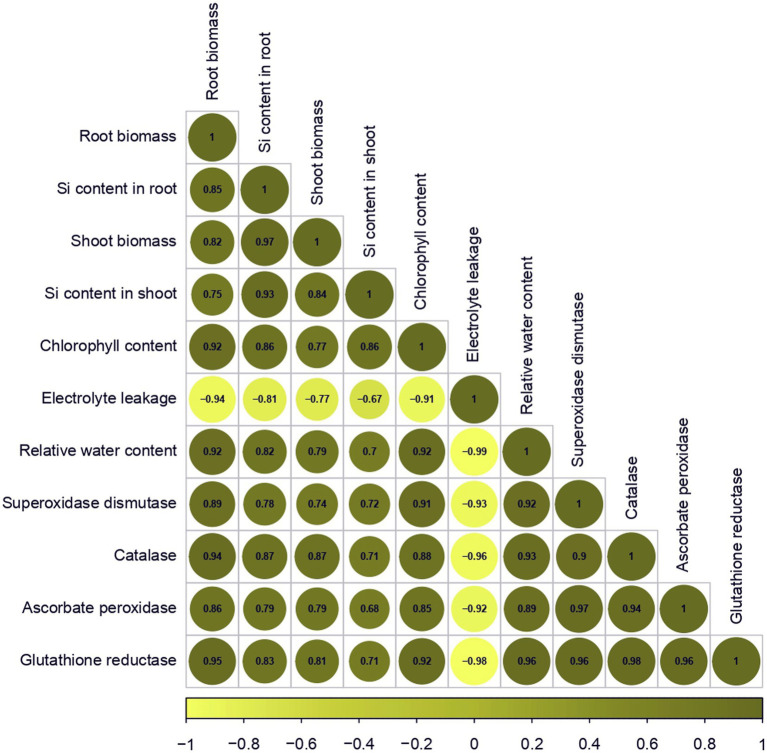
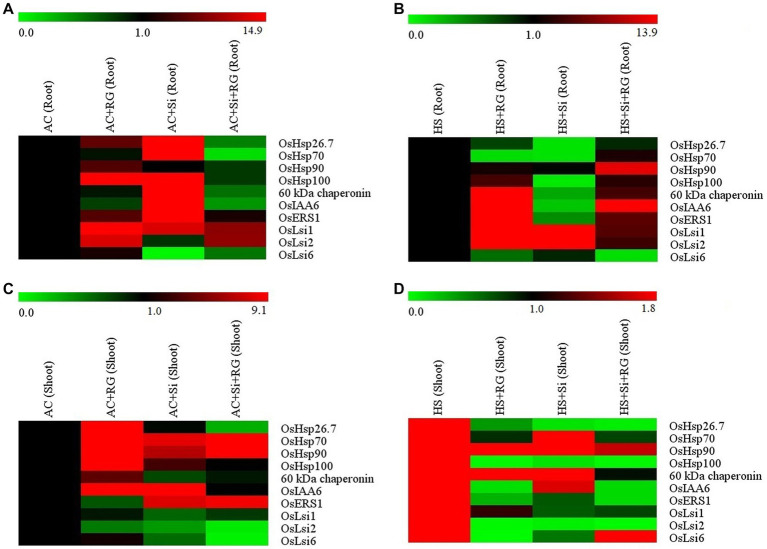
Heat stress caused due to increasing warming climate has become a severe threat to global food production including rice. Silicon plays a major role in improving growth and productivity of rice by aiding in alleviating heat stress in rice. Soil silicon is only sparingly available to the crops can be made available by silicate solubilizing and plant-growth-promoting bacteria that possess the capacity to solubilize insoluble silicates can increase the availability of soluble silicates in the soil. In addition, plant growth promoting bacteria are known to enhance the tolerance to abiotic stresses of plants, by affecting the biochemical and physiological characteristics of plants. The present study is intended to understand the role of beneficial bacteria viz. sp. IIRR N1 a silicate solublizer and , a plant growth promoting bacteria and their interaction with insoluble silicate sources on morpho-physiological and molecular attributes of rice ( L.) seedlings after exposure to heat stress in a controlled hydroponic system. Joint inoculation of silicates and both the bacteria increased silicon content in rice tissue, root and shoot biomass, significantly increased the antioxidant enzyme activities (viz. superoxidase dismutase, catalase and ascorbate peroxidase) compared to other treatments with sole application of either silicon or bacteria. The physiological traits (viz. chlorophyll content, relative water content) were also found to be significantly enhanced in presence of silicates and both the bacteria after exposure to heat stress conditions. Expression profiling of shoot and root tissues of rice seedlings revealed that seedlings grown in the presence of silicates and both the bacteria exhibited higher expression of heat shock proteins (HSPs viz., , OsHsp100 and ), hormone-related genes () and silicon transporters ( and ) as compared to seedlings treated with either silicates or with the bacteria alone. The results thus reveal the interactive effect of combined application of silicates along with bacteria sp. IIRR N1, inoculation not only led to augmented silicon uptake by rice seedlings but also influenced the plant biomass and elicited higher expression of HSPs, hormone-related and silicon transporter genes leading to improved tolerance of seedling to heat stress.
气候变暖导致的热胁迫已成为包括水稻在内的全球粮食生产的严重威胁。硅通过帮助减轻水稻的热胁迫,在提高水稻生长和生产力方面发挥着重要作用。土壤中的硅对作物的有效性很低,而具有溶解不溶性硅酸盐能力的硅酸盐溶解菌和促进植物生长的细菌可以使硅变得可利用,从而增加土壤中可溶性硅酸盐的有效性。此外,已知促进植物生长的细菌通过影响植物的生化和生理特性来增强植物对非生物胁迫的耐受性。本研究旨在了解有益细菌即硅酸盐溶解菌IIRR N1和促进植物生长的细菌及其与不溶性硅酸盐源的相互作用对在可控水培系统中热胁迫后水稻(L.)幼苗形态生理和分子特性的影响。与单独施用硅或细菌的其他处理相比,联合接种硅酸盐和这两种细菌增加了水稻组织中的硅含量、根和地上部生物量,显著提高了抗氧化酶活性(即超氧化物歧化酶、过氧化氢酶和抗坏血酸过氧化物酶)。在热胁迫条件下,还发现硅酸盐和这两种细菌同时存在时,生理特性(即叶绿素含量、相对含水量)也显著增强。水稻幼苗地上部和根部组织的表达谱分析表明,与单独用硅酸盐或细菌处理的幼苗相比,在硅酸盐和这两种细菌存在下生长的幼苗热休克蛋白(HSPs即、OsHsp100和)、激素相关基因()和硅转运蛋白(和)的表达更高。结果表明,硅酸盐与IIRR N1菌联合施用具有交互作用,接种不仅导致水稻幼苗硅吸收增加,还影响植物生物量,并引发HSPs、激素相关和硅转运蛋白基因的高表达,从而提高幼苗对热胁迫的耐受性。