Malik Laraib, Sanaullah Muhammad, Mahmood Faisal, Hussain Sabir, Siddique Muhammad Hussnain, Anwar Faiza, Shahzad Tanvir
Department of Environmental Sciences, Government College University Faisalabad, Allama Iqbal Road, Faisalabad, 38000 Pakistan.
Institute of Soil and Environmental Sciences, University of Agriculture, Faisalabad, Pakistan.
Chem Biol Technol Agric. 2022;9(1):58. doi: 10.1186/s40538-022-00327-x. Epub 2022 Aug 22.
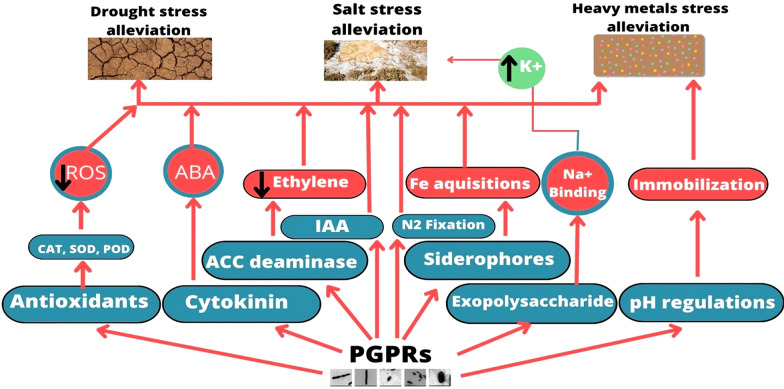
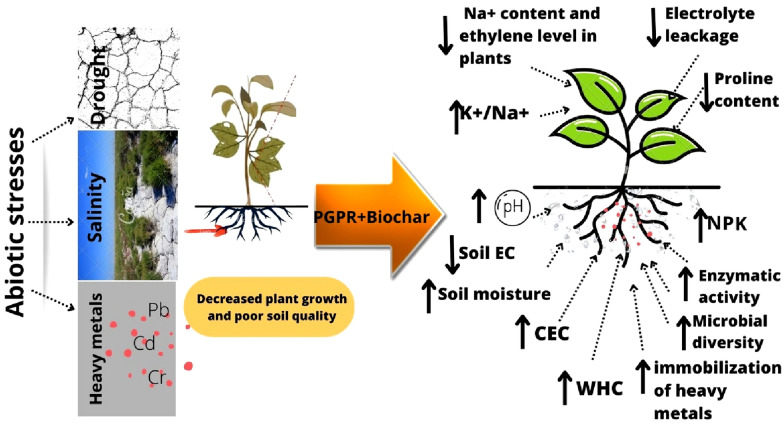
Sustainable food security is a major challenge in today's world, particularly in developing countries. Among many factors, environmental stressors, i.e., drought, salinity and heavy metals are major impediments in achieving sustainable food security. This calls for finding environment-friendly and cheap solutions to address these stressors. Plant growth-promoting rhizobacteria (PGPR) have long been established as an environment-friendly means to enhance agricultural productivity in normal and stressed soils and are being applied at field scale. Similarly, pyrolyzing agro-wastes into biochar with the aim to amend soils is being proposed as a cheap additive for enhancement of soil quality and crop productivity. Many pot and some field-scale experiments have confirmed the potential of biochar for sustainable increase in agricultural productivity. Recently, many studies have combined the PGPR and biochar for improving soil quality and agricultural productivity, under normal and stressed conditions, with the assumption that both of these additives complement each other. Most of these studies have reported a significant increase in agricultural productivity in co-applied treatments than sole application of PGPR or biochar. This review presents synthesis of these studies in addition to providing insights into the mechanistic basis of the interaction of the PGPR and biochar. Moreover, this review highlights the future perspectives of the research in order to realize the potential of co-application of the PGPR and biochar at field scale.
可持续粮食安全是当今世界面临的一项重大挑战,在发展中国家尤为如此。在诸多因素中,环境压力因素,即干旱、盐碱化和重金属,是实现可持续粮食安全的主要障碍。这就需要找到环境友好且成本低廉的解决方案来应对这些压力因素。长期以来,植物根际促生细菌(PGPR)已被确立为一种在正常和胁迫土壤中提高农业生产力的环境友好型手段,并且正在田间规模上应用。同样,将农业废弃物热解为生物炭以改良土壤,被提议作为一种廉价添加剂来提高土壤质量和作物生产力。许多盆栽实验和一些田间规模实验已经证实了生物炭在可持续提高农业生产力方面的潜力。最近,许多研究将PGPR和生物炭结合起来,用于在正常和胁迫条件下改善土壤质量和农业生产力,其假设是这两种添加剂相互补充。这些研究中的大多数都报告称,与单独施用PGPR或生物炭相比,联合施用处理下的农业生产力有显著提高。本综述除了对PGPR与生物炭相互作用的机理基础提供见解外,还对这些研究进行了综合。此外,本综述强调了该研究的未来前景,以便在田间规模上实现PGPR与生物炭联合施用的潜力。