Zahmatkesh Sasan, Amesho Kassian T T, Sillanpää Mika
Department of Chemical Engineering, University of Science and Technology of Mazandaran, P.O. Box 48518-78195, Behshahr, Iran.
Institute of Environmental Engineering, National Sun Yat-Sen University, Kaohsiung 804, Taiwan.
J Hazard Mater Adv. 2022 Aug;7:100121. doi: 10.1016/j.hazadv.2022.100121. Epub 2022 Jul 3.
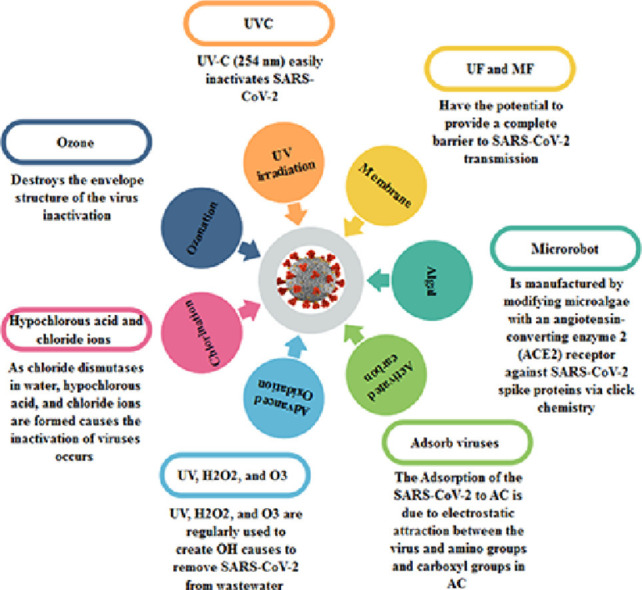
Advanced wastewater treatment technologies are effective methods and currently attract growing attention, especially in arid and semi-arid areas, for reusing water, reducing water pollution, and explicitly declining, inactivating, or removing SARS-CoV-2. Overall, removing organic matter and micropollutants prior to wastewater reuse is critical, considering that water reclamation can help provide a crop irrigation system and domestic purified water. Advanced wastewater treatment processes are highly recommended for contaminants such as monovalent ions from an abiotic source and SARS-CoV-2 from an abiotic source. This work introduces the fundamental knowledge of various methods in advanced water treatment, including membranes, filtration, Ultraviolet (UV) irradiation, ozonation, chlorination, advanced oxidation processes, activated carbon (AC), and algae. Following that, an analysis of each process for organic matter removal and mitigation or prevention of SARS-CoV-2 contamination is discussed. Next, a comprehensive overview of recent advances and breakthroughs is provided for each technology. Finally, the advantages and disadvantages of each method are discussed.
先进的废水处理技术是有效的方法,目前正日益受到关注,特别是在干旱和半干旱地区,用于水的再利用、减少水污染以及明确地降低、灭活或去除严重急性呼吸综合征冠状病毒2(SARS-CoV-2)。总体而言,考虑到水的回收利用有助于提供作物灌溉系统和家庭净化水,在废水再利用之前去除有机物和微污染物至关重要。对于来自非生物源的单价离子和来自非生物源的SARS-CoV-2等污染物,强烈推荐采用先进的废水处理工艺。这项工作介绍了先进水处理中各种方法的基础知识,包括膜、过滤、紫外线(UV)照射、臭氧化、氯化、高级氧化工艺、活性炭(AC)和藻类。随后,讨论了每个工艺去除有机物以及减轻或预防SARS-CoV-2污染的情况。接下来,对每种技术的最新进展和突破进行了全面概述。最后,讨论了每种方法的优缺点。