Zahmatkesh Sasan, Sillanpaa Mika, Rezakhani Yousof, Wang Chongqing
Department of Chemical Engineering, University of Science and Technology of Mazandaran, P.O. Box 48518-78195, Behshahr, Iran.
Faculty of Science and Technology, School of Applied Physics, University Kebangsaan Malaysia, 43600, Bangi, Selangor, Malaysia.
J Hazard Mater Adv. 2022 Aug;7:100140. doi: 10.1016/j.hazadv.2022.100140. Epub 2022 Aug 4.
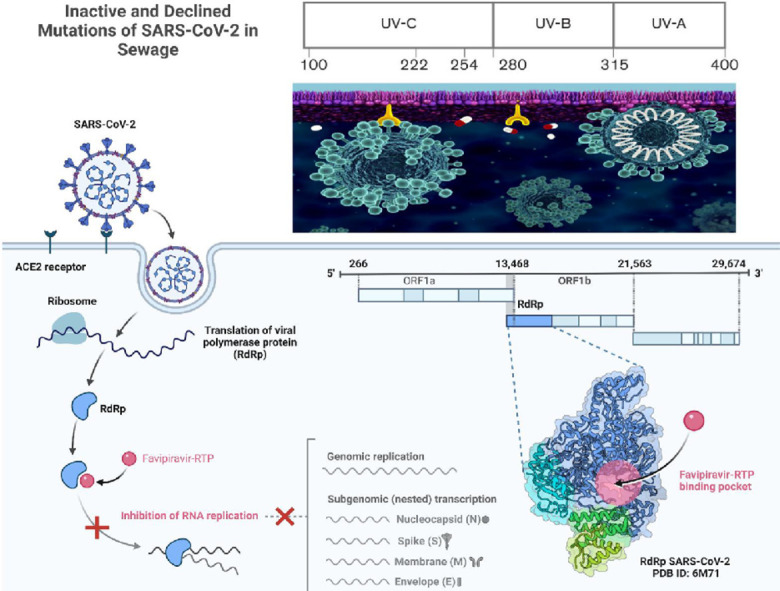
The coronavirus known as COVID-19, which causes pandemics, is causing a global epidemic at a critical stage today. Furthermore, novel mutations in the SARS-CoV-2 spike protein have been discovered in an entirely new strain, impacting the clinical and epidemiological features of COVID-19. Variants of these viruses can increase the transmission in wastewater, lead to reinfection, and reduce immunity provided by monoclonal antibodies and vaccinations. According to the research, a large quantity of viral RNA was discovered in wastewater, suggesting that wastewater can be a crucial source of epidemiological data and health hazards. The purpose of this paper is to introduce a few basic concepts regarding wastewater surveillance as a starting point for comprehending COVID-19's epidemiological aspects. Next, the observation of Alpha (B.1.1.7), Beta (B.1.351), Gamma (P.1), Delta (B.1.617.2), and Omicron (B.1.1.529) in wastewater is discussed in detail. Secondly, the essential information for the initial, primary, and final treating sewage in SARS-CoV-2 is introduced. Following that, a thorough examination is provided to highlight the newly developed methods for eradicating SARS-CoV-2 using a combination of solar water disinfection (SODIS) and ultraviolet radiation A (UVA (315-400 nm)), ultraviolet radiation B (UVB (280-315 nm)), and ultraviolet radiation C (UVC (100-280 nm)) processes. SARS-CoV-2 eradication requires high temperatures (above 56°C) and UVC. However, SODIS technologies are based on UVA and operate at cooler temperatures (less than 45°C). Hence, it is not appropriate for sewage treatment (or water consumption) to be conducted using SODIS methods in the current pandemic. Finally, SARS-CoV-2 may be discovered in sewage utilizing the wastewater-based epidemiology (WBE) monitoring method.
导致大流行的新冠病毒(COVID-19)如今正处于全球疫情的关键阶段。此外,在一种全新的毒株中发现了严重急性呼吸综合征冠状病毒2(SARS-CoV-2)刺突蛋白的新突变,这影响了COVID-19的临床和流行病学特征。这些病毒的变种可增加在废水中的传播,导致再次感染,并降低单克隆抗体和疫苗提供的免疫力。根据研究,在废水中发现了大量病毒核糖核酸(RNA),这表明废水可能是流行病学数据和健康危害的重要来源。本文旨在介绍一些关于废水监测的基本概念,作为理解COVID-19流行病学方面的起点。接下来,将详细讨论在废水中对阿尔法(B.1.1.7)、贝塔(B.1.351)、伽马(P.1)、德尔塔(B.1.617.2)和奥密克戎(B.1.1.529)的监测情况。其次,介绍了SARS-CoV-2初次、初级和最终处理污水的基本信息。随后,进行了全面审查,以突出新开发的利用太阳能水消毒(SODIS)与紫外线A(UVA(315 - 400纳米))、紫外线B(UVB(280 - 315纳米))和紫外线C(UVC(100 - 280纳米))相结合的方法来根除SARS-CoV-2的情况。根除SARS-CoV-2需要高温(高于56°C)和UVC。然而,SODIS技术基于UVA且在较低温度(低于45°C)下运行。因此,在当前疫情期间,使用SODIS方法进行污水处理(或用水)并不合适。最后,可利用基于废水的流行病学(WBE)监测方法在污水中发现SARS-CoV-2。