Tandon Ajay, Roder-DeWan Sanam, Chopra Mickey, Chhabra Sheena, Croke Kevin, Cros Marion, Hasan Rifat, Jammy Guru Rajesh, Manchanda Navneet, Nagaraj Amith, Pandey Rahul, Pradhan Elina, Rajkumar Andrew Sunil, Peters Michael A, Kruk Margaret E
Global Program for Health, Nutrition and Population, World Bank, Washington, DC 20433, USA.
Harvard TH Chan School of Public Health, Harvard University, Boston, MA 02115, USA.
Lancet Reg Health Southeast Asia. 2023 Jul 23;15:100253. doi: 10.1016/j.lansea.2023.100253. eCollection 2023 Aug.
Despite substantial progress in improving maternal and newborn health, India continues to experience high rates of newborn mortality and stillbirths. One reason may be that many births happen in health facilities that lack advanced services-such as Caesarean section, blood transfusion, or newborn intensive care. Stratification based on pregnancy risk factors is used to guide 'high-risk' women to advanced facilities. To assess the utility of risk stratification for guiding the choice of facility, we estimated the frequency of adverse newborn outcomes among women classified as 'low risk' in India.
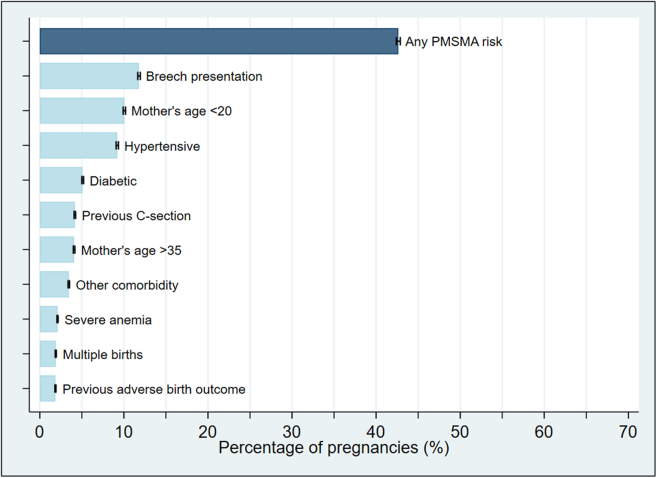
We used the 2019-21 Fifth National Family Health Survey (NFHS-5)-India's Demographic and Health Survey-which includes modules administered to women aged 15-49 years. In addition to pregnancy history and outcomes, the survey collected a range of risk factors, including biomarkers. We used national obstetric risk guidelines to classify women as 'high risk' versus 'low risk' and assessed the frequency of stillbirths, newborn deaths, and unplanned Caesarean sections for the respondent's last pregnancy lasting 7 or more months in the past five years. We calculated the proportion of deliveries occurring at non-hospital facilities in all the Indian states.
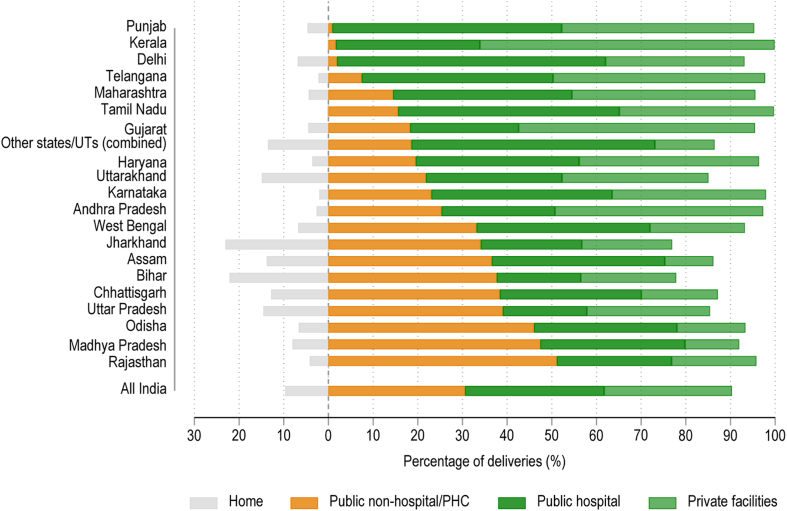
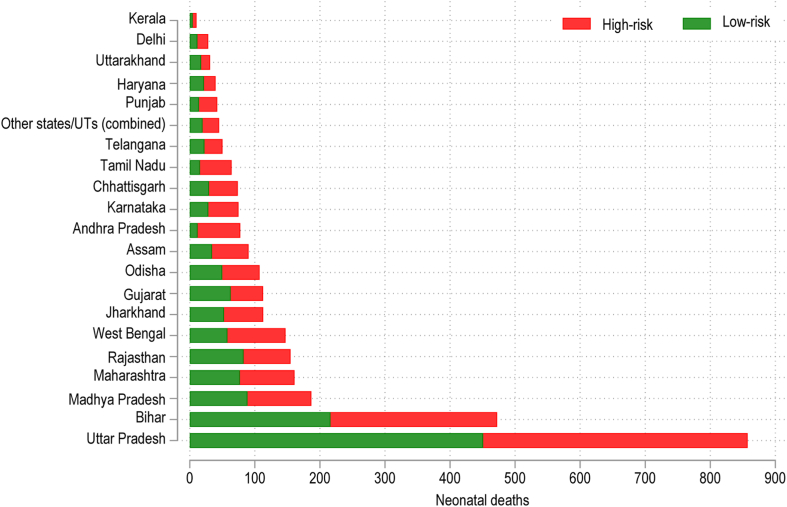
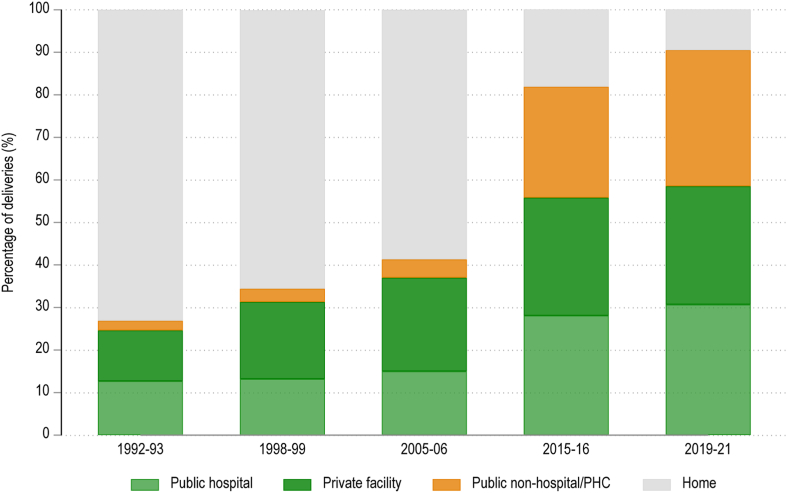
Using data from nearly 176,699 recent pregnancies, we found that 46.6% of India's newborn deaths and 56.3% of stillbirths were among women who were 'low risk' according to national guidelines. Women classified as 'low risk' had a Caesarean section rate of 8.4% (95% CI 8.1-8.7%), marginally lower than the national average of 10.0% (95% CI 9.8-10.3%). In India as a whole, 32.0% (95% CI 31.5-32.5%) of deliveries occurred in facilities that were likely to lack advanced services. There was substantial variation across the country, with less than 5% non-hospital public facility deliveries in Punjab, Kerala, and Delhi compared to more than 40% in Odisha, Madhya Pradesh, and Rajasthan. Newborn mortality tended to be lower in states with highest hospital delivery rates.
Individual risk stratification based on factors identified in pregnancy fails to accurately predict which women will have delivery complications and experience stillbirth and newborn death in India. Thus a determination of 'low risk' should not be used to guide women to health facilities lacking key life saving services, including Caesarean section, blood transfusion, and advanced newborn resuscitation and care.
Bill and Melinda Gates Foundation and the World Bank. The findings, interpretations and conclusions expressed in the paper are entirely those of the authors, and do not represent the views of the Gates Foundation or of the World Bank, its Executive Directors, or the countries they represent.
尽管在改善孕产妇和新生儿健康方面取得了重大进展,但印度的新生儿死亡率和死产率仍然很高。一个原因可能是许多分娩发生在缺乏诸如剖腹产、输血或新生儿重症监护等先进服务的医疗机构。基于妊娠风险因素的分层用于指导“高危”妇女前往先进的医疗机构。为了评估风险分层在指导医疗机构选择方面的效用,我们估计了印度被归类为“低风险”的妇女中不良新生儿结局的发生率。
我们使用了2019 - 2021年第五次全国家庭健康调查(NFHS - 5)——印度的人口与健康调查,其中包括对15 - 49岁女性进行的模块调查。除了妊娠史和结局外,该调查还收集了一系列风险因素,包括生物标志物。我们使用国家产科风险指南将妇女分为“高风险”和“低风险”,并评估了过去五年中受访者最后一次持续7个月或更长时间的妊娠的死产、新生儿死亡和非计划剖腹产的发生率。我们计算了印度所有邦在非医院机构分娩的比例。
利用近176,699例近期妊娠的数据,我们发现,根据国家指南,印度46.6%的新生儿死亡和56.3%的死产发生在“低风险”妇女中。被归类为“低风险”的妇女剖腹产率为8.4%(95%置信区间8.1 - 8.7%),略低于全国平均水平10.0%(95%置信区间9.8 - 10.3%)。在印度全国范围内,32.0%(95%置信区间31.5 - 32.5%)的分娩发生在可能缺乏先进服务的机构。全国各地存在很大差异,旁遮普邦、喀拉拉邦和德里非医院公共机构分娩率低于5%,而奥里萨邦、中央邦和拉贾斯坦邦则超过40%。医院分娩率最高的邦新生儿死亡率往往较低。
基于妊娠期间确定的因素进行的个体风险分层未能准确预测哪些妇女会出现分娩并发症以及在印度经历死产和新生儿死亡。因此,不应将“低风险”的判定用于指导妇女前往缺乏包括剖腹产、输血以及先进的新生儿复苏和护理等关键救生服务的医疗机构。
比尔及梅琳达·盖茨基金会和世界银行。本文所表达的研究结果、解读和结论完全是作者的观点,并不代表盖茨基金会或世界银行、其执行董事或他们所代表国家的观点。