Horváth László, Mirani Sara, Girgis Michael Magdy Fahmy, Rácz Szilvia, Bácskay Ildikó, Bhattoa Harjit Pal, Tóth Béla E
Department of Pharmaceutical Surveillance and Economics, Faculty of Pharmacy, University of Debrecen, Debrecen, Hungary.
Department of Medical Imaging, Faculty of Medicine, University of Debrecen, Debrecen, Hungary.
Front Pharmacol. 2023 Jul 14;14:1232285. doi: 10.3389/fphar.2023.1232285. eCollection 2023.
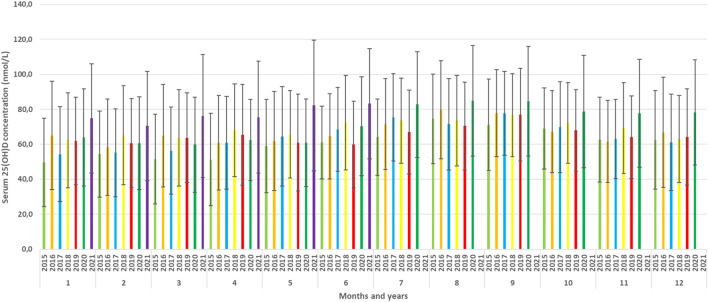
Vitamin D (vitD) deficiency may have importance in some diseases, but there is a lack of data in our country to clarify the current situation. Our aim was to examine the basic characteristics of patients' vitD status, and the ratio of vitD deficiency and its relation to certain diseases, assess seasonality and trends, and reveal the indirect impact of the COVID-19 pandemic on vitD supplementation at the patient population level. Anonymized data on 25(OH)D test results were obtained from the clinical data registry of a tertiary teaching hospital covering the period between 1 January 2015 and 30 June 2021. VitD consumption (pharmacy sale) data were retrieved from the database of the National Health Insurance Fund of Hungary in order to calculate the defined daily dose (DDD)/1,000 inhabitants/day. Descriptive statistics and odds ratios with their 95% confidence intervals were calculated. The two-sample -test and F-test were used to analyze our patients' data. Significant differences were considered if <0.05. Altogether, 45,567 samples were investigated; the mean age was 49 ± 19.1 years and 68.4% of them were female subjects. Overall, 20% of all patients had hypovitaminosis D, and just over 7% of patients had vitD deficiency. Male subjects had higher odds for hypovitaminosis or vitD deficiency (65.4 ± 28.2 nmol/L 68.4 ± 28.4 nmol/L; <0.0001). The mean 25(OH)D concentration has changed during the year, reaching a peak in September and a minimum in February. Patients with diseases of the circulatory system, genitourinary system, certain conditions originating in the perinatal period, and "sine morbo" (i.e., without a disease; such as those aged over 45 years and female teenagers) had statistically higher odds for lower 25(OH)D concentrations ( <0.00001). VitD consumption showed seasonality, being higher in autumn and winter. A slight increase started in the season of 2017/18, and two huge peaks were detected at the beginning of 2020 and 2021 in association with the COVID-19 waves. Our data are the first to describe data concerning vitD in our region. It reinforces the notion of vitD supplementation for some risk groups and also in healthy individuals. To prevent the winter decline, vitD supplementation should be started in September. This and the results during the COVID-19 pandemic highlight the importance of health education encouraging vitamin D supplementation.
维生素D(vitD)缺乏在某些疾病中可能具有重要意义,但我国缺乏相关数据来阐明当前状况。我们的目的是研究患者vitD状态的基本特征、vitD缺乏率及其与某些疾病的关系,评估季节性和趋势,并揭示2019冠状病毒病大流行在患者群体层面上对vitD补充剂的间接影响。从一家三级教学医院2015年1月1日至2021年6月30日期间的临床数据登记处获取了关于25(OH)D检测结果的匿名数据。为了计算限定日剂量(DDD)/每千居民/天,从匈牙利国家健康保险基金数据库中检索了vitD消费(药房销售)数据。计算了描述性统计数据以及带有95%置信区间的比值比。使用两样本t检验和F检验来分析我们患者的数据。如果P<0.05,则认为存在显著差异。总共调查了45567个样本;平均年龄为49±19.1岁,其中68.4%为女性受试者。总体而言,所有患者中有20%存在维生素D缺乏,略超过7%的患者存在vitD缺乏。男性受试者患维生素D缺乏症或vitD缺乏的几率更高(65.4±28.2 nmol/L对68.4±28.4 nmol/L;P<0.0001)。一年中25(OH)D的平均浓度有所变化,9月达到峰值,2月达到最低值。患有循环系统疾病、泌尿生殖系统疾病、某些围生期起源的病症以及“无疾病”(即没有疾病;如45岁以上人群和女性青少年)的患者,其25(OH)D浓度较低的几率在统计学上更高(P<0.00001)。vitD消费呈现季节性,秋季和冬季较高。2017/18年度开始略有上升,并在2020年初和2021年初与2019冠状病毒病疫情相关联时检测到两个巨大峰值。我们的数据首次描述了我们地区关于vitD的数据。它强化了对一些风险群体以及健康个体补充vitD的观念。为防止冬季vitD水平下降,应在9月开始补充vitD。这一点以及2019冠状病毒病大流行期间的结果凸显了鼓励补充维生素D的健康教育的重要性。