Division of Pediatric Nephrology, Department of Pediatrics, Dr. V. Hauner Children's Hospital, Ludwig-Maximilians University, Lindwurmstraße 4, 80337, Munich, Germany.
Faculty of Medicine, Biomedical Center, Protein Analysis Unit, Ludwig-Maximilians University, Planegg-Martinsried, Munich, Germany.
Pediatr Nephrol. 2024 Jan;39(1):203-212. doi: 10.1007/s00467-023-06098-3. Epub 2023 Jul 31.
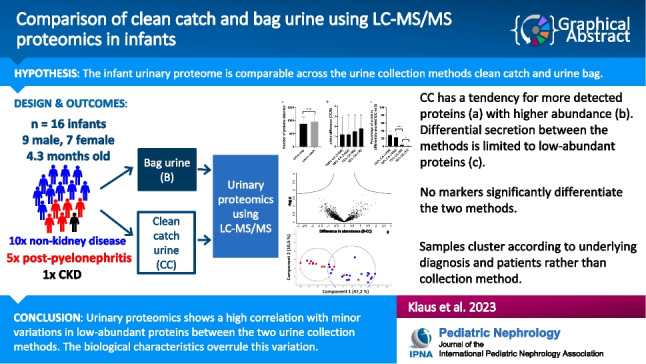
Urinary proteomics identifies the totality of urinary proteins and can therefore help in getting an early and precise diagnosis of various pathological processes in the kidneys. In infants, non-invasive urine collection is most commonly accomplished with a urine bag or clean catch. The influence of those two collection methods on urinary proteomics was assessed in this study.
Thirty-two urine samples were collected in infants using urine bag and clean catch within 24 h. Nine boys and seven girls with a mean age of 4.3 ± 2.9 months were included (5 × post-pyelonephritis, 10 × non-kidney disease, 1 × chronic kidney disease (CKD)). Liquid chromatography-mass spectrometry (LC-MS/MS) was performed in data-independent acquisition (DIA) mode. Protein identification and quantification were achieved using Spectronaut.
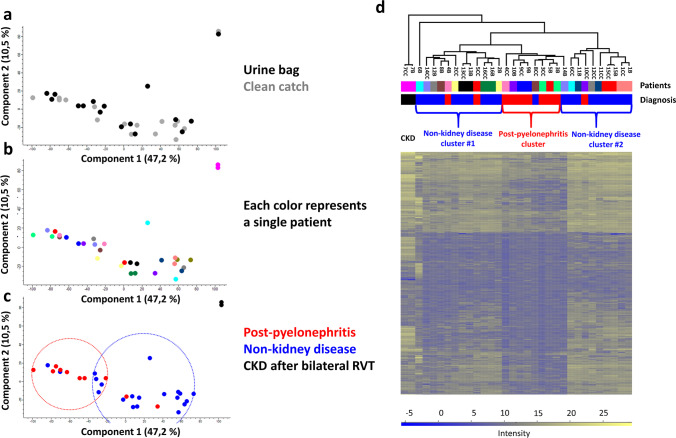
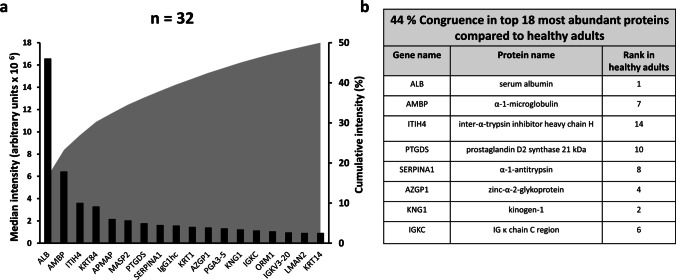
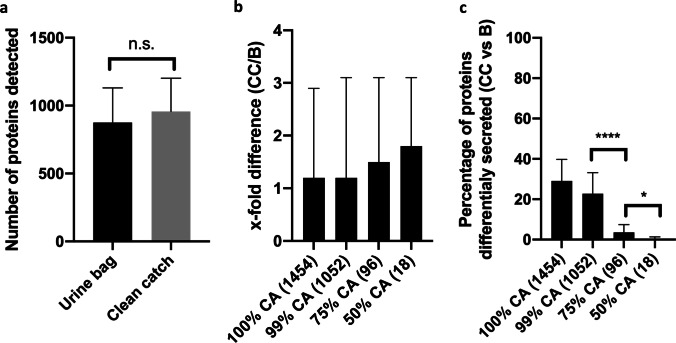
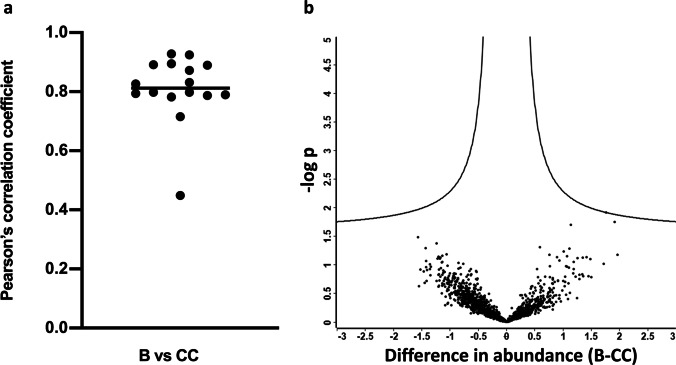
A total of 1454 urinary proteins were detected. Albumin and α-1-microglobulin were detected the most. The 18 top-abundant proteins accounted for 50% of total abundance. The number of proteins was slightly, but insignificantly higher in clean catch (957 ± 245) than in bag urine (876 ± 255). The median intensity was 1.2 × higher in the clean catch. Overall, differential detection of proteins was 29% between the collection methods; however, it diminished to 3% in the 96 top-abundant proteins. Pearson's correlation coefficient was 0.81 ± 0.11, demonstrating a high intraindividual correlation. A principal component analysis and a heat map showed clustering according to diagnoses and patients rather than to the collection method.
Urinary proteomics shows a high correlation with minor variation in low-abundant proteins between the two urine collection methods. The biological characteristics overrule this variation. Graphical abstract A higher resolution version of the Graphical abstract is available as Supplementary information.
尿蛋白质组学可鉴定尿液中的全部蛋白质,因此有助于对肾脏各种病理过程进行早期、准确的诊断。在婴儿中,最常通过尿袋或清洁采集来进行非侵入性尿液收集。本研究评估了这两种采集方法对尿蛋白质组学的影响。
在 24 小时内,32 例婴儿通过尿袋和清洁采集收集尿液。纳入 9 名男婴和 7 名女婴,平均年龄为 4.3±2.9 个月(5 例肾盂肾炎后,10 例非肾脏疾病,1 例慢性肾脏病)。采用液相色谱-质谱(LC-MS/MS)在数据非依赖性采集(DIA)模式下进行分析。使用 Spectronaut 进行蛋白质鉴定和定量。
共检测到 1454 种尿液蛋白质。白蛋白和α-1 微球蛋白的检出率最高。前 18 种高丰度蛋白占总丰度的 50%。清洁采集的蛋白数量(957±245)略高于尿袋收集(876±255),但无统计学差异。清洁采集的蛋白中位强度高 1.2 倍。总体而言,两种采集方法间的蛋白差异检出率为 29%,但在 96 种高丰度蛋白中降至 3%。Pearson 相关系数为 0.81±0.11,表明个体内相关性较高。主成分分析和热图显示聚类是根据诊断和患者进行的,而不是根据采集方法。
尿蛋白质组学显示两种尿液采集方法间的低丰度蛋白相关性高,差异较小。生物学特征会使这种差异发生变化。