Center for Reproductive Medicine, Department of Obstetrics and Gynecology, Peking University Third Hospital, No. 49 North Huayuan Road, Haidian District, Beijing, 100191, China.
National Clinical Research Center for Obstetrics and Gynecology, Beijing, 100191, China.
BMC Pregnancy Childbirth. 2023 Jul 31;23(1):549. doi: 10.1186/s12884-023-05859-0.
Late rescue intracytoplasmic sperm injection (r-ICSI) has not been widely accepted as an alternative solution for unexpected total fertilisation failure (TFF) after in vitro fertilisation (IVF), due to the time-dependent in vitro deterioration of oocyte quality and endometrial growth not being synchronised with embryo development. This study aimed to evaluate the safety profile and effectiveness of freeze-all blastocyst transfer in combination with late r-ICSI.
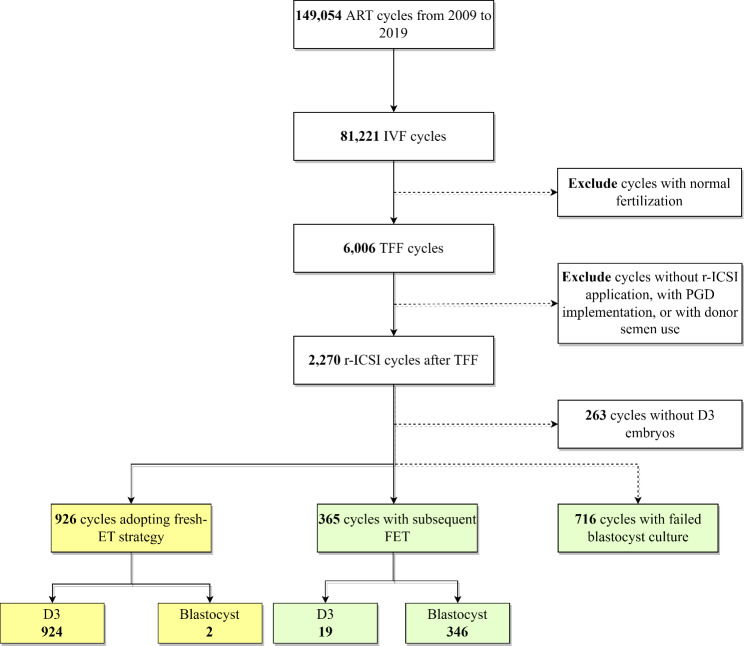
This was a retrospective cohort study carried out at the Reproductive Centre of Peking University Third Hospital, Beijing, China. All participants received treatment between 2009 and 2019. 2,270 patients in the aggregate encountered unexpected TFF during 149,054 cycles of IVF and adopted a late r-ICSI procedure. Among these patients, 263 women did not have cleavage-stage embryos available for evaluation. The remaining patients were grouped according to different embryo transfer (ET) strategies (926 women in Group 1 underwent fresh ET, 365 women in Group 2 underwent freeze-all ET, 716 women in Group 3 experienced blastulation failure). Patients received different ET strategies after r-ICSI, with the main outcome measures included live birth rate (LBR), cumulative live birth rate (cLBR), and conservative cLBR.
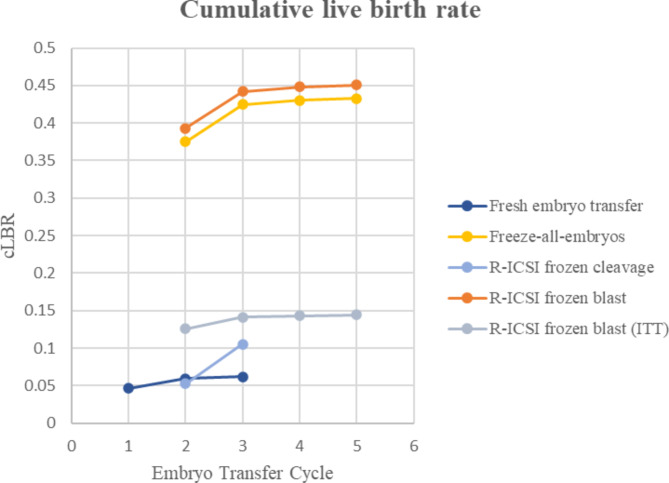
TFF occurred in 7.4% of all IVF cycles. Group 1 tended to be older at oocyte retrieval, with more infertile years, higher follicle-stimulating hormone (FSH) levels, higher gonadotropin consumption, and fewer oocytes retrieved. Group 2 exhibited considerably better LBRs following the first ET cycle (37.53% vs. 4.64%) and cLBRs (52.60% vs. 8.21%). After adjustment for covariates using binary logistic regression analyses, Group 2 still showed better obstetric performance in LBRs [OR:11.77, 95% CI (8.42-16.45)], cLBRs (OR:11.29, 95% CI (7.84-16.27)], and conservative cLBRs (OR:2.55, 95% CI (1.83-3.55)]. Additionally, the two groups showed similar miscarriage rates, whilst no new-borns with malformations or congenital diseases were reported.
Freeze-all blastocyst stage ET serves as an optimal strategy to support late r-ICSI. However, for women with limited oocytes available for r-ICSI use, weighing the benefits against the costs of the procedure might be prudent before implementing in vitro blastulation.
由于卵母细胞质量的体外退化随时间变化,以及子宫内膜生长与胚胎发育不同步,因此体外受精(IVF)后出现意外完全受精失败(TFF)时,晚期补救卵胞浆内单精子注射(r-ICSI)并未被广泛视为一种替代解决方案。本研究旨在评估冷冻全部囊胚转移联合晚期 r-ICSI 的安全性和有效性。
这是一项在中国北京北京大学第三医院生殖中心进行的回顾性队列研究。所有参与者均于 2009 年至 2019 年期间接受治疗。在 149054 个 IVF 周期中,共有 2270 例患者在意外发生 TFF 时采用了晚期 r-ICSI 程序。其中 263 名女性没有可供评估的卵裂期胚胎。根据不同的胚胎移植(ET)策略,将其余患者分为三组(926 名女性在第 1 组中进行新鲜 ET,365 名女性在第 2 组中进行冷冻全部 ET,716 名女性在第 3 组中出现胚泡发育失败)。r-ICSI 后患者接受了不同的 ET 策略,主要观察指标包括活产率(LBR)、累积活产率(cLBR)和保守性 cLBR。
所有 IVF 周期中 TFF 的发生率为 7.4%。第 1 组在取卵时年龄较大,不孕年限较长,FSH 水平较高,促性腺激素用量较大,取卵数较少。第 2 组在第一次 ET 周期后的 LBR(37.53% vs. 4.64%)和 cLBR(52.60% vs. 8.21%)均明显较高。使用二元逻辑回归分析调整协变量后,第 2 组的 LBR [OR:11.77,95%CI(8.42-16.45)]、cLBR [OR:11.29,95%CI(7.84-16.27)]和保守性 cLBR [OR:2.55,95%CI(1.83-3.55)]的产科表现仍较好。此外,两组的流产率相似,且未报告有新生儿出现畸形或先天性疾病。
冷冻全部囊胚期 ET 是支持晚期 r-ICSI 的最佳策略。然而,对于卵母细胞数量有限的女性,在实施体外囊胚培养之前,权衡该程序的利弊可能是明智的。