Luck J Carter, Blaha Cheryl, Cauffman Aimee, Gao Zhaohui, Arnold Amy C, Cui Jian, Sinoway Lawrence I
Milton S. Hershey Medical Center, Penn State Heart and Vascular Institute, Pennsylvania State University College of Medicine, Hershey, PA, United States.
Department of Neural and Behavioral Sciences, Pennsylvania State University College of Medicine, Hershey, PA, United States.
Front Physiol. 2023 Jul 17;14:1225814. doi: 10.3389/fphys.2023.1225814. eCollection 2023.
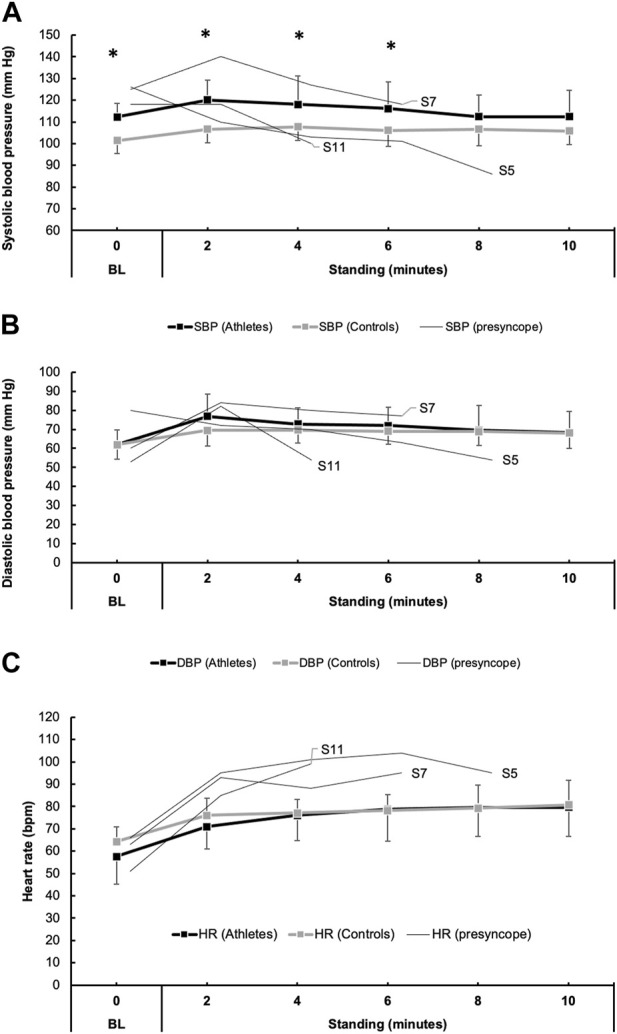
Recent studies suggest that SARS-CoV-2 infection alters autonomic and vascular function in young, otherwise healthy, adults. However, whether these alterations exist in young competitive athletes remains unknown. This study aimed to assess the effects of COVID-19 on cardiac autonomic control and vascular function in collegiate athletes who tested positive for COVID-19, acknowledging the limitations imposed by the early stages of the pandemic. Sixteen collegiate athletes from various sports underwent a battery of commonly used autonomic and vascular function tests (23 ± 9, range: 12-44 days post-infection). Additionally, data from 26 healthy control participants were included. In response to the Valsalva maneuver, nine athletes had a reduced early phase II blood pressure response and/or reduced Valsalva ratio. A depressed respiratory sinus arrhythmia amplitude was observed in three athletes. Three athletes became presyncopal during standing and did not complete the 10-min orthostatic challenge. Brachial artery flow-mediated dilation, when allometrically scaled to account for differences in baseline diameter, was not different between athletes and controls (10.0% ± 3.5% vs. 7.1% ± 2.4%, = 0.058). Additionally, no differences were observed between groups when FMD responses were normalized by shear rate (athletes: 0.055% ± 0.026%/s-1, controls: 0.068% ± 0.049%/s-1, = 0.40). Few atypical and borderline responses to autonomic function tests were observed in athletes following an acute SARS-CoV-2 infection. The most meaningful autonomic abnormality being the failure of three athletes to complete a 10-min orthostatic challenge. These findings suggest that some athletes may develop mild alterations in autonomic function in the weeks after developing COVID-19, while vascular function is not significantly impaired.
最近的研究表明,严重急性呼吸综合征冠状病毒2(SARS-CoV-2)感染会改变年轻、原本健康的成年人的自主神经和血管功能。然而,这些改变在年轻的竞技运动员中是否存在仍不清楚。本研究旨在评估2019冠状病毒病(COVID-19)对COVID-19检测呈阳性的大学生运动员心脏自主神经控制和血管功能的影响,同时承认疫情早期阶段所带来的局限性。16名来自不同运动项目的大学生运动员接受了一系列常用的自主神经和血管功能测试(感染后23±9天,范围:12 - 44天)。此外,还纳入了26名健康对照参与者的数据。在瓦尔萨尔瓦动作(Valsalva maneuver)测试中,9名运动员的早期II期血压反应降低和/或瓦尔萨尔瓦比值降低。3名运动员观察到呼吸性窦性心律不齐幅度降低。3名运动员在站立时出现接近晕厥状态,未完成10分钟的直立性挑战。将肱动脉血流介导的扩张按异速生长比例进行缩放以考虑基线直径差异后,运动员和对照组之间没有差异(10.0%±3.5%对7.1%±2.4%,P = 0.058)。此外,当血流介导的扩张反应按剪切速率进行标准化时,两组之间未观察到差异(运动员:0.055%±0.026%/s-1,对照组:0.068%±0.049%/s-1,P = 0.40)。在急性SARS-CoV-2感染后的运动员中,很少观察到对自主神经功能测试的非典型和临界反应。最有意义的自主神经异常是3名运动员未能完成10分钟的直立性挑战。这些发现表明,一些运动员在感染COVID-19后的几周内可能会出现自主神经功能的轻度改变,而血管功能没有受到明显损害。