Ji Xueyan, Samsudin Shamsulariffin Bin, Hassan Muhammad Zarif Bin, Farizan Noor Hamzani, Yuan Yubin, Chen Wang
Department of Sports Studies, Faculty of Educational Studies, Universiti Putra Malaysia, 43400, Serdang, Selangor, Malaysia.
Department of Language and Humanities Education, Faculty of Educational Studies, Universiti Putra Malaysia, 43400, Serdang, Selangor, Malaysia.
Sci Rep. 2025 May 16;15(1):17056. doi: 10.1038/s41598-025-01941-z.
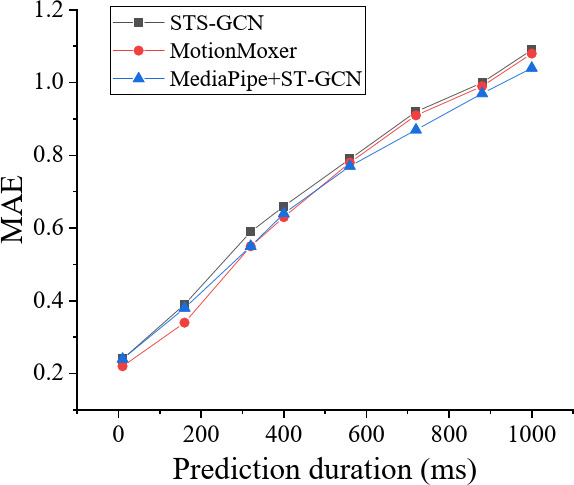
In the contemporary educational environment, junior high school students' physical education is facing the challenge of improving teaching quality, strengthening students' physique, and cultivating lifelong physical habits. Traditional physical education teaching methods are limited by resources, feedback efficiency and other factors, and it is difficult to meet students' personalized learning needs. With the rapid development of artificial intelligence and deep learning technology, a new opportunity is provided for physical education innovation. This study intends to develop a Spatial Temporal-Graph Convolutional Network (ST-GCN) action detection algorithm based on the MediaPipe framework. This is achieved by integrating deep learning and artificial intelligence technologies. The algorithm aims to accurately identify the performance of junior high school students in sports activities, particularly in exercises such as sit-ups. By doing so, the study seeks to enhance the adaptability and teaching quality of physical education. Finally, this approach promotes the individualized development of students. By constructing the spatio-temporal graph model of human skeletal point sequence, accurate recognition of sit-ups can be achieved. Firstly, the algorithm obtains the data of human skeleton points through attitude estimation technology. Then it constructs a spatio-temporal graph model, which represents human skeleton points as nodes in the graph and the connectivity between nodes as edges. In HMDB51 dataset, the proposed average detection accuracy of ST-GCN action recognition algorithm based on MediaPipe framework reaches 88.3%. The proposed method has advantages in long-term prediction (> 500ms), especially at 1000ms, the values of Mean Absolute Error and Mean Per Joint Position Error are 71.1 and 1.04 respectively. They are obviously lower than those of other algorithms. ST-GCN action detection algorithm based on deep learning and artificial intelligence technology can significantly improve the accuracy of action recognition in junior middle school students' sports activities, and provide an immediate and accurate feedback mechanism for physical education teaching. This approach helps students correct their movements and enhance their sports skills. Additionally, it enables teachers to gain a deeper understanding of students' physical performance. These benefits provide strong support for the implementation of differentiated teaching.
在当代教育环境下,初中生的体育教育面临着提高教学质量、增强学生体质以及培养终身体育习惯的挑战。传统体育教学方法受到资源、反馈效率等因素的限制,难以满足学生的个性化学习需求。随着人工智能和深度学习技术的快速发展,为体育教育创新提供了新机遇。本研究旨在基于MediaPipe框架开发一种时空图卷积网络(ST-GCN)动作检测算法。这是通过整合深度学习和人工智能技术来实现的。该算法旨在准确识别初中生在体育活动中的表现,特别是在仰卧起坐等运动项目中。通过这样做,本研究旨在提高体育教育的适应性和教学质量。最后,这种方法促进学生的个性化发展。通过构建人体骨骼点序列的时空图模型,可以实现对仰卧起坐的准确识别。首先,该算法通过姿态估计技术获取人体骨骼点的数据。然后构建时空图模型,将人体骨骼点表示为图中的节点,节点之间的连接关系表示为边。在HMDB51数据集中,基于MediaPipe框架提出的ST-GCN动作识别算法的平均检测准确率达到88.3%。所提出的方法在长期预测(>500ms)方面具有优势,特别是在1000ms时,平均绝对误差和平均每关节位置误差的值分别为71.1和1.04。它们明显低于其他算法。基于深度学习和人工智能技术的ST-GCN动作检测算法能够显著提高初中生体育活动中动作识别的准确率,并为体育教学提供即时准确的反馈机制。这种方法有助于学生纠正动作并提高运动技能。此外,它使教师能够更深入地了解学生的身体表现。这些益处为实施差异化教学提供了有力支持。