Vitreo-Retina, Uvea and ROP Services, Dr. Rajendra Prasad Centre for Ophthalmic Sciences, AIIMS, New Delhi, India.
Indian J Ophthalmol. 2023 Aug;71(8):3080-3084. doi: 10.4103/IJO.IJO_3285_22.
To analyze the topographic distribution of neovascularization (NV) and capillary nonperfusion (CNP) using ultra-wide field fluorescein angiography (UWFFA) in patients with proliferative diabetic retinopathy (PDR).
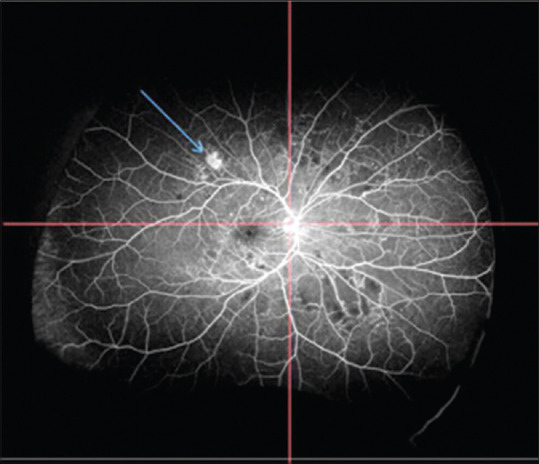
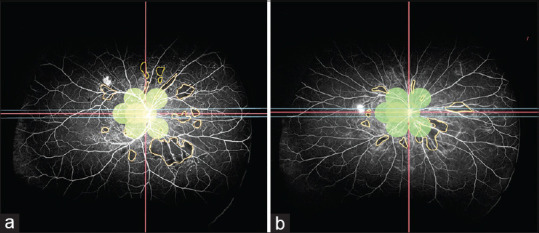
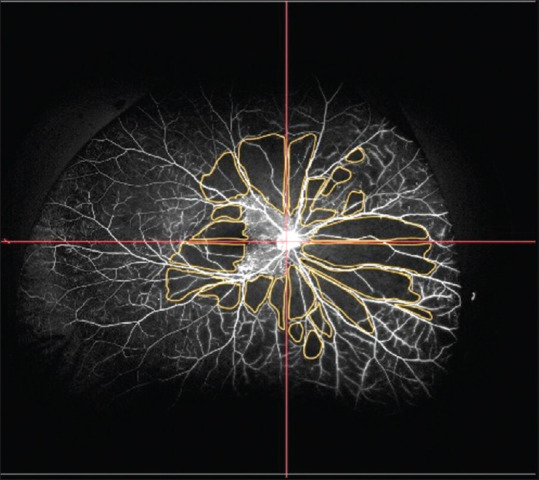
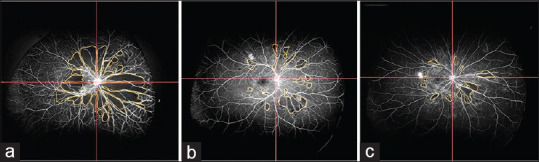
This was a prospective, single-center, observational study in which all patients who presented between March 2019 and December 2020 and satisfied the inclusion criteria were recruited. In our study, patients with treatment-naïve PDR without any fibrovascular proliferation underwent UWFFA. The images were analyzed qualitatively for the topographic distribution of NV and the CNP area was quantified. The number of lesions picked by UWFFA was compared with 7 standard field (7SF) image using overlay of 7SF. The main outcome measure was characteristics of neovascularization, such as the number, location, and area of CNP, measured using UWFFA, which was considered with 95% confidence intervals (CI).
Two hundred and fifty-three eyes of 187 patients with a mean age of 56.03 ± 8 years were included. Mean neovascularization elsewhere (NVE) was 2.91 ± 3.43. Maximum NVEs were seen in the superotemporal (ST; 0.9 ± 1.13) quadrant, followed by the inferotemporal (IT; 0.7 ± 1.08), inferonasal (IN; 0.66 ± 1.02) and superonasal (SN; 0.66 ± 1.01) quadrants. Maximum CNP area was seen in the SN (13.75 ± 8.83 disc diameter square [DD]) quadrant, followed by the IN (13.48 ± 8.59 DD), IT (11.34 ± 8.37 DD), and ST (11.3 ± 8.34 DD) quadrants. Mean CNP area was maximum in patients with only neovascularization of disc (NVD; 64.99 ± 41.47 DD), followed by both NVD and NVE (61.37 ± 35.61 DD), and was minimum in patients with only NVE (36.44 ± 22.03 DD). Eighty-one (32%) eyes out of 253 had NVE and 189 (75%) out of 253 had CNP area outside 7SF (overlay) of Early Treatment Diabetic Retinopathy Study (ETDRS).
Diabetic NV lesions and CNP areas are distributed asymmetrically throughout the retina and are not restricted to the posterior pole. Compared to conventional 7SF imaging, UWFFA reveals significantly more retinal vascular pathology in patients with PDR.
利用超广角荧光素血管造影(UWFFA)分析增生型糖尿病视网膜病变(PDR)患者的新生血管(NV)和无灌注毛细血管(CNP)的地形分布。
这是一项前瞻性、单中心、观察性研究,招募了 2019 年 3 月至 2020 年 12 月期间出现并符合纳入标准的所有患者。在我们的研究中,对未经治疗的无任何纤维血管增生的 PDR 患者进行 UWFFA。使用 7 标准视野(7SF)图像叠加对图像进行定性分析,以评估 NV 和 CNP 区域的地形分布,并对 UWFFA 检测到的病变数量与 7SF 进行比较。主要观察指标是 NV 的特征,如 CNP 的数量、位置和面积,采用 UWFFA 进行测量,置信区间(CI)为 95%。
共纳入 187 例患者的 253 只眼,平均年龄为 56.03±8 岁。平均其他部位的新生血管(NVE)为 2.91±3.43。最大的 NVEs 见于上颞(ST;0.9±1.13)象限,其次是下颞(IT;0.7±1.08)、下鼻(IN;0.66±1.02)和上鼻(SN;0.66±1.01)象限。最大的 CNP 面积见于 SN(13.75±8.83 视盘直径平方[DD])象限,其次是 IN(13.48±8.59 DD)、IT(11.34±8.37 DD)和 ST(11.3±8.34 DD)象限。仅存在视盘新生血管(NVD)的患者的平均 CNP 面积最大(64.99±41.47 DD),其次是同时存在 NVD 和 NVE(61.37±35.61 DD),仅存在 NVE 的患者最小(36.44±22.03 DD)。253 只眼中,81 只(32%)有 NVE,253 只眼中 189 只(75%)有 7SF 以外的 CNP 区域(ETDRS 早期糖尿病视网膜病变研究的叠加)。
糖尿病性 NV 病变和 CNP 区域在整个视网膜呈不对称分布,并不局限于后极部。与传统的 7SF 成像相比,UWFFA 显示 PDR 患者的视网膜血管病变明显更多。