Laboratory of Viral Immunology, Department of Medical Microbiology and Infectious Diseases, University of Manitoba, Winnipeg, Manitoba, Canada.
Department of Medical Microbiology, University of Nairobi, Nairobi, Kenya.
PLoS One. 2023 Aug 2;18(8):e0287738. doi: 10.1371/journal.pone.0287738. eCollection 2023.
In the context of the current COVID-19 pandemic, there is still limited information about how people suffering from autoimmune diseases respond to the different COVID vaccines. The fact that they are taking an immunosuppressant or other drugs that aim to decrease the immune system activities, such as hydroxychloroquine (HCQ), could also impact their ability to respond to a COVID vaccine and vaccines in general.
Heathy donors were given 200mg of HCQ daily for 6-weeks to assess HCQs impact on the systemic T cells and humoral immune response. Peripheral blood mononuclear cells (PBMC) and plasma were obtained at baseline and 6-weeks after starting daily HCQ. Flow cytometry assays were designed to determine changes in T cell activation and T cell responses. Bead array multiplex were used to analyse antibodies and cytokine levels before and after HCQ intake.
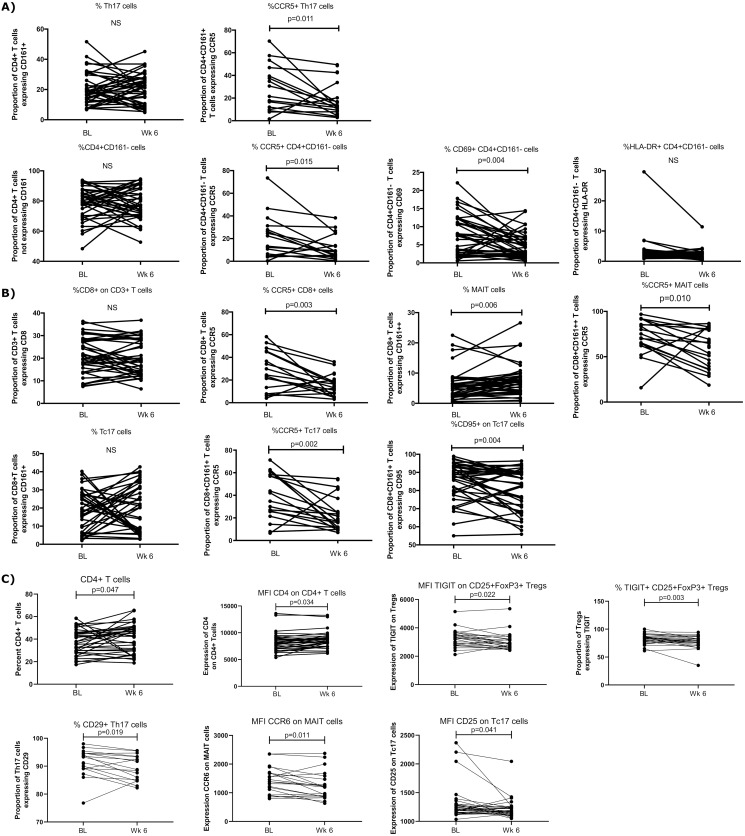
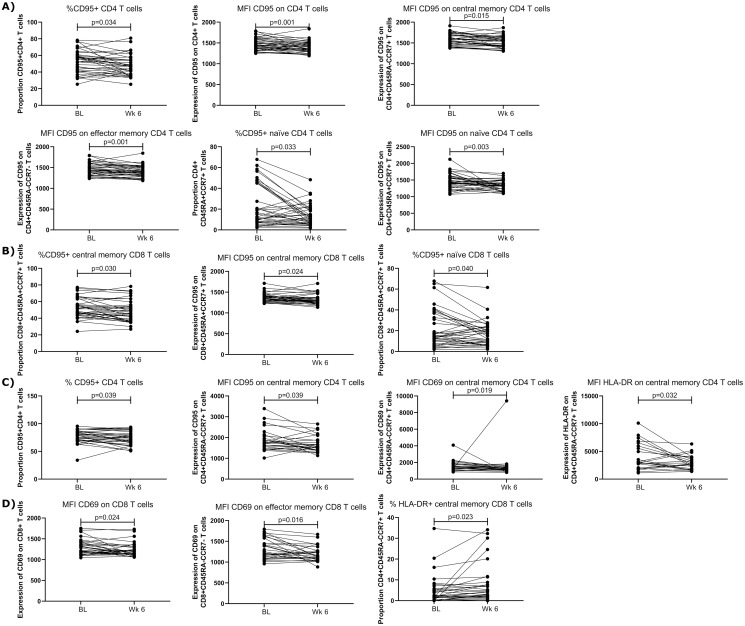
As anticipated, HCQ treatment decreased ex vivo T cell activation. We observed a decrease in CD4+CD161- expressing CCR5 (p = 0.015) and CD69 (p = 0.004) as well as in CD8+CCR5+ (p = 0.003), CD8+CD161+CCR5+ (p = 0.002) and CD8+CD161+CD95+ (p = 0.004). Additionally, HCQ decreased the proportion of Th17 expressing CD29 (p = 0.019), a subset associated with persistent inflammation. The proportion of T regulatory cells expressing the inhibitory molecule TIGIT was also reduced by HCQ (p = 0.003). As well, T cells from people on HCQ were less responsive to activation and cytokine production following stimulation with recall antigens and memory T cells were less likely to produce both IFNγ and TNFα following stimulation.
This study shows HCQ is associated with lower T cell activation and decreased T cell cytokine production. While this study was not performed with the intent of looking at COVID vaccine response, it does provide important information about the changes in immune response that may occur in patient taking HCQ as a treatment for their autoimmune disease.
在当前 COVID-19 大流行的背景下,关于自身免疫性疾病患者对不同 COVID 疫苗的反应,仍然知之甚少。他们正在服用免疫抑制剂或其他旨在降低免疫系统活性的药物,如羟氯喹 (HCQ),这也可能影响他们对 COVID 疫苗和一般疫苗的反应能力。
健康供体每日服用 200mg HCQ 6 周,以评估 HCQ 对系统 T 细胞和体液免疫反应的影响。在开始每日服用 HCQ 之前和 6 周后采集外周血单核细胞 (PBMC) 和血浆。流式细胞术检测设计用于确定 T 细胞激活和 T 细胞反应的变化。使用珠阵列多重分析在服用 HCQ 前后分析抗体和细胞因子水平。
正如预期的那样,HCQ 治疗降低了体外 T 细胞激活。我们观察到 CD4+CD161-表达的 CCR5(p = 0.015)和 CD69(p = 0.004)以及 CD8+CCR5+(p = 0.003)、CD8+CD161+CCR5+(p = 0.002)和 CD8+CD161+CD95+(p = 0.004)减少。此外,HCQ 降低了表达 CD29 的 Th17 比例(p = 0.019),这是与持续炎症相关的亚群。HCQ 还降低了表达抑制分子 TIGIT 的调节性 T 细胞的比例(p = 0.003)。同样,HCQ 治疗的患者的 T 细胞对激活和细胞因子产生的反应性降低,并且记忆 T 细胞在刺激后产生 IFNγ和 TNFα的可能性更小。
这项研究表明 HCQ 与较低的 T 细胞激活和减少的 T 细胞细胞因子产生有关。虽然这项研究不是为了研究 COVID 疫苗反应而进行的,但它确实提供了有关免疫反应变化的重要信息,这些变化可能发生在自身免疫性疾病患者服用 HCQ 作为治疗药物的情况下。