Department of Medical Microbiology and Infectious Diseases, University of Manitoba, Winnipeg, MB, Canada.
Department Medical Microbiology, University of Nairobi, Nairobi, Kenya.
J Int AIDS Soc. 2018 Jul;21(7):e25150. doi: 10.1002/jia2.25150.
At its basic level, HIV infection requires a replication-competent virus and a susceptible target cell. Elevated levels of vaginal inflammation has been associated with the increased risk of HIV infection as it brings highly activated HIV target cells (CCR5+CD4+ T cells; CCR5+CD4+CD161+ Th17 T cells) to the female genital tract (FGT) where they interact with HIV. Decreased HIV risk has been associated with a phenotype of decreased immune activation, called immune quiescence, described among Kenyan female sex workers who were intensely exposed to HIV yet remain uninfected. Current prevention approaches focus on limiting viral access. We took the novel HIV prevention approach of trying to limit the number of HIV target cells in the genital tract by reducing inflammation using safe, affordable and globally accessible anti-inflammatory drugs.
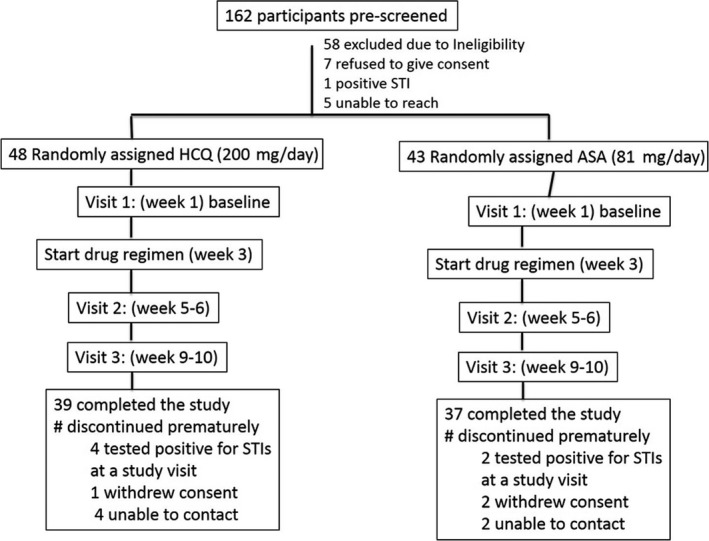
We hypothesized that the daily administration of low doses of acetylsalicylic acid (ASA 81 mg) or hydroxychloroquine (HCQ 200 mg) would reduce inflammation thereby decreasing HIV target cells at the FGT. Low-risk HIV seronegative women from Nairobi, Kenya were randomized for six weeks therapy of ASA (n = 37) or HCQ (n = 39) and tested to determine the impact on their systemic and mucosal immune environment.
The results showed that HCQ use was associated with a significant reduction in the proportion of systemic T cells that were CCR5+CD4+ (p = 0.01) and Th17 (p = 0.01). In the ASA arm, there was a 35% and 28% decrease in the proportion of genital T cells that were CD4+CCR5+ (p = 0.017) and Th17 (p = 0.04) respectively. Proteomic analyses of the cervical lavage showed ASA use was associated with significantly reduced amount of proteins involved in the inflammatory response and cell recruitment at the mucosa, although none of the individual proteins passed multiple comparison correction. These changes were more apparent in women with Lactobacillus dominant microbiomes.
Together, these data indicate that taking low-dose ASA daily was associated with significant reduction in HIV target cells at the FGT. This study provides proof-of-concept for a novel HIV-prevention approach that reducing inflammation using safe, affordable and globally accessible non-steroidal anti-inflammatory agents is associated with significant reduction in the proportion of HIV-target cells at the FGT.
从根本上讲,HIV 感染需要具有复制能力的病毒和易感靶细胞。阴道炎症水平升高与 HIV 感染风险增加有关,因为它将高度激活的 HIV 靶细胞(CCR5+CD4+T 细胞;CCR5+CD4+CD161+Th17T 细胞)带到女性生殖道(FGT),在那里它们与 HIV 相互作用。HIV 风险降低与一种称为免疫静止的免疫激活表型有关,在肯尼亚女性性工作者中观察到这种表型,她们大量接触 HIV 但仍未感染。目前的预防方法侧重于限制病毒进入。我们采取了一种新颖的 HIV 预防方法,即通过使用安全、负担得起且在全球范围内可获得的抗炎药物来减少炎症,从而减少生殖道中的 HIV 靶细胞数量。
我们假设每天低剂量服用乙酰水杨酸(ASA81mg)或羟氯喹(HCQ200mg)可减轻炎症,从而减少 FGT 中的 HIV 靶细胞。从肯尼亚内罗毕招募低危 HIV 血清阴性的女性,随机接受六周的 ASA(n=37)或 HCQ(n=39)治疗,并进行测试以确定其对全身和黏膜免疫环境的影响。
结果表明,HCQ 治疗与系统 T 细胞中 CCR5+CD4+(p=0.01)和 Th17(p=0.01)比例的显著降低有关。在 ASA 组中,生殖道 T 细胞中 CD4+CCR5+(p=0.017)和 Th17(p=0.04)的比例分别下降了 35%和 28%。宫颈冲洗液的蛋白质组学分析表明,ASA 治疗与黏膜炎症反应和细胞募集相关的蛋白量显著减少有关,尽管没有一种蛋白质通过多重比较校正。在乳酸杆菌占主导地位的微生物组的女性中,这些变化更为明显。
总之,这些数据表明,每天服用低剂量 ASA 与 FGT 中 HIV 靶细胞的显著减少有关。这项研究为一种新的 HIV 预防方法提供了概念验证,即使用安全、负担得起且在全球范围内可获得的非甾体抗炎药来减轻炎症与 FGT 中 HIV 靶细胞比例的显著降低有关。