Division of Nephrology, Endocrinology, and Vascular Medicine, Tohoku University Graduate School of Medicine, Sendai, Japan.
Division of Medical Science, Tohoku University Graduate School of Biomedical Engineering, Sendai, Japan.
Sci Rep. 2023 Aug 2;13(1):12508. doi: 10.1038/s41598-023-39657-7.
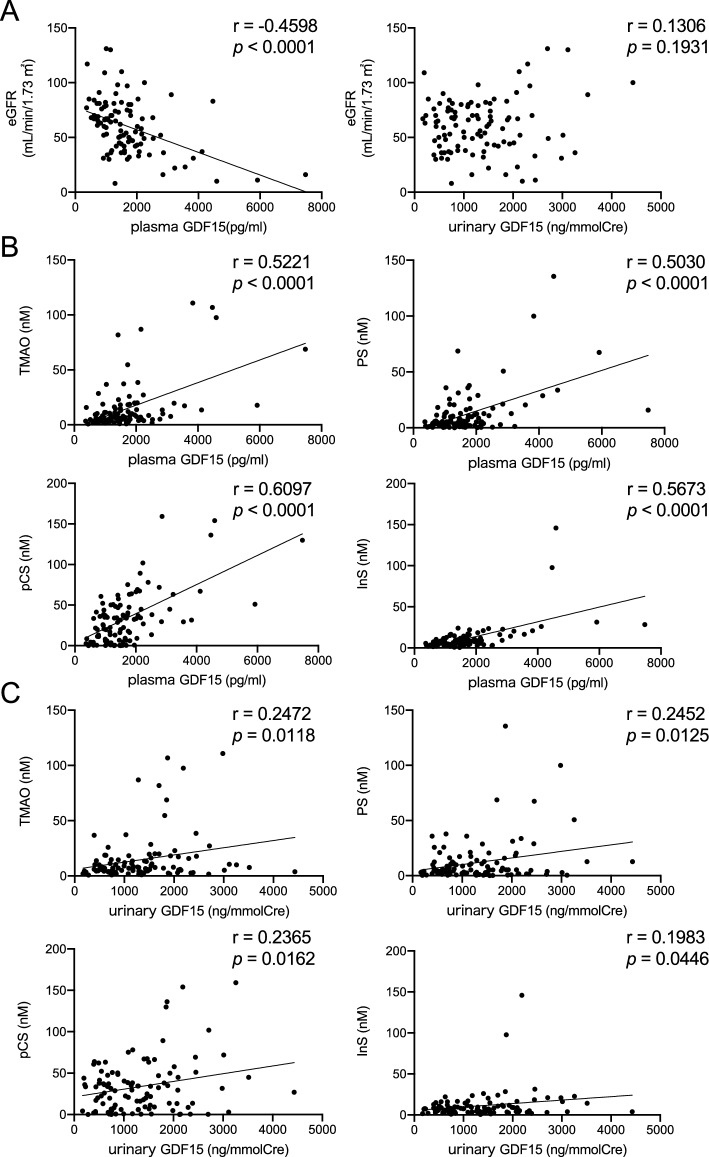
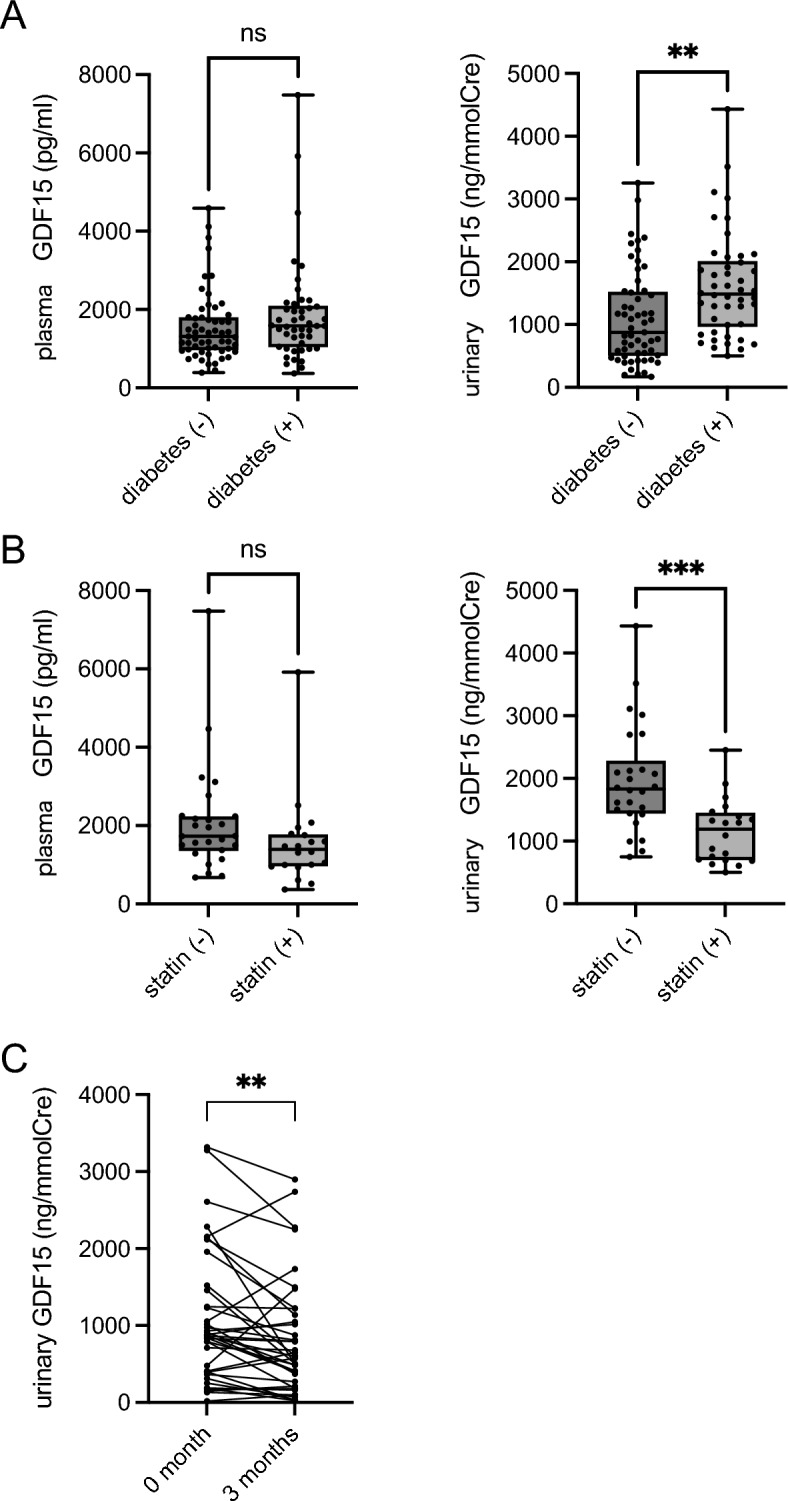
Sensitive biomarkers can enhance the diagnosis, prognosis, and surveillance of chronic kidney disease (CKD), such as diabetic kidney disease (DKD). Plasma growth differentiation factor 15 (GDF15) levels are a novel biomarker for mitochondria-associated diseases; however, it may not be a useful indicator for CKD as its levels increase with declining renal function. This study explores urinary GDF15's potential as a marker for CKD. The plasma and urinary GDF15 as well as 15 uremic toxins were measured in 103 patients with CKD. The relationship between the urinary GDF15-creatinine ratio and the uremic toxins and other clinical characteristics was investigated. Urinary GDF15-creatinine ratios were less related to renal function and uremic toxin levels compared to plasma GDF15. Additionally, the ratios were significantly higher in patients with CKD patients with diabetes (p = 0.0012) and reduced with statin treatment. In a different retrospective DKD cohort study (U-CARE, n = 342), multiple and logistic regression analyses revealed that the baseline urinary GDF15-creatinine ratios predicted a decline in estimated glomerular filtration rate (eGFR) over 2 years. Compared to the plasma GDF15 level, the urinary GDF15-creatinine ratio is less dependent on renal function and sensitively fluctuates with diabetes and statin treatment. It may serve as a good prognostic marker for renal function decline in patients with DKD similar to the urine albumin-creatinine ratio.
敏感生物标志物可增强慢性肾脏病(CKD),如糖尿病肾病(DKD)的诊断、预后和监测。血浆生长分化因子 15(GDF15)水平是一种与线粒体相关疾病的新型生物标志物;然而,它可能不是 CKD 的有用指标,因为其水平随着肾功能下降而升高。本研究探讨了尿 GDF15 作为 CKD 标志物的潜力。在 103 例 CKD 患者中测量了血浆和尿 GDF15 以及 15 种尿毒症毒素。研究了尿 GDF15-肌酐比值与尿毒症毒素和其他临床特征之间的关系。与血浆 GDF15 相比,尿 GDF15-肌酐比值与肾功能和尿毒症毒素水平的相关性较低。此外,患有糖尿病的 CKD 患者的比值明显更高(p = 0.0012),且他汀类药物治疗后降低。在另一项回顾性 DKD 队列研究(U-CARE,n = 342)中,多元和逻辑回归分析显示,基线尿 GDF15-肌酐比值可预测 2 年内估计肾小球滤过率(eGFR)下降。与血浆 GDF15 水平相比,尿 GDF15-肌酐比值对肾功能的依赖性较小,并且对糖尿病和他汀类药物治疗的敏感性波动较大。它可能是 DKD 患者肾功能下降的良好预后标志物,与尿白蛋白-肌酐比值相似。