Department of Clinical, Neuro and Developmental Psychology, Amsterdam Public Health Research Institute, Vrije Universiteit Amsterdam, Amsterdam, The Netherlands.
International Institute for Psychotherapy, Babeș-Bolyai University, Cluj-Napoca, Romania.
Eur Psychiatry. 2023 Aug 3;66(1):e63. doi: 10.1192/j.eurpsy.2023.2437.
It is not clear if there is an interaction between psychotherapy and pharmacotherapy. First, there may be no interaction at all, meaning that the effects of both are independent of each other. Second, antidepressants may reduce the effects of psychotherapy, and third, antidepressants may increase the effects of psychotherapy. We examined which of the three is correct.
We conducted random effects meta-analyses of randomized trials comparing psychotherapies for adult depression with control conditions. The proportion of users of antidepressants was used as a predictor of the effect size in a series of meta-regression analyses, while adjusting for relevant moderators, such as type of control group and baseline severity.
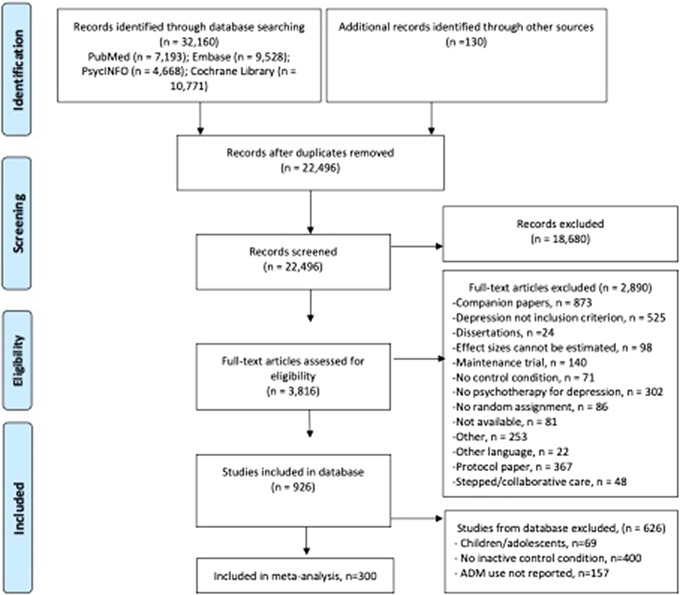
We included 300 randomized controlled trials (353 comparisons between treatment and control; 32,852 participants). The main effect size of psychotherapy was = 0.71 (95% CI: 0.64; 0.79) with high heterogeneity ( = 82; 95% CI: 80; 84). We found no significant association between the proportion of antidepressants users and effect size ( = .07). We did find a significant association with some other predictors, including the type of control group and risk of bias. The use of antidepressants was associated with higher response rates within the control conditions, but not with the relative effects of the treatments compared to the control groups.
We found support for the independent effects of psychotherapy and pharmacotherapy, which is good news from a clinical perspective. Apparently, patients can start with psychotherapy and do not have to be afraid that this will reduce the effects of the therapy.
目前尚不清楚心理治疗和药物治疗之间是否存在相互作用。首先,两者之间可能根本没有相互作用,这意味着两者的效果是相互独立的。其次,抗抑郁药可能会降低心理治疗的效果,第三,抗抑郁药可能会增加心理治疗的效果。我们检查了这三种情况中哪一种是正确的。
我们对比较成人抑郁症心理治疗与对照条件的随机试验进行了随机效应荟萃分析。抗抑郁药使用者的比例作为一系列荟萃回归分析中效应量的预测因子,同时调整了相关的调节因素,如对照组的类型和基线严重程度。
我们纳入了 300 项随机对照试验(353 项治疗与对照比较;32852 名参与者)。心理治疗的主要效应大小为 = 0.71(95%CI:0.64;0.79),异质性高( = 82;95%CI:80;84)。我们没有发现抗抑郁药使用者比例与效应大小之间存在显著关联( = 0.07)。我们确实发现与一些其他预测因子之间存在关联,包括对照组的类型和偏倚风险。抗抑郁药的使用与对照条件下的更高反应率相关,但与治疗与对照组相比的相对效果无关。
我们从临床角度发现了心理治疗和药物治疗独立作用的支持证据,这是一个好消息。显然,患者可以从心理治疗开始,不必担心这会降低治疗效果。