Tuberculosis Laboratory, The Francis Crick Institute, London, NW1 1AT, UK.
High Throughput Screening Laboratory, The Francis Crick Institute, London, NW1 1AT, UK.
J Neuroinflammation. 2023 Aug 3;20(1):184. doi: 10.1186/s12974-023-02861-3.
Although mainly causing a respiratory syndrome, numerous neurological symptoms have been identified following of SARS-CoV-2 infection. However, how the virus affects the brain and how the mutations carried by the different variants modulate those neurological symptoms remain unclear.
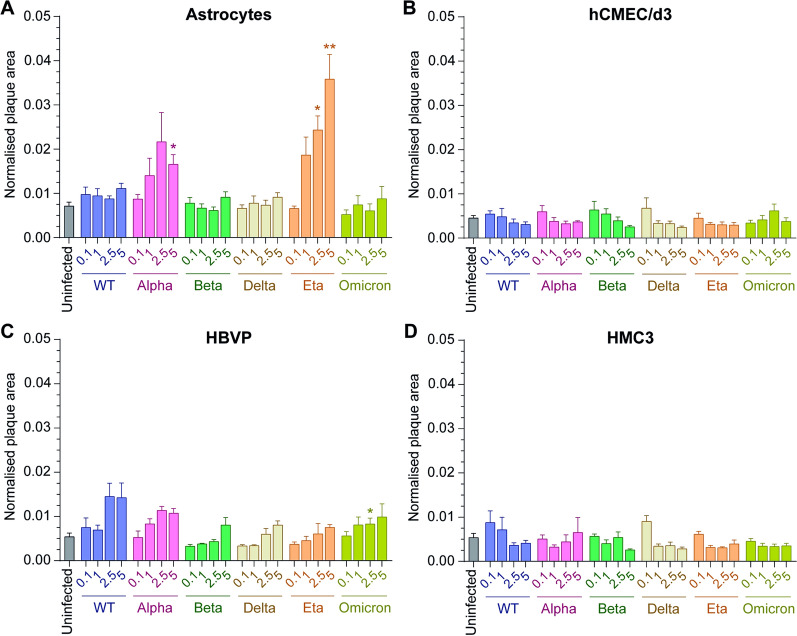
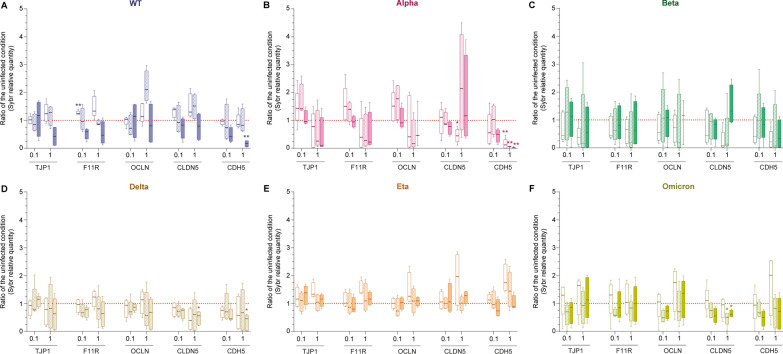
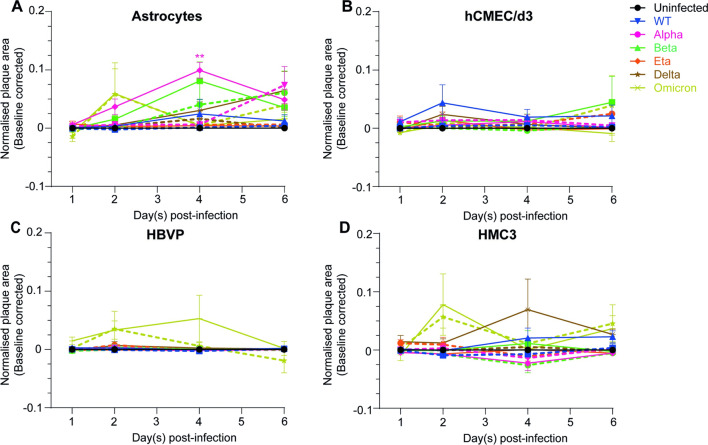
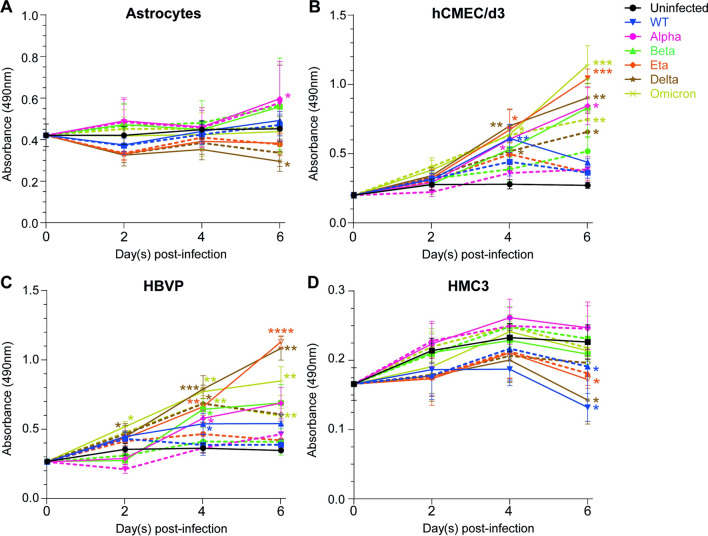
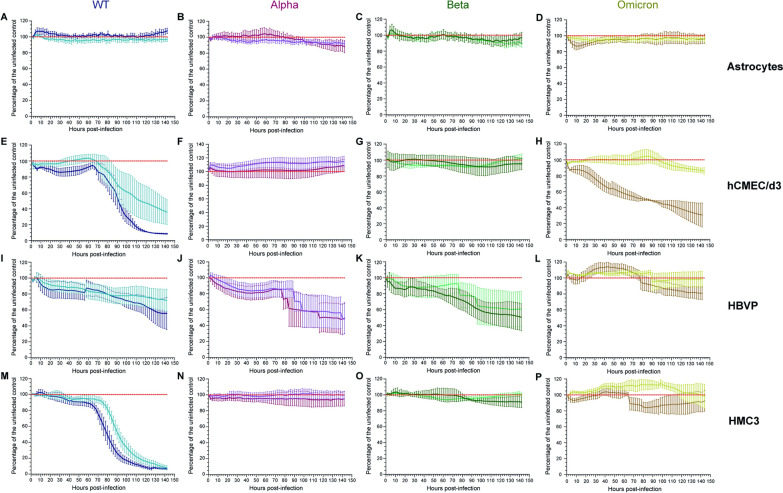
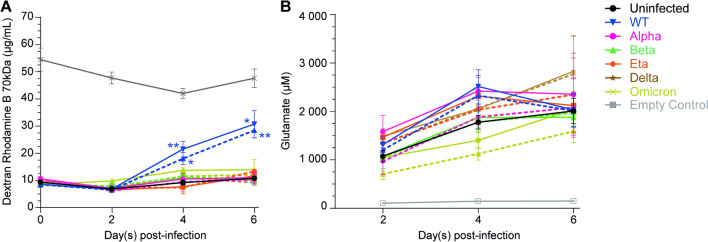
We used primary human pericytes, foetal astrocytes, endothelial cells and a microglial cell line to investigate the effect of several SARS-CoV-2 variants of concern or interest on their functional activities. Cells and a 3D blood-brain barrier model were infected with the wild-type form of SARS-CoV-2, Alpha, Beta, Delta, Eta, or Omicron (BA.1) variants at various MOI. Cells and supernatant were used to evaluate cell susceptibility to the virus using a microscopic assay as well as effects of infection on (i) cell metabolic activity using a colorimetric MTS assay; (ii) viral cytopathogenicity using the xCELLigence system; (iii) extracellular glutamate concentration by fluorometric assay; and (iv) modulation of blood-brain barrier permeability.
We demonstrate that productive infection of brain cells is SARS-CoV-2 variant dependent and that all the variants induce stress to CNS cells. The wild-type virus was cytopathic to all cell types except astrocytes, whilst Alpha and Beta variants were only cytopathic for pericytes, and the Omicron variant cytopathic for endothelial cells and pericytes. Lastly wild-type virus increases blood-brain barrier permeability and all variants, except Beta, modulate extracellular glutamate concentration, which can lead to excitotoxicity or altered neurotransmission.
These results suggest that SARS-CoV-2 is neurotropic, with deleterious consequences for the blood-brain barrier integrity and central nervous system cells, which could underlie neurological disorders following SARS-CoV-2 infection.
尽管主要引起呼吸道综合征,但在 SARS-CoV-2 感染后已确定了许多神经症状。然而,病毒如何影响大脑以及不同变体携带的突变如何调节这些神经症状仍不清楚。
我们使用原代人周细胞、胎鼠星形胶质细胞、内皮细胞和小胶质细胞系来研究几种关注或感兴趣的 SARS-CoV-2 变体对其功能活动的影响。细胞和 3D 血脑屏障模型以不同的 MOI 感染 SARS-CoV-2 的野生型、Alpha、Beta、Delta、Eta 或 Omicron(BA.1)变体。使用显微镜检测法评估细胞对病毒的敏感性,并使用细胞代谢活性比色 MTS 测定法、(ii)使用 xCELLigence 系统评估感染对病毒细胞病变的影响;(iii)通过荧光测定法评估细胞外谷氨酸浓度;以及(iv)调节血脑屏障通透性。
我们证明了脑细胞的有效感染依赖于 SARS-CoV-2 变体,并且所有变体都会引起中枢神经系统细胞的应激。除了星形胶质细胞外,野生型病毒对所有细胞类型均无细胞病变作用,而 Alpha 和 Beta 变体仅对周细胞具有细胞病变作用,Omicron 变体对内皮细胞和周细胞具有细胞病变作用。最后,野生型病毒增加血脑屏障通透性,除了 Beta 变体之外,所有变体都调节细胞外谷氨酸浓度,这可能导致兴奋性毒性或改变神经递质传递。
这些结果表明,SARS-CoV-2 具有嗜神经性,对血脑屏障完整性和中枢神经系统细胞具有有害影响,这可能是 SARS-CoV-2 感染后出现神经紊乱的基础。