Wittels S Howard, Renaghan Eric, Wishon Michael Joseph, Wittels Harrison L, Chong Stephanie, Wittels Eva Danielle, Hendricks Stephanie, Hecocks Dustin, Bellamy Kyle, Girardi Joe, Lee Stephen, McDonald Samantha, Feigenbaum Luis A
Department of Anesthesiology, Mount Sinai Medical Center, USA.
Department of Anesthesiology, Wertheim School of Medicine, Florida International University, USA.
Heliyon. 2023 Jul 16;9(7):e18125. doi: 10.1016/j.heliyon.2023.e18125. eCollection 2023 Jul.
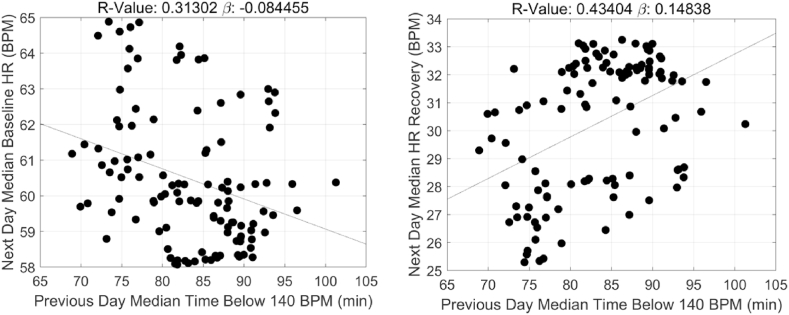
The autonomic nervous system (ANS) is profoundly affected by high intensity exercise. However, evidence is less clear on ANS recovery and function following prolonged bouts of high intensity exercise, especially in non-endurance athletes. Therefore, this study aimed to investigate the relationships between duration and intensity of acute exercise training sessions and ANS recovery and function in Division I football athletes. Fifty, male football athletes were included in this study. Subjects participated in 135 days of exercise training sessions throughout the 25-week season and wore armband monitors (Warfighter Monitor, Tiger Tech Solutions) equipped with electrocardiography capabilities. Intensity was measured via heart rate (HR) during an 'active state', defined as HR ≥ 85 bpm. Further, data-driven intensity thresholds were used and included HR < 140 bpm, HR < 150 bpm, HR < 160 bpm, HR ≥ 140 bpm, HR ≥ 150 bpm and HR ≥ 160 bpm. Baseline HR and HR recovery were measured and represented ANS recovery and function 24h post-exercise. Linear regression models assessed the relationships between time spent at the identified intensity thresholds and ANS recovery and function 24h post-exercise. Statistical significance set at α < 0.05. Athletes participated in 128 training sessions, totaling 2735 data points analyzed. Subjects were predominantly non-Hispanic black (66.0%), aged 21.2 (±1.5) years and average body mass index of 29.2 (4.7) kg⋅(m). For baseline HR, statistically significant associations between duration and next-day ANS recovery were observed at HR < 140 bpm ( = -0.08 ± 0.02, R = 0.31, p < 0.001), HR above 150 and 160 bpm intensity thresholds ( = 0.25 ± 0.02, R = 0.69, p < 0.0000 and = 0.59 ± 0.06, R = 0.71, p < 0.0000). Similar associations were observed for HR recovery: HR < 140 bpm ( = 0.15 ± 0.03, R = 0.43, p < 0.0000) and HR above 150 and 160 bpm ( = -0.33 ± 0.03, R = 0.73, p < 0.0000 and = -0.80 ± 0.06, R = 0.71, p < 0.0000). The strengths of these associations increased with increasing intensity, HR ≥ 150 and 160 bpm (baseline HR: range = 0.25 vs 0.59, R: 0.69 vs 0.71 and HR recovery: range = -0.33 vs -0.80, R = 0.73 vs 0.77). Time spent in lower intensity thresholds, elicited weaker associations with ANS recovery and function 24h post-exercise, with statistical significance observed only at HR < 140 bpm ( = -0.08 ± 0.02, R = 0.31, p < 0.001). The findings of this study showed that ANS recovery and function following prolonged high intensity exercise remains impaired for more than 24h. Strength and conditioning coaches should consider shorter bouts of strenuous exercise and extending recovery periods within and between exercise training sessions.
自主神经系统(ANS)会受到高强度运动的深刻影响。然而,关于长时间高强度运动后自主神经系统的恢复和功能,证据尚不明确,尤其是在非耐力运动员中。因此,本研究旨在调查一级足球运动员急性运动训练课的持续时间和强度与自主神经系统恢复和功能之间的关系。本研究纳入了50名男性足球运动员。受试者在整个25周的赛季中参加了135天的运动训练课,并佩戴了具备心电图功能的臂带监测器(Warfighter Monitor,Tiger Tech Solutions)。在“活跃状态”下通过心率(HR)测量强度,“活跃状态”定义为心率≥85次/分钟。此外,还使用了数据驱动的强度阈值,包括心率<140次/分钟、心率<150次/分钟、心率<160次/分钟、心率≥140次/分钟、心率≥150次/分钟和心率≥160次/分钟。测量了基线心率和心率恢复情况,以代表运动后24小时的自主神经系统恢复和功能。线性回归模型评估了在确定的强度阈值下花费的时间与运动后24小时自主神经系统恢复和功能之间的关系。设定统计显著性水平为α<0.05。运动员参加了128次训练课,共分析了2735个数据点。受试者主要为非西班牙裔黑人(66.0%),年龄21.2(±1.5)岁,平均体重指数为29.2(4.7)kg·(m)。对于基线心率,在心率<140次/分钟(β=-0.08±0.02,R=0.31,p<0.001)、心率高于150和160次/分钟强度阈值(β=0.25±0.02,R=0.69,p<0.0000和β=0.59±0.06,R=0.71,p<0.0000)时,观察到持续时间与次日自主神经系统恢复之间存在统计学显著关联。心率恢复也观察到类似的关联:心率<140次/分钟(β=0.15±0.03,R=0.43,p<0.0000)以及心率高于150和160次/分钟(β=-0.33±0.03,R=0.73,p<0.0000和β=-0.80±0.06,R=0.71,p<0.0000)。这些关联的强度随着强度增加而增强,心率≥150和160次/分钟(基线心率:β范围=0.25对0.59,R:0.69对0.71;心率恢复:β范围=-0.33对-0.80,R=0.73对0.77)。在较低强度阈值下花费的时间与运动后24小时自主神经系统恢复和功能的关联较弱,仅在心率<140次/分钟时观察到统计学显著性(β=-0.08±0.02,R=0.31,p<0.001)。本研究结果表明,长时间高强度运动后自主神经系统的恢复和功能在超过24小时内仍受到损害。力量和体能教练应考虑缩短剧烈运动的时间,并延长运动训练课期间及之间的恢复时间。