William James Center for Research, Ispa - Instituto Universitário, Lisboa, Portugal.
CIP-UAL, Departamento de Psicologia, Universidade Autónoma de Lisboa Luís de Camões, Lisboa, Portugal.
J Geriatr Psychiatry Neurol. 2024 Mar;37(2):146-156. doi: 10.1177/08919887231195228. Epub 2023 Aug 4.
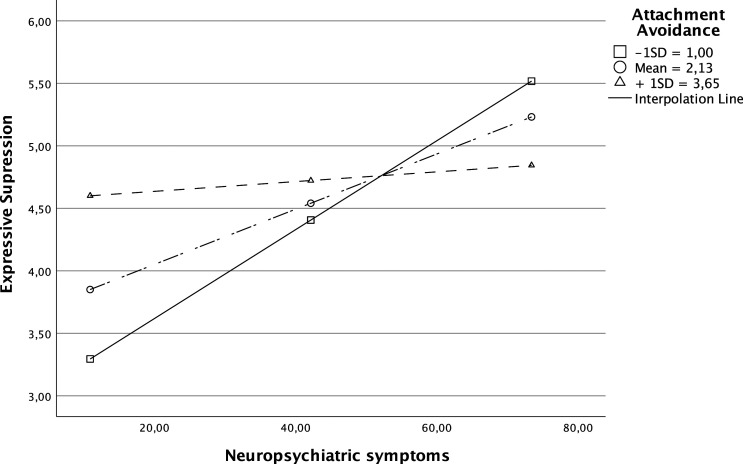
Family caregivers are usually the main source of support for persons living with dementia, being exposed to a loved one's suffering, which can lead to experiencing strong and negative emotions. This study aimed to identify factors capable of explaining individual differences in the way caregivers regulate their emotions. This cross-sectional study included 78 informal caregivers (M = 64.84 years; SD = 13.32) and 84 controls (non-caregivers) (M = 77 years; SD = 7.59). Neuropsychiatric symptoms (NPS), attachment orientations, and emotion regulation were measured using self-report scales. Caregivers of persons living with dementia used more expressive suppression in comparison to non-caregivers. NPS and attachment avoidance were associated with expressive suppression. Moderation analyses showed that NPS only predicted expressive suppression when attachment avoidance was low or medium. The present study showed that caregivers are more likely to suppress their emotions in the presence of NPS, especially those with lower/middle levels of attachment avoidance. Psychological interventions targeting emotion regulation should be offered especially to caregivers that face NPS of persons living with dementia and present lower/middle levels of attachment avoidance.
家庭照顾者通常是患有痴呆症的人的主要支持来源,他们要面对亲人的痛苦,这可能导致他们经历强烈和负面的情绪。本研究旨在确定能够解释照顾者情绪调节个体差异的因素。这项横断面研究包括 78 名非正式照顾者(M=64.84 岁;SD=13.32)和 84 名对照者(非照顾者)(M=77 岁;SD=7.59)。使用自我报告量表测量神经精神症状(NPS)、依恋取向和情绪调节。与非照顾者相比,痴呆症患者的照顾者更多地使用表达抑制。NPS 和回避型依恋与表达抑制有关。调节分析表明,只有当回避型依恋水平较低或中等时,NPS 才会预测表达抑制。本研究表明,当照顾者面临患有痴呆症的人的 NPS 且回避型依恋水平较低/中等时,他们更有可能抑制自己的情绪。应特别向面临患有痴呆症的人的 NPS 且回避型依恋水平较低/中等的照顾者提供针对情绪调节的心理干预。