Columbia University School of Nursing, New York City, New York, USA.
Cardiology, NewYork-Presbyterian Queens Hospital, Flushing, New York, USA.
Open Heart. 2023 Aug;10(2). doi: 10.1136/openhrt-2023-002385.
This study aims to leverage natural language processing (NLP) and machine learning clustering analyses to (1) identify co-occurring symptoms of patients undergoing catheter ablation for atrial fibrillation (AF) and (2) describe clinical and sociodemographic correlates of symptom clusters.
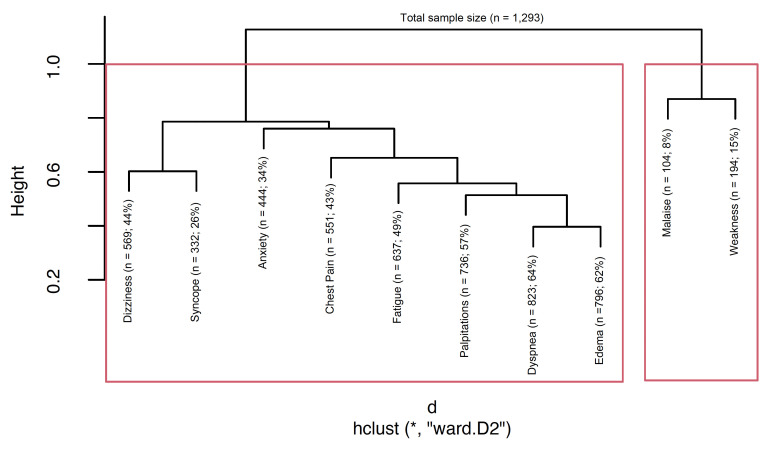
We conducted a cross-sectional retrospective analysis using electronic health records data. Adults who underwent AF ablation between 2010 and 2020 were included. Demographic, comorbidity and medication information was extracted using structured queries. Ten AF symptoms were extracted from unstructured clinical notes (n=13 416) using a validated NLP pipeline (F-score=0.81). We used the unsupervised machine learning approach known as Ward's hierarchical agglomerative clustering to characterise and identify subgroups of patients representing different clusters. Fisher's exact tests were used to investigate subgroup differences based on age, gender, race and heart failure (HF) status.
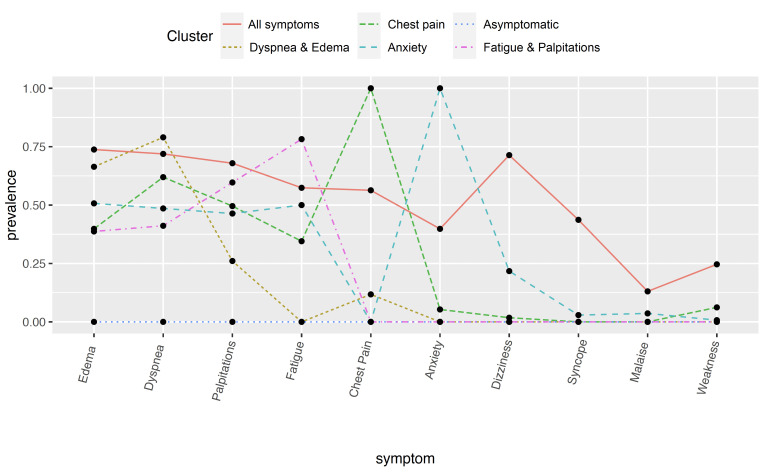
A total of 1293 patients were included in our analysis (mean age 65.5 years, 35.2% female, 58% white). The most frequently documented symptoms were dyspnoea (64%), oedema (62%) and palpitations (57%). We identified six symptom clusters: generally symptomatic, dyspnoea and oedema, chest pain, anxiety, fatigue and palpitations, and asymptomatic (reference). The asymptomatic cluster had a significantly higher prevalence of male, white and comorbid HF patients.
We applied NLP and machine learning to a large dataset to identify symptom clusters, which may signify latent biological underpinnings of symptom experiences and generate implications for clinical care. AF patients' symptom experiences vary widely. Given prior work showing that AF symptoms predict adverse outcomes, future work should investigate associations between symptom clusters and postablation outcomes.
本研究旨在利用自然语言处理(NLP)和机器学习聚类分析来:(1) 识别接受心房颤动(AF)导管消融治疗的患者共现的症状;(2) 描述症状群的临床和社会人口统计学相关性。
我们使用电子健康记录数据进行了一项横断面回顾性分析。纳入了 2010 年至 2020 年间接受 AF 消融治疗的成年人。使用结构化查询提取人口统计学、合并症和药物信息。使用经过验证的 NLP 管道(F 分数=0.81)从非结构化临床记录中提取了 10 种 AF 症状(n=13416)。我们使用称为 Ward 层次凝聚聚类的无监督机器学习方法来描述和识别代表不同群组的患者亚组。Fisher 确切检验用于根据年龄、性别、种族和心力衰竭(HF)状态调查亚组差异。
我们的分析共纳入了 1293 名患者(平均年龄 65.5 岁,35.2%为女性,58%为白人)。记录最频繁的症状是呼吸困难(64%)、水肿(62%)和心悸(57%)。我们确定了六个症状群:一般症状、呼吸困难和水肿、胸痛、焦虑、疲劳和心悸以及无症状(参考)。无症状群组中男性、白人及合并 HF 的患者比例明显更高。
我们将 NLP 和机器学习应用于大型数据集,以识别症状群,这可能代表症状体验的潜在生物学基础,并为临床护理提供启示。AF 患者的症状体验差异很大。鉴于先前的研究表明 AF 症状可预测不良结局,未来的研究应调查症状群与消融后结局之间的关联。