Columbia University School of Nursing, 560 W. 168th Street, New York, NY 10032, USA.
Department of Cardiology, NewYork-Presbyterian Queens Hospital, 56-45 Main St, Queens, NY 11355, USA.
Eur J Cardiovasc Nurs. 2024 Apr 12;23(3):241-250. doi: 10.1093/eurjcn/zvad068.
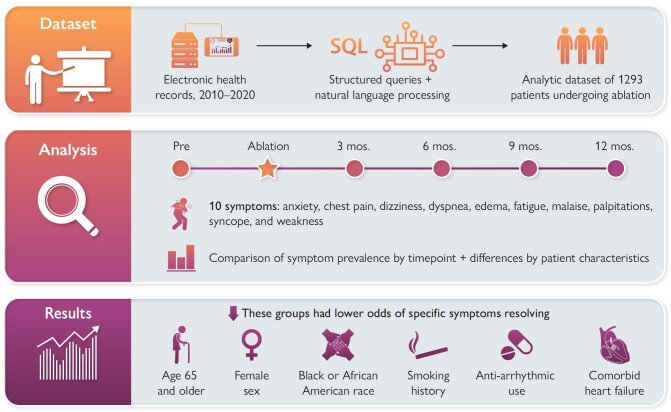
Atrial fibrillation (AF) symptom relief is a primary indication for catheter ablation, but AF symptom resolution is not well characterized. The study objective was to describe AF symptom documentation in electronic health records (EHRs) pre- and post-ablation and identify correlates of post-ablation symptoms.
We conducted a retrospective cohort study using EHRs of patients with AF (n = 1293), undergoing ablation in a large, urban health system from 2010 to 2020. We extracted symptom data from clinical notes using a natural language processing algorithm (F score: 0.81). We used Cochran's Q tests with post-hoc McNemar's tests to determine differences in symptom prevalence pre- and post-ablation. We used logistic regression models to estimate the adjusted odds of symptom resolution by personal or clinical characteristics at 6 and 12 months post-ablation. In fully adjusted models, at 12 months post-ablation patients, patients with heart failure had significantly lower odds of dyspnoea resolution [odds ratio (OR) 0.38, 95% confidence interval (CI) 0.25-0.57], oedema resolution (OR 0.37, 95% CI 0.25-0.56), and fatigue resolution (OR 0.54, 95% CI 0.34-0.85), but higher odds of palpitations resolution (OR 1.90, 95% CI 1.25-2.89) compared with those without heart failure. Age 65 and older, female sex, Black or African American race, smoking history, and antiarrhythmic use were also associated with lower odds of resolution of specific symptoms at 6 and 12 months.
The post-ablation symptom patterns are heterogeneous. Findings warrant confirmation with larger, more representative data sets, which may be informative for patients whose primary goal for undergoing an ablation is symptom relief.
心房颤动(AF)症状缓解是导管消融的主要适应证,但 AF 症状的缓解情况尚未得到很好的描述。本研究的目的是描述消融前和消融后电子健康记录(EHR)中 AF 症状的记录,并确定消融后症状的相关因素。
我们使用 2010 年至 2020 年间在一个大型城市卫生系统中接受消融治疗的 AF 患者(n=1293)的 EHR 进行了一项回顾性队列研究。我们使用自然语言处理算法(F 分数:0.81)从临床记录中提取症状数据。我们使用 Cochran's Q 检验和事后 McNemar 检验来确定消融前和消融后症状发生率的差异。我们使用逻辑回归模型来估计个人或临床特征在消融后 6 个月和 12 个月时症状缓解的调整后比值比。在完全调整的模型中,在消融后 12 个月,心力衰竭患者呼吸困难缓解的可能性显著降低[比值比(OR)0.38,95%置信区间(CI)0.25-0.57],水肿缓解(OR 0.37,95%CI 0.25-0.56)和疲劳缓解(OR 0.54,95%CI 0.34-0.85),但心悸缓解的可能性更高(OR 1.90,95%CI 1.25-2.89)与无心力衰竭的患者相比。65 岁及以上、女性、黑人和非洲裔美国人种族、吸烟史和抗心律失常药物的使用与 6 个月和 12 个月时特定症状缓解的可能性降低也有关。
消融后症状模式具有异质性。这些发现需要通过更大、更具代表性的数据集进行验证,这可能对主要目标是缓解症状而接受消融的患者有帮助。