Department of Orthopaedic Surgery, Pudong New Area Peoples' Hospital, No. 490 Chuanhuan South Road, Pudong New Area, Shanghai, 201299, People's Republic of China.
School of Health Science and Engineering, University of Shanghai for Science and Technology, Shanghai, 200093, China.
Sci Rep. 2023 Aug 4;13(1):12679. doi: 10.1038/s41598-023-39879-9.
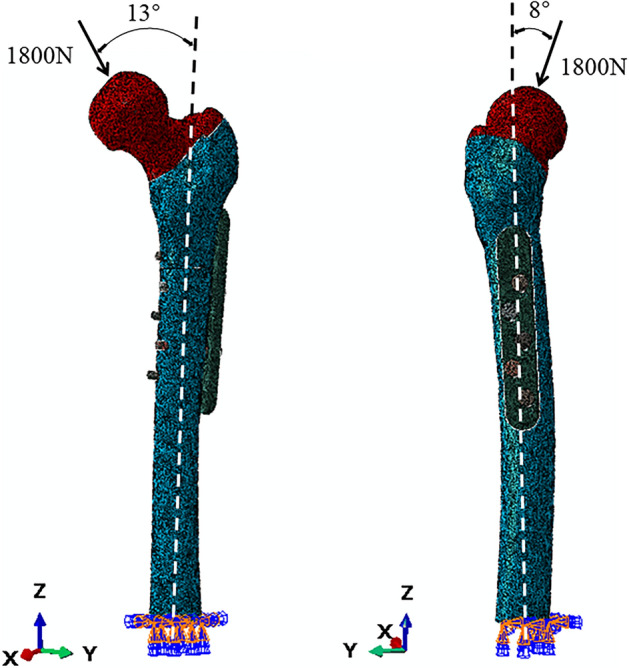
To explore how the thickness of the femoral lateral wall influences the effectiveness of internal fixation systems used to treat intertrochanteric fractures. CT images of the pelvis and femur of a male adult were used to construct an intertrochanteric fracture model (AO/OTA 31-A2) with various thicknesses of the femoral lateral wall (FLW). Four finite element (FE) models were created with the lateral femoral walls being 10 mm, 20 mm, 30 mm, and 40 mm thick. The fracture models were fixed with a dynamic hip screw (DHS), a proximal femoral nail anti-rotation (PFNA), and a proximal femoral locking compression plate (P-FLCP). A simulated vertical load was applied to the femoral head. The stress and displacement of the implant and femur in each model were recorded for comparison. The FE analysis of the intertrochanteric fracture models showed that the PFNA system could provide better stability than the DHS and P-FLCP with the same thickness of FLW. The FLW provided buttress support to the femoral head and neck when using a DHS and PFNA, and the buttress strength was proportional to the thickness of FLW. The maximum stress in the DHS model was recorded on the DHS plate which accommodated the lag screw. For the PFNA model, the maximum stress appeared at the connection between the nail and blade. In the P-FLCP model, the maximum stresses were highly concentrated at the connection between the cephalic nails and the proximal plate. The thickness of the femoral lateral wall should be considered an important factor when selecting a suitable internal fixation system for intertrochanteric fractures. Based on the FE analysis, intramedullary fixation, such as PFNA, experiences lower stress levels and a moderate displacement in comparison to DHS and P-FCLP when used to treat intertrochanteric fractures.
探讨股骨外侧壁厚度如何影响治疗股骨转子间骨折的内固定系统的有效性。使用成年男性骨盆和股骨的 CT 图像构建了具有不同股骨外侧壁(FLW)厚度的股骨转子间骨折模型(AO/OTA 31-A2)。创建了四个有限元(FE)模型,其外侧股骨壁分别为 10mm、20mm、30mm 和 40mm。使用动力髋螺钉(DHS)、股骨近端钉抗旋(PFNA)和股骨近端锁定加压板(P-FLCP)固定骨折模型。在股骨头施加模拟垂直载荷。记录每个模型中植入物和股骨的应力和位移以进行比较。股骨转子间骨折模型的 FE 分析表明,在相同的 FLW 厚度下,PFNA 系统比 DHS 和 P-FLCP 能提供更好的稳定性。当使用 DHS 和 PFNA 时,FLW 为股骨头和颈提供支撑,支撑强度与 FLW 的厚度成正比。DHS 模型中的最大应力记录在容纳拉力螺钉的 DHS 板上。对于 PFNA 模型,最大应力出现在钉和刀片之间的连接处。在 P-FLCP 模型中,最大应力高度集中在头钉和近端板之间的连接处。在选择适合股骨转子间骨折的内固定系统时,股骨外侧壁的厚度应被视为一个重要因素。基于 FE 分析,与 DHS 和 P-FCLP 相比,髓内固定(如 PFNA)在治疗股骨转子间骨折时,其应力水平较低,位移适中。