Department of Epidemiology of Infectious Diseases, Faculty of Pharmacy, Malaria Research and Training Center (MRTC), University of Sciences, Techniques and Technologies of Bamako, Environnement, Santé, Sociétés (USTTB/UCAD/UGB/CNRST/CNRS), BP 1805, IRL 3189, Bamako, Mali.
IHPE, University Montpellier, CNRS, Ifremer, University Perpignan Via Domitia, Perpignan, France.
Parasit Vectors. 2023 Aug 4;16(1):263. doi: 10.1186/s13071-023-05860-8.
Although schistosomiasis is a public health issue in Mali, little is known about the parasite genetic profile. The purpose of this study was to analyze the genetic profile of the schistosomes of Schistosoma haematobium group in school-aged children in various sites in Mali.
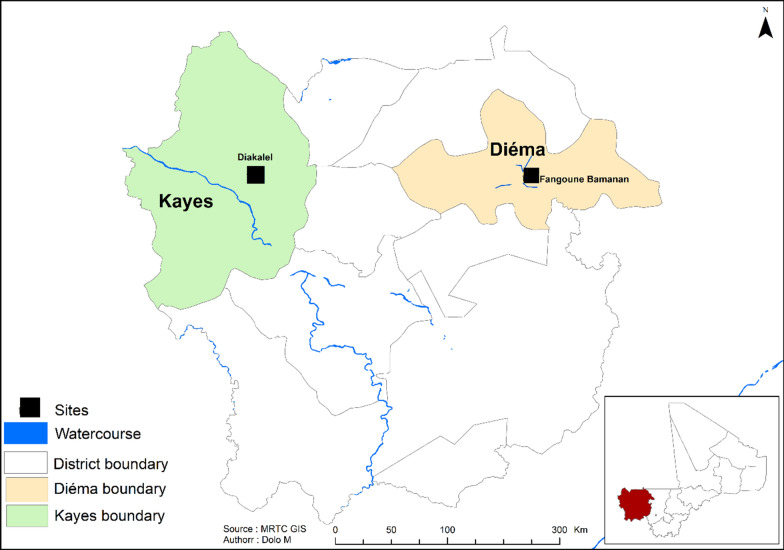
Urine samples were collected from 7 to 21 November 2021 and subjected to a filtration method for the presence S. haematobium eggs. The study took place in two schistosomiasis endemic villages (Fangouné Bamanan and Diakalèl), qualified as hotspots according to the World Health Organization (WHO) definition. Molecular genotyping on both Cox1 and ITS2/18S was used for eggs' taxonomic assignation.
A total of 970 miracidia were individually collected from 63 school-aged children and stored on Whatman FTA cards for molecular analysis. After genotyping 42.0% (353/840) and 58.0% (487/840) of miracidia revealed Schistosoma bovis and S. haematobium Cox1 profiles, respectively; 95.7 (885/925) and 4.3% (40/925) revealed S. haematobium and S. haematobium/S. curassoni profiles for ITS/18S genes, respectively. There was a significant difference in the Cox1 and ITS2/18S profile distribution according to the village (P < 0.0001). Overall, 45.6% (360/789) were hybrids, of which 72.0% (322/447) were from Diakalèl. Three hybrids' profiles (Sb/Sc_ShxSc with 2.3%; Sb/Sc_ShxSh with 40.5%; Sh_ShxSc with 2.8%) and one pure profile (Sh_ShxSh with 54.4%) were identified.
Our findings show, for the first time to our knowledge, high prevalence of hybrid schistosomes in Mali. More studies are needed on population genetics of schistosomes at the human and animal interface to evaluate the parasite's gene flow and its consequences on epidemiology of the disease as well as the transmission to humans.
尽管血吸虫病是马里的一个公共卫生问题,但对寄生虫的遗传特征知之甚少。本研究旨在分析马里不同地点学龄儿童感染的曼氏血吸虫组的血吸虫的遗传特征。
2021 年 11 月 7 日至 21 日收集尿液样本,并采用过滤法检查曼氏血吸虫卵。研究在两个被世界卫生组织(WHO)定义为热点的血吸虫病流行村庄(Fangouné Bamanan 和 Diakalèl)进行。对 Cox1 和 ITS2/18S 进行分子基因分型,用于卵的分类归属。
从 63 名学龄儿童中总共单独收集了 970 尾尾蚴,并储存在 Whatman FTA 卡上进行分子分析。对 42.0%(353/840)和 58.0%(487/840)的尾蚴 Cox1 基因进行基因分型,分别显示为牛血吸虫和曼氏血吸虫 Cox1 图谱;95.7%(885/925)和 4.3%(40/925)显示为曼氏血吸虫和曼氏血吸虫/库氏血吸虫 ITS/18S 图谱。根据村庄,Cox1 和 ITS2/18S 图谱分布存在显著差异(P<0.0001)。总体而言,45.6%(360/789)为杂种,其中 72.0%(322/447)来自 Diakalèl。鉴定出 3 种杂种图谱(Sb/Sc_ShxSc 为 2.3%;Sb/Sc_ShxSh 为 40.5%;Sh_ShxSc 为 2.8%)和 1 种纯合图谱(Sh_ShxSh 为 54.4%)。
我们的研究结果首次表明,马里的杂交血吸虫病发病率很高。需要进一步研究人类和动物接触点的血吸虫种群遗传学,以评估寄生虫的基因流及其对疾病流行病学以及向人类传播的影响。