Hemrungrojn Solaphat, Tangwongchai Sookjaroen, Charernboon Thammanard, Phanasathit Muthita, Chaipresertsud Pisit, Maleevach Pacharaporn, Likitjaroen Yuttachai, Phanthumchinda Kammant, Assawatinna Ratiya, Amrapala Arisara, Maes Michael
Department of Psychiatry, Faculty of Medicine, Chulalongkorn University and King Chulalongkorn Memorial Hospital, the Thai Red Cross Society, Bangkok, Thailand.
Cognitive Fitness and Biopsychiatry Technology Research Unit, Faculty of Medicine, Chulalongkorn University, Bangkok, Thailand.
Front Neurol. 2023 Jul 20;14:1194917. doi: 10.3389/fneur.2023.1194917. eCollection 2023.
The purpose of this study was to (1) validate the Thai version of the Neuropsychiatric Inventory Questionnaire (NPI-Q) as a screening tool for behavioral and psychological symptoms of dementia (BPSD), and (2) examine the relationship between cognitive performance and BPSD in an elderly population with amnestic mild cognitive impairment (aMCI) and dementia of Alzheimer's type (DAT).
One hundred and twenty participants, comprising 80 aMCI and 40 DAT patients, and their respective caregivers were included in the study. Participants completed the NPI-Q and the Neuropsychiatric Inventory (NPI) within 2 weeks of each other and cognitive performance was primarily assessed using the Montreal Cognitive Assessment (MoCA).
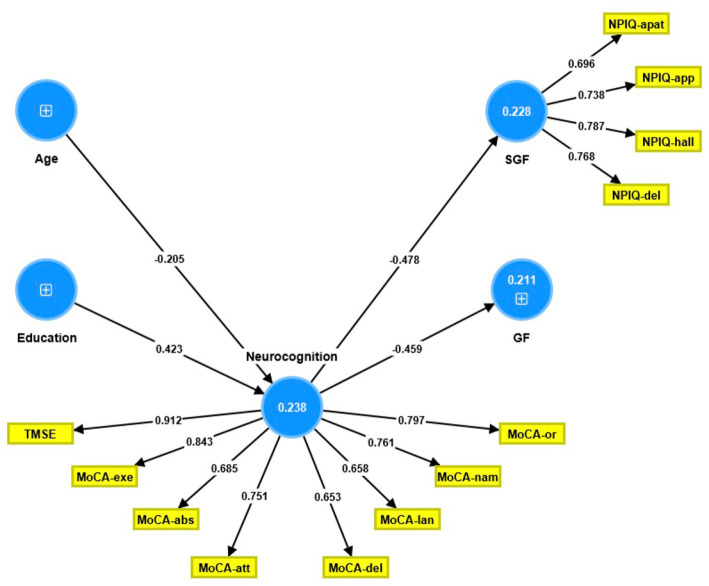
The Thai NPI-Q had good validity and reliability. Pure exploratory bifactor analysis revealed that a general factor and a single-group factor (with high loadings on delusions, hallucinations, apathy, and appetite) underpinned the NPI-Q domains. Significant negative correlations between the MoCA total score and the general and single-group NPI-Q scores were found in all subjects (aMCI + DAT combined) and DAT alone, but not in aMCI. Cluster analysis allocated subjects with BPSD (10% of aMCI and 50% of DAT participants) into a distinct "DAT + BPSD" class.
The NPI-Q is an appropriate instrument for assessing BPSD and the total score is largely predicted by cognitive deficits. It is plausible that aMCI subjects with severe NPI-Q symptoms (10% of our sample) may have a poorer prognosis and constitute a subgroup of aMCI patients who will likely convert into probable dementia.
本研究的目的是:(1)验证泰语版的神经精神症状问卷(NPI-Q)作为痴呆行为和心理症状(BPSD)的筛查工具;(2)研究遗忘型轻度认知障碍(aMCI)和阿尔茨海默病型痴呆(DAT)老年人群中认知表现与BPSD之间的关系。
本研究纳入了120名参与者,包括80名aMCI患者和40名DAT患者及其各自的照料者。参与者在两周内先后完成NPI-Q和神经精神症状量表(NPI),认知表现主要通过蒙特利尔认知评估量表(MoCA)进行评估。
泰语版NPI-Q具有良好的效度和信度。单纯探索性双因素分析显示,一个一般因素和一个单组因素(在妄想、幻觉、淡漠和食欲方面负荷较高)构成了NPI-Q各领域的基础。在所有受试者(aMCI+DAT合并组)和单独的DAT组中,MoCA总分与NPI-Q一般因素和单组因素得分之间存在显著负相关,但在aMCI组中未发现。聚类分析将有BPSD的受试者(10%的aMCI参与者和50%的DAT参与者)归为一个独特的“DAT+BPSD”类别。
NPI-Q是评估BPSD的合适工具,总分很大程度上由认知缺陷预测。有严重NPI-Q症状的aMCI受试者(占我们样本的10%)预后可能较差,可能构成aMCI患者中可能转化为很可能痴呆的一个亚组。