Cairo University Faculty of Physical Therapy, Department of physical therapy for Surgery.
Jouf University College of Applied Medical Science.
Afr Health Sci. 2023 Mar;23(1):575-583. doi: 10.4314/ahs.v23i1.60.
Coccydynia is a challenging disorder that is frequently managed conservatively.
This study aimed to evaluate the efficacy of adding kinesiotaping versus pelvic floor exercise to conventional therapy in the management of post-colonoscopy coccydynia.
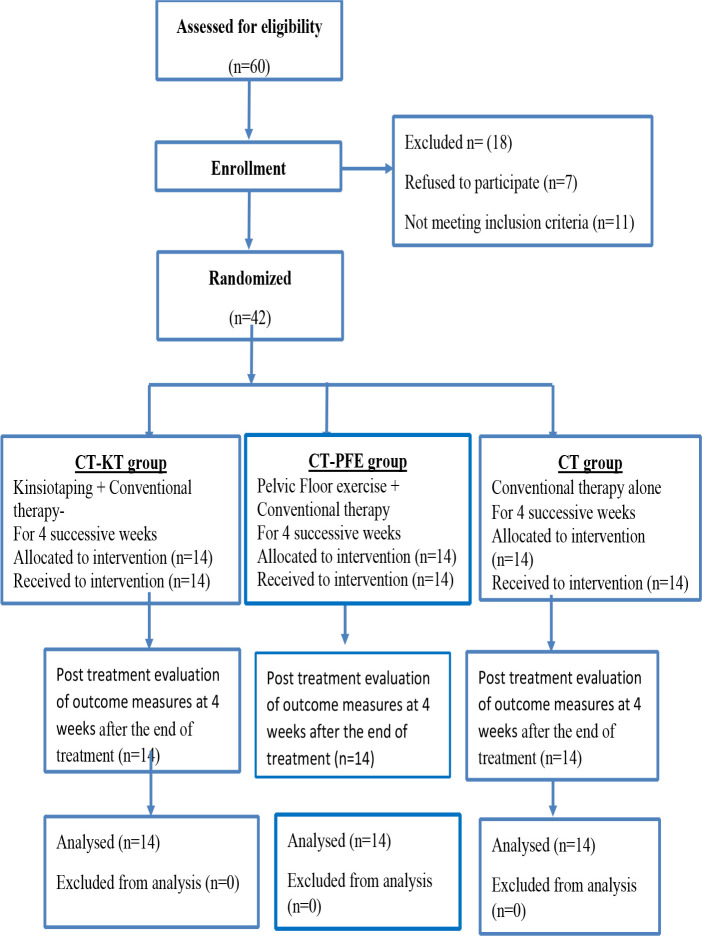
Forty-two participants, aged 25-45 years, were randomly assigned to: the conventional therapy group (CT) receiving Piriformis and Iliopsoas muscle stretching exercise, clamshell exercise, and seat cushioning; the CT plus kinesiotaping group (CT-KT) receiving additional kinesiotaping; or the CT plus pelvic floor exercise (PFE) group (CT-PFE) executing additional PFE. All groups completed 4 weeks of training, 3 days a week. Pain intensity, assessed by the Pain Numeric Rating Scale (PNRS), and functional disability, evaluated by the Oswestry Disability Index (ODI), were estimated at baseline and after 4 weeks.
There were significant inter-group variations in PNRS and ODI, where (P = 0.0001) and (P = 0.03), respectively. Differences between experimental groups were noteworthy in terms of NPRS, where the major change was in favor of group CT-KT (P = 0.001). However, there was no significant difference between them regarding their impact on ODI.
CT-KT is more effective than CT-PFE in reducing pain associated with coccydynia post-colonoscopy, but there is no difference in their effects on functional disability. CT-KT is therefore recommended as an alternative treatment option for post-colonoscopy coccydynia.
尾痛症是一种具有挑战性的疾病,通常采用保守治疗。
本研究旨在评估在常规治疗的基础上增加运动贴布疗法与骨盆底运动对结肠镜检查后尾痛症的疗效。
42 名 25-45 岁的参与者被随机分配到以下三组:常规治疗组(CT)接受梨状肌和髂腰肌拉伸运动、蚌式运动和坐垫;CT 加运动贴布疗法组(CT-KT)接受额外的运动贴布疗法;或 CT 加骨盆底运动组(CT-PFE)执行额外的骨盆底运动。所有组均完成 4 周的训练,每周 3 天。在基线和 4 周后评估疼痛强度(疼痛数字评分量表 [PNRS])和功能障碍(Oswestry 残疾指数 [ODI])。
PNRS 和 ODI 存在显著的组间差异(P = 0.0001)和(P = 0.03)。在 PNRS 方面,实验组之间的差异显著,其中 CT-KT 组的变化最大(P = 0.001)。然而,在 ODI 方面,它们的影响没有显著差异。
与 CT-PFE 相比,CT-KT 更能有效减轻结肠镜检查后尾痛症相关的疼痛,但对功能障碍的影响没有差异。因此,CT-KT 被推荐作为结肠镜检查后尾痛症的替代治疗选择。