Newborn Intensive Care Unit, Faculty of Pediatrics, The Seventh Medical Center of Chinese People's Liberation Army (CPLA) General Hospital, Beijing, China.
The Second School of Clinical Medicine, Southern Medical University, Guangzhou, China.
Front Public Health. 2023 Jul 20;11:1191941. doi: 10.3389/fpubh.2023.1191941. eCollection 2023.
To determine the COVID-19 vaccination rate in preterm-born children aged 3-7 in China and influential factors, identify vaccination-related adverse reactions, and clarify reasons behind parental refusal of vaccination to their children.
This cross-sectional study was conducted in parents of preterm-born children aged 3-7 in different regions of China through WeChat.
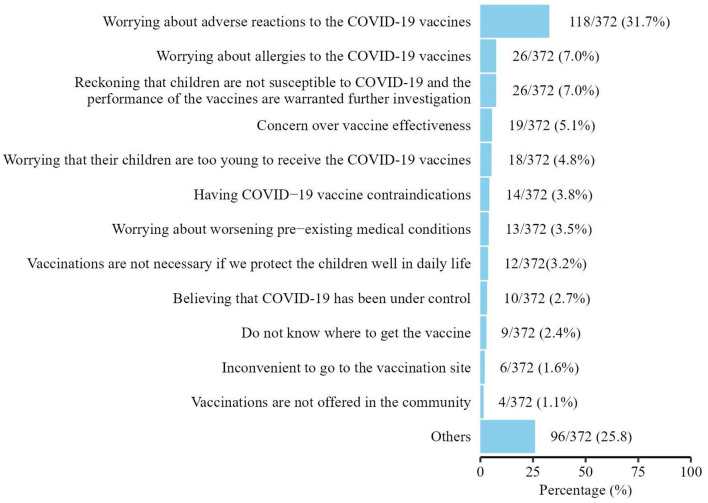
Of 1,924 Chinese preterm-born children aged 3-7 included in this study, 1,552 (80.7%) had been vaccinated against COVID-19, with a higher vaccination rate in eastern China. Children older than 4 years, kids in kindergartens and primary schools, children living in eastern or western China, and children whose fathers had received at least one dose of a COVID-19 vaccine tended to be vaccinated against COVID-19 after adjusting for other covariates. Conversely, children living in urban areas, children whose annual family income was < 50,000 CNY or more than 300,000 CNY, premature children who underwent hospital transfers, and children with underlying diseases were less likely to get vaccinated. Adverse reactions occurred in 59/1,552 (3.8%) vaccinated children. Parents of 118/372 (31.7%) children expressed their concerns over adverse reactions to COVID-19 vaccination. Other reasons like the absence of information about the place where they could get vaccination were mentioned as well.
COVID-19 vaccination-related adverse reactions rarely occurred and most of them were mild among preterm-born children aged 3-7. Higher vaccination coverage can be achieved as parents are provided with more scientific data about benefits of vaccination, vaccination contraindications and precautions, and more information about vaccination sites.
了解中国 3-7 岁早产儿 COVID-19 疫苗接种率及影响因素,识别疫苗相关不良反应,阐明家长拒绝为子女接种疫苗的原因。
本横断面研究通过微信调查了来自中国不同地区的 3-7 岁早产儿的家长。
共纳入 1924 名 3-7 岁中国早产儿,其中 1552 名(80.7%)接种过 COVID-19 疫苗,东部地区的接种率较高。调整其他协变量后,年龄>4 岁、在幼儿园和小学就读、居住在东部或西部、父亲至少接种过 1 剂 COVID-19 疫苗的儿童更倾向于接种 COVID-19 疫苗。相反,居住在城市、家庭年收入<50000 元或>300000 元、有医院转诊史的早产儿、有基础疾病的儿童接种疫苗的可能性较低。在 1552 名接种疫苗的儿童中,有 59 名(3.8%)出现不良反应。372 名儿童的家长(31.7%)对 COVID-19 疫苗接种的不良反应表示担忧。此外,还有一些其他原因,如缺乏接种地点的信息。
3-7 岁早产儿接种 COVID-19 疫苗相关不良反应少见,且大多为轻度。为家长提供更多关于疫苗接种益处、禁忌证和注意事项的科学数据,以及更多关于接种地点的信息,可提高接种率。