• 文献检索
  • 文档翻译
  • 深度研究
  • 学术资讯
  • Suppr Zotero 插件Zotero 插件
  • 邀请有礼
  • 套餐&价格
  • 历史记录
应用&插件
Suppr Zotero 插件Zotero 插件浏览器插件Mac 客户端Windows 客户端微信小程序
定价
高级版会员购买积分包购买API积分包
服务
文献检索文档翻译深度研究API 文档MCP 服务
关于我们
关于 Suppr公司介绍联系我们用户协议隐私条款
关注我们

Suppr 超能文献

核心技术专利:CN118964589B侵权必究
粤ICP备2023148730 号-1Suppr @ 2026

文献检索

告别复杂PubMed语法,用中文像聊天一样搜索,搜遍4000万医学文献。AI智能推荐,让科研检索更轻松。

立即免费搜索

文件翻译

保留排版,准确专业,支持PDF/Word/PPT等文件格式,支持 12+语言互译。

免费翻译文档

深度研究

AI帮你快速写综述,25分钟生成高质量综述,智能提取关键信息,辅助科研写作。

立即免费体验

基于计划复杂性的机器学习模型在调强放射治疗剂量验证中伽马通过率预测的研究

Study of the prediction of gamma passing rate in dosimetric verification of intensity-modulated radiotherapy using machine learning models based on plan complexity.

作者信息

Bin Shizhen, Zhang Ji, Shen Luyao, Zhang Junjun, Wang Qi

机构信息

Radiotherapy Center, Third Xiangya Hospital of Central South University, Changsha, China.

Radiotherapy Center, The Central Hospital of Shaoyang, Shaoyang, China.

出版信息

Front Oncol. 2023 Jul 21;13:1094927. doi: 10.3389/fonc.2023.1094927. eCollection 2023.

DOI:10.3389/fonc.2023.1094927
PMID:37546404
原文链接:https://pmc.ncbi.nlm.nih.gov/articles/PMC10401596/
Abstract

OBJECTIVE

To predict the gamma passing rate (GPR) in dosimetric verification of intensity-modulated radiotherapy (IMRT) using three machine learning models based on plan complexity and find the best prediction model by comparing and evaluating the prediction ability of the regression and classification models of three classical algorithms: artificial neural network (ANN), support vector machine (SVM) and random forest (RF).

MATERIALS AND METHODS

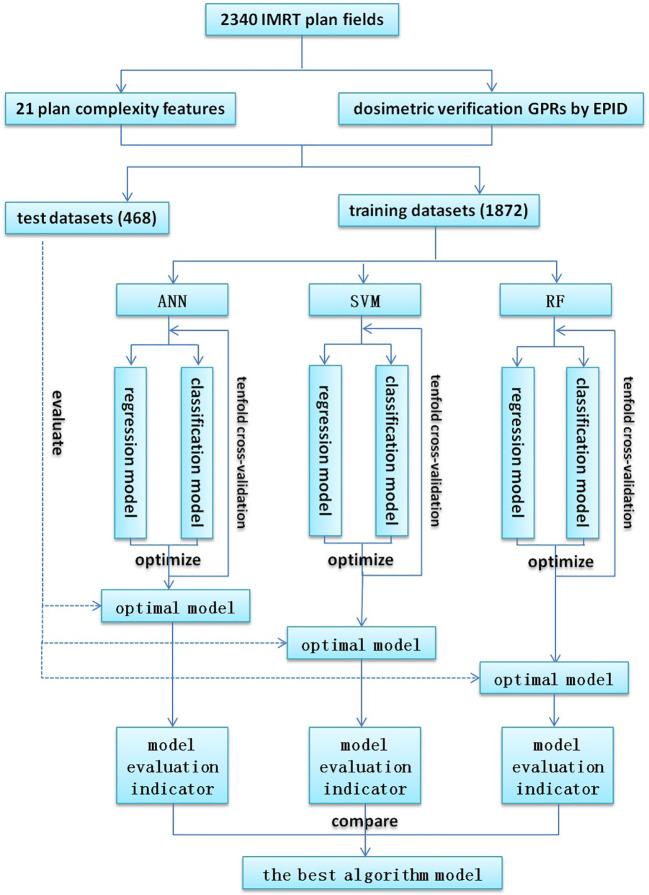
269 clinical IMRT plans were chosen retrospectively and the GPRs of a total of 2340 fields by the 2%/2mm standard at the threshold of 10% were collected for dosimetric verification using electronic portal imaging device (EPID). Subsequently, the plan complexity feature values of each field were extracted and calculated, and a total of 6 machine learning models (classification and regression models for three algorithms) were trained to learn the relation between 21 plan complexity features and GPRs. Each model was optimized by tuning the hyperparameters and ten-fold cross validation. Finally, the GPRs predicted by the model were compared with measured values to verify the accuracy of the model, and the evaluation indicators were applied to evaluate each model to find the algorithm with the best prediction performance.

RESULTS

The RF algorithm had the optimal prediction effect on GPR, and its mean absolute error (MAE) on the test set was 1.81%, root mean squared error (RMSE) was 2.14%, and correlation coefficient (CC) was 0.72; SVM was the second and ANN was the worst. Among the classification models, the RF algorithm also had the optimal prediction performance with the highest area under the curve (AUC) value of 0.80, specificity and sensitivity of 0.80 and 0.68 respectively, followed by SVM and the worst ANN.

CONCLUSION

All the three classic algorithms, ANN, SVM, and RF, could realize the prediction and classification of GPR. The RF model based on plan complexity had the optimal prediction performance which could save valuable time for quality control workers to improve quality control efficiency.

摘要

目的

使用基于计划复杂度的三种机器学习模型预测调强放射治疗(IMRT)剂量验证中的伽马通过率(GPR),并通过比较和评估三种经典算法(人工神经网络(ANN)、支持向量机(SVM)和随机森林(RF))的回归和分类模型的预测能力,找出最佳预测模型。

材料与方法

回顾性选取269个临床IMRT计划,使用电子射野影像装置(EPID)收集总共2340个射野在10%阈值下按2%/2mm标准的GPR,用于剂量验证。随后,提取并计算每个射野的计划复杂度特征值,训练总共6个机器学习模型(三种算法的分类和回归模型),以学习21个计划复杂度特征与GPR之间的关系。通过调整超参数和十折交叉验证对每个模型进行优化。最后,将模型预测的GPR与测量值进行比较,验证模型的准确性,并应用评估指标评估每个模型,以找出预测性能最佳的算法。

结果

RF算法对GPR的预测效果最佳,其在测试集上的平均绝对误差(MAE)为1.81%,均方根误差(RMSE)为2.14%,相关系数(CC)为0.72;SVM次之;ANN最差。在分类模型中,RF算法的预测性能也最佳,曲线下面积(AUC)值最高,为0.80,特异性和敏感性分别为0.80和0.68,其次是SVM,ANN最差。

结论

ANN、SVM和RF这三种经典算法均能实现GPR的预测和分类。基于计划复杂度的RF模型具有最佳的预测性能,可为质量控制人员节省宝贵时间,提高质量控制效率。

https://cdn.ncbi.nlm.nih.gov/pmc/blobs/5343/10401596/0cac6797e912/fonc-13-1094927-g005.jpg
https://cdn.ncbi.nlm.nih.gov/pmc/blobs/5343/10401596/df48c71b777d/fonc-13-1094927-g001.jpg
https://cdn.ncbi.nlm.nih.gov/pmc/blobs/5343/10401596/65c75e1323cc/fonc-13-1094927-g002.jpg
https://cdn.ncbi.nlm.nih.gov/pmc/blobs/5343/10401596/e60e0fd60ca7/fonc-13-1094927-g003.jpg
https://cdn.ncbi.nlm.nih.gov/pmc/blobs/5343/10401596/c0db03ce0552/fonc-13-1094927-g004.jpg
https://cdn.ncbi.nlm.nih.gov/pmc/blobs/5343/10401596/0cac6797e912/fonc-13-1094927-g005.jpg
https://cdn.ncbi.nlm.nih.gov/pmc/blobs/5343/10401596/df48c71b777d/fonc-13-1094927-g001.jpg
https://cdn.ncbi.nlm.nih.gov/pmc/blobs/5343/10401596/65c75e1323cc/fonc-13-1094927-g002.jpg
https://cdn.ncbi.nlm.nih.gov/pmc/blobs/5343/10401596/e60e0fd60ca7/fonc-13-1094927-g003.jpg
https://cdn.ncbi.nlm.nih.gov/pmc/blobs/5343/10401596/c0db03ce0552/fonc-13-1094927-g004.jpg
https://cdn.ncbi.nlm.nih.gov/pmc/blobs/5343/10401596/0cac6797e912/fonc-13-1094927-g005.jpg

相似文献

1
Study of the prediction of gamma passing rate in dosimetric verification of intensity-modulated radiotherapy using machine learning models based on plan complexity.基于计划复杂性的机器学习模型在调强放射治疗剂量验证中伽马通过率预测的研究
Front Oncol. 2023 Jul 21;13:1094927. doi: 10.3389/fonc.2023.1094927. eCollection 2023.
2
Improvement of prediction and classification performance for gamma passing rate by using plan complexity and dosiomics features.利用计划复杂度和剂量学特征提高伽马通过率的预测和分类性能。
Radiother Oncol. 2020 Dec;153:250-257. doi: 10.1016/j.radonc.2020.07.031. Epub 2020 Jul 23.
3
Machine learning-based ensemble prediction model for the gamma passing rate of VMAT-SBRT plan.基于机器学习的 VMAT-SBRT 计划伽马通过率的综合预测模型。
Phys Med. 2024 Jan;117:103204. doi: 10.1016/j.ejmp.2023.103204. Epub 2023 Dec 27.
4
Detecting MLC modeling errors using radiomics-based machine learning in patient-specific QA with an EPID for intensity-modulated radiation therapy.利用基于放射组学的机器学习在 EPID 用于调强放射治疗的个体化 QA 中检测 MLC 建模误差。
Med Phys. 2021 Mar;48(3):991-1002. doi: 10.1002/mp.14699. Epub 2021 Jan 27.
5
Predicting gamma passing rates for portal dosimetry-based IMRT QA using machine learning.使用机器学习预测基于门控剂量学的调强放射治疗 QA 的伽马通过率。
Med Phys. 2019 Oct;46(10):4666-4675. doi: 10.1002/mp.13752. Epub 2019 Aug 27.
6
Evaluation of prediction and classification performances in different machine learning models for patient-specific quality assurance of head-and-neck VMAT plans.不同机器学习模型对头颈部 VMAT 计划个体化质量保证预测和分类性能的评估。
Med Phys. 2022 Jan;49(1):727-741. doi: 10.1002/mp.15393. Epub 2021 Dec 13.
7
Prediction of patient-specific quality assurance for volumetric modulated arc therapy using radiomics-based machine learning with dose distribution.使用基于剂量分布的放射组学机器学习预测容积调强弧形治疗的个体化质量保证。
J Appl Clin Med Phys. 2024 Jan;25(1):e14215. doi: 10.1002/acm2.14215. Epub 2023 Nov 21.
8
Pretreatment patient-specific quality assurance prediction based on 1D complexity metrics and 3D planning dose: classification, gamma passing rates, and DVH metrics.基于 1D 复杂度指标和 3D 计划剂量的预处理患者特异性质量保证预测:分类、伽马通过率和剂量体积直方图指标。
Radiat Oncol. 2023 Nov 20;18(1):192. doi: 10.1186/s13014-023-02376-4.
9
Patient-specific quality assurance prediction models based on machine learning for novel dual-layered MLC linac.基于机器学习的新型双层 MLC 直线加速器的个体化质量保证预测模型。
Med Phys. 2023 Feb;50(2):1205-1214. doi: 10.1002/mp.16091. Epub 2022 Nov 25.
10
Machine Learning for Patient-Specific Quality Assurance of VMAT: Prediction and Classification Accuracy.基于机器学习的 VMAT 个体化质量保证:预测和分类准确性。
Int J Radiat Oncol Biol Phys. 2019 Nov 15;105(4):893-902. doi: 10.1016/j.ijrobp.2019.07.049. Epub 2019 Aug 1.

引用本文的文献

1
Enhancing patient-specific quality assurance for VMAT for breast cancer treatment: A machine learning approach for gamma passing rate (GPR) prediction.提高乳腺癌治疗VMAT的患者特异性质量保证:一种用于伽马通过率(GPR)预测的机器学习方法。
J Appl Clin Med Phys. 2025 Sep;26(9):e70251. doi: 10.1002/acm2.70251.
2
Impact of ovary-sparing treatment planning on plan quality, treatment time and gamma passing rates in intensity-modulated radiotherapy for stage I/II cervical cancer.保留卵巢的治疗计划对Ⅰ/Ⅱ期宫颈癌调强放疗计划质量、治疗时间和伽马通过率的影响。
Medicine (Baltimore). 2023 Dec 15;102(50):e36373. doi: 10.1097/MD.0000000000036373.

本文引用的文献

1
Improvement of IMRT QA prediction using imaging-based neural architecture search.基于影像的神经架构搜索提高调强放疗 QA 预测
Med Phys. 2022 Aug;49(8):5236-5243. doi: 10.1002/mp.15694. Epub 2022 May 15.
2
Quality assurance-based optimization (QAO): Towards improving patient-specific quality assurance in volumetric modulated arc therapy plans using machine learning.基于质量保证的优化(QAO):利用机器学习提高容积调强弧形治疗计划中患者特异性质量保证的方法。
Phys Med. 2021 Jul;87:136-143. doi: 10.1016/j.ejmp.2021.03.017. Epub 2021 Mar 26.
3
Convolutional neural networks in medical image understanding: a survey.
医学图像理解中的卷积神经网络:一项综述。
Evol Intell. 2022;15(1):1-22. doi: 10.1007/s12065-020-00540-3. Epub 2021 Jan 3.
4
Detecting MLC modeling errors using radiomics-based machine learning in patient-specific QA with an EPID for intensity-modulated radiation therapy.利用基于放射组学的机器学习在 EPID 用于调强放射治疗的个体化 QA 中检测 MLC 建模误差。
Med Phys. 2021 Mar;48(3):991-1002. doi: 10.1002/mp.14699. Epub 2021 Jan 27.
5
The structural similarity index for IMRT quality assurance: radiomics-based error classification.用于调强放疗质量保证的结构相似性指数:基于放射组学的误差分类。
Med Phys. 2021 Jan;48(1):80-93. doi: 10.1002/mp.14559. Epub 2020 Nov 27.
6
Improvement of prediction and classification performance for gamma passing rate by using plan complexity and dosiomics features.利用计划复杂度和剂量学特征提高伽马通过率的预测和分类性能。
Radiother Oncol. 2020 Dec;153:250-257. doi: 10.1016/j.radonc.2020.07.031. Epub 2020 Jul 23.
7
Prediction of the individual multileaf collimator positional deviations during dynamic IMRT delivery priori with artificial neural network.运用人工神经网络预测动态调强放射治疗过程中多叶准直器的个体位置偏差。
Med Phys. 2020 Apr;47(4):1421-1430. doi: 10.1002/mp.14014. Epub 2020 Jan 30.
8
Use of metrics to quantify IMRT and VMAT treatment plan complexity: A systematic review and perspectives.使用指标量化调强放疗和容积旋转调强治疗计划的复杂性:系统评价与观点。
Phys Med. 2019 Aug;64:98-108. doi: 10.1016/j.ejmp.2019.05.024. Epub 2019 Jul 9.
9
Predicting gamma passing rates for portal dosimetry-based IMRT QA using machine learning.使用机器学习预测基于门控剂量学的调强放射治疗 QA 的伽马通过率。
Med Phys. 2019 Oct;46(10):4666-4675. doi: 10.1002/mp.13752. Epub 2019 Aug 27.
10
Machine Learning for Patient-Specific Quality Assurance of VMAT: Prediction and Classification Accuracy.基于机器学习的 VMAT 个体化质量保证:预测和分类准确性。
Int J Radiat Oncol Biol Phys. 2019 Nov 15;105(4):893-902. doi: 10.1016/j.ijrobp.2019.07.049. Epub 2019 Aug 1.