Lin Weiyin, Wang Xicheng, Zhang Jianbo, Wen Chunyan, Kang Wen, Mao Lin, Yang Jie, Dou Yanyun, Shi Liying, Dang Bianli, Lan Yun, Li Hong, Li Yonghong, Chen Xiejie, He Haolan, Xu Min, He Yaozu, Hu Fengyu, Lu Ruichao, Cai Weiping, Li Linghua
Guangzhou Eighth People's Hospital, Guangzhou Medical University, Guangzhou, Guangdong, China.
Yunnan Provincial Infectious Disease Hospital, Kunming, Yunnan, China.
Lancet Reg Health West Pac. 2023 Mar 25;36:100749. doi: 10.1016/j.lanwpc.2023.100749. eCollection 2023 Jul.
The direct-acting antiviral agents (DAAs) have revolutionized the treatment of Hepatitis C Virus (HCV) infection. However, a simple and feasible treatment strategy with high efficacy and safety for HCV in patients coinfected with Human Immunodeficiency Virus (HIV) remains an unmet medical need, especially in areas with limited health resource. This study aims to assess the efficacy and safety of 12 weeks of treatment with sofosbuvir and velpatasvir in patients with chronic HCV/HIV-1 coinfection.
We conducted a multicenter, single-arm, open-label study in China, which involved chronic HCV/HIV-1 coinfected patients who are receiving an antiretroviral regimen of a combination tablet consisting of elvitegravir, cobicistat, emtricitabine, tenofovir alafenamide, (EVG/c/FTC/TAF) once daily. Patients with liver cirrhosis or experienced to DAAs treatment were excluded. All patients received combined sofosbuvir (400 mg) and velpatasvir (100 mg) tablet once daily for 12 weeks regardless of HCV genotype. The primary efficacy endpoint was sustained virologic response, defined as HCV RNA <15 IU/mL at 12 weeks after completion of treatment (SVR12). The primary safety endpoint was the proportion of patients who prematurely discontinued treatment because of adverse events. Safety and efficacy data were analyzed with an intention-to-treat (ITT) population (last observation carried forward) and per-protocol (PP) population. This trial is registered on ChiCTR.org.cn with number being ChiCTR1800020246.
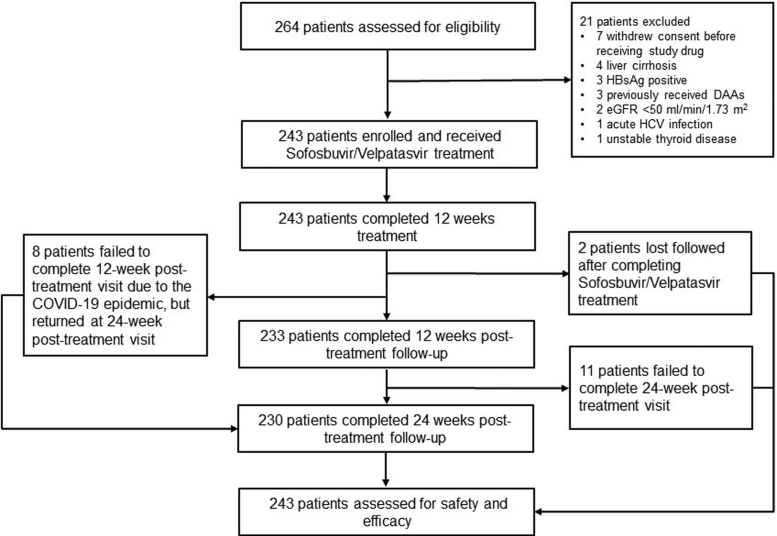
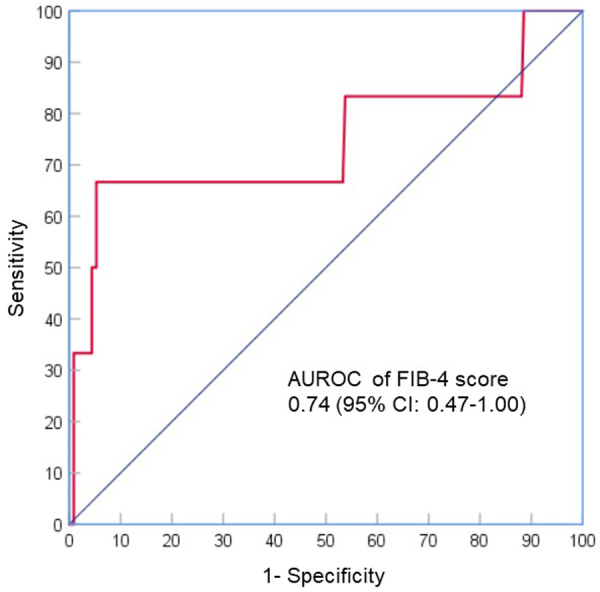
Of the 243 patients enrolled, 78% were male, 9% had been previously treated for HCV with interferon, and none had pre-defined cirrhosis, although 8% had Fibrosis 4 score (FIB-4) >3.25. A total of 233 patients completed 12-week post-treatment follow-up. Overall, 227/233 patients (97%) achieved SVR12: 100% (63/63) in those with HCV genotype 1, 67% (2/3) in those with genotype 2, 95% (84/88) in those with genotype 3, 99% (78/79) in those with genotype 6. Rates of SVR12 were lower among those with baseline FIB-4 >3.25 than those without (78% [14/18] vs. 99% [211/212], P < 0.001). HIV-1 suppression was not compromised. The most common adverse events were upper respiratory tract infection (5%), cough (3%), abnormal renal function (2%), abnormal liver function (2%), constipation (2%), urinary tract infection (2%) and sleep disorders (2%). No participant discontinued treatment because of adverse events or death.
Twelve weeks of treatment with sofosbuvir/velpatasvir provide high rates of SVR and is well-tolerated in patients coinfected with HIV-1 and HCV regardless of HCV genotypes. Non-invasive liver fibrosis score may help to further distinguish patients at greater likelihood of a suboptimal response.
The 13th Five Year Plan of the Ministry of Science and Technology of China for the prevention and treatment of major infectious diseases such as AIDS and viral hepatitis, the National Key Research and Development Program of China, Medical Key Discipline Program of Guangzhou-Viral Infectious Diseases (2021-2023), Basic research program on people's Livelihood Science and technology of Guangzhou, and National Natural Science Foundation of China.
直接抗病毒药物(DAAs)彻底改变了丙型肝炎病毒(HCV)感染的治疗方式。然而,对于合并人类免疫缺陷病毒(HIV)感染的HCV患者,一种简单可行、高效且安全的治疗策略仍是未被满足的医疗需求,尤其是在卫生资源有限的地区。本研究旨在评估索磷布韦和维帕他韦治疗12周对慢性HCV/HIV-1合并感染患者的疗效和安全性。
我们在中国进行了一项多中心、单臂、开放标签研究,纳入正在接受由埃替拉韦、考比司他、恩曲他滨、替诺福韦艾拉酚胺组成的复方片剂(EVG/c/FTC/TAF)每日一次抗逆转录病毒治疗方案的慢性HCV/HIV-1合并感染患者。排除肝硬化患者或曾接受过DAAs治疗的患者。所有患者无论HCV基因型如何,均接受索磷布韦(400mg)和维帕他韦(100mg)联合片剂每日一次,共治疗12周。主要疗效终点为持续病毒学应答,定义为治疗完成后12周时HCV RNA<15 IU/mL(SVR12)。主要安全终点是因不良事件而提前停药的患者比例。使用意向性分析(ITT)人群(末次观察结转)和符合方案(PP)人群分析安全性和疗效数据。本试验已在中国临床试验注册中心(ChiCTR.org.cn)注册,注册号为ChiCTR1800020246。
在纳入的243例患者中,78%为男性,9%曾接受过干扰素治疗HCV,虽然8%的患者纤维化4评分(FIB-4)>3.25,但均无预先定义的肝硬化。共有233例患者完成了治疗后12周的随访。总体而言,227/233例患者(97%)实现了SVR12:HCV基因型1的患者中为100%(63/63),基因型2的患者中为67%(2/3),基因型3的患者中为95%(84/88),基因型6的患者中为99%(78/79)。基线FIB-4>3.25的患者中SVR12率低于无该情况的患者(78%[14/18]对99%[211/212],P<0.001)。HIV-1抑制未受影响。最常见的不良事件为上呼吸道感染(5%)、咳嗽(3%)、肾功能异常(2%)、肝功能异常(2%)、便秘(2%)、尿路感染(2%)和睡眠障碍(2%)。没有参与者因不良事件或死亡而停药。
索磷布韦/维帕他韦治疗12周可实现高SVR率,且在合并HIV-1和HCV感染的患者中耐受性良好,无论HCV基因型如何。非侵入性肝纤维化评分可能有助于进一步区分疗效欠佳可能性较大的患者。
中国科学技术部“十三五”艾滋病、病毒性肝炎等重大传染病防治专项、国家重点研发计划、广州市医学重点学科项目-病毒性传染病(2021-2023)、广州市民生科技基础研究项目以及国家自然科学基金。