Peitz Katharina, Stumme Johanna, Jockwitz Christiane, Bittner Nora, Caspers Svenja, Heim Stefan
Institute of Neuroscience and Medicine (INM-1), Research Center Jülich, Jülich, Germany.
Department of Psychiatry, Psychotherapy and Psychosomatics, Medical Faculty, RWTH Aachen University, Aachen, Germany.
Front Aging Neurosci. 2023 Jul 20;15:1193283. doi: 10.3389/fnagi.2023.1193283. eCollection 2023.
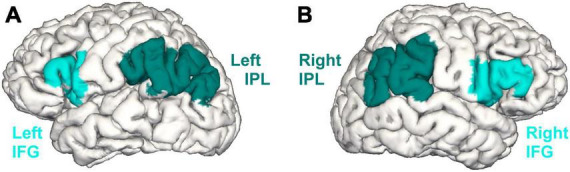
Bilingualism is associated with higher gray matter volume (GMV) as a form of brain reserve in brain regions such as the inferior frontal gyrus (IFG) and the inferior parietal lobule (IPL). A recent cross-sectional study reported the age-related GMV decline in the left IFG and IPL to be steeper for bilinguals than for monolinguals. The present study aimed at supporting this finding for the first time with longitudinal data.
In the current study, 200 participants aged 19 to 79 years (87 monolinguals, 113 sequential bilinguals, mostly native German speakers with variable second language background) were included. Trajectories of GMV decline in the bilateral IFG and IPL were analyzed in mono- and bilinguals over two time points (mean time interval: 3.6 years). For four regions of interest (left/right IFG and left/right IPL), mixed Analyses of Covariance were conducted to assess (i) GMV changes over time, (ii) GMV differences for language groups (monolinguals/bilinguals), and (iii) the interaction between time point and language group. Corresponding analyses were conducted for the two factors of GMV, surface area (SA) and cortical thickness (CT).
There was higher GMV in bilinguals compared to monolinguals in the IPL, but not IFG. While the left and right IFG and the right IPL displayed a similar GMV change in mono- and bilinguals, GMV decline within the left IPL was significantly steeper in bilinguals. There was greater SA in bilinguals in the bilateral IPL and a steeper CT decline in bilinguals within in the left IPL.
The cross-sectional observations of a steeper GMV decline in bilinguals could be confirmed for the left IPL. Additionally, the higher GMV in bilinguals in the bilateral IPL may indicate that bilingualism contributes to brain reserve especially in posterior brain regions. SA appeared to contribute to bilinguals' higher GMV in the bilateral IPL, while CT seemed to account for the steeper structural decline in bilinguals in the left IPL. The present findings demonstrate the importance of time as an additional factor when assessing the neuroprotective effects of bilingualism on structural features of the human brain.
双语与更大的灰质体积(GMV)相关,这是一种大脑储备形式,存在于诸如额下回(IFG)和顶下小叶(IPL)等脑区。最近一项横断面研究报告称,双语者左IFG和IPL中与年龄相关的GMV下降比单语者更陡峭。本研究旨在首次用纵向数据支持这一发现。
在本研究中,纳入了200名年龄在19至79岁之间的参与者(87名单语者,113名顺序双语者,大多为以德语为母语且第二语言背景各异)。在两个时间点(平均时间间隔:3.6年)对单语者和双语者双侧IFG和IPL中GMV下降轨迹进行了分析。针对四个感兴趣区域(左/右IFG和左/右IPL),进行了混合协方差分析,以评估(i)GMV随时间的变化,(ii)语言组(单语者/双语者)之间的GMV差异,以及(iii)时间点与语言组之间的相互作用。对GMV的两个因素,即表面积(SA)和皮质厚度(CT)进行了相应分析。
与单语者相比,双语者在IPL中的GMV更高,但在IFG中并非如此。虽然单语者和双语者的左、右IFG以及右IPL显示出相似的GMV变化,但双语者左IPL内的GMV下降明显更陡峭。双语者双侧IPL的SA更大,且双语者左IPL内的CT下降更陡峭。
双语者GMV下降更陡峭这一横断面观察结果在左IPL中得到了证实。此外,双语者双侧IPL中较高的GMV可能表明双语有助于大脑储备,尤其是在后脑区域。SA似乎是双语者双侧IPL中较高GMV的原因,而CT似乎解释了双语者左IPL中更陡峭的结构下降。本研究结果表明,在评估双语对人类大脑结构特征的神经保护作用时,时间作为一个额外因素的重要性。