Department of Medical Informatics, College of Medicine, The Catholic University of Korea, Seoul, Korea.
Division of Endocrinology and Metabolism, Department of Internal Medicine, Seoul St. Mary's Hospital, College of Medicine, The Catholic University of Korea, Seoul, Korea.
J Korean Med Sci. 2023 Aug 7;38(31):e253. doi: 10.3346/jkms.2023.38.e253.
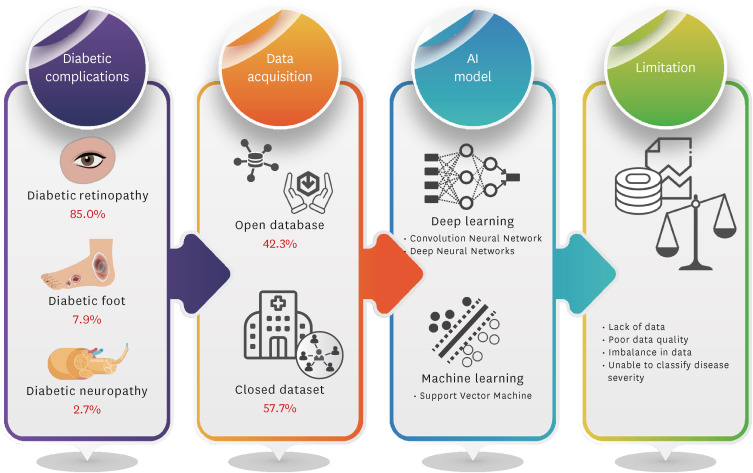
Artificial intelligence (AI)-based diagnostic technology using medical images can be used to increase examination accessibility and support clinical decision-making for screening and diagnosis. To determine a machine learning algorithm for diabetes complications, a literature review of studies using medical image-based AI technology was conducted using the National Library of Medicine PubMed, and the Excerpta Medica databases. Lists of studies using diabetes diagnostic images and AI as keywords were combined. In total, 227 appropriate studies were selected. Diabetic retinopathy studies using the AI model were the most frequent (85.0%, 193/227 cases), followed by diabetic foot (7.9%, 18/227 cases) and diabetic neuropathy (2.7%, 6/227 cases). The studies used open datasets (42.3%, 96/227 cases) or directly constructed data from fundoscopy or optical coherence tomography (57.7%, 131/227 cases). Major limitations in AI-based detection of diabetes complications using medical images were the lack of datasets (36.1%, 82/227 cases) and severity misclassification (26.4%, 60/227 cases). Although it remains difficult to use and fully trust AI-based imaging analysis technology clinically, it reduces clinicians' time and labor, and the expectations from its decision-support roles are high. Various data collection and synthesis data technology developments according to the disease severity are required to solve data imbalance.
基于人工智能的医学影像诊断技术可用于提高检查的可及性,并支持筛查和诊断的临床决策。为了确定一种用于糖尿病并发症的机器学习算法,我们对使用基于医学图像的人工智能技术的研究进行了文献回顾,检索了美国国家医学图书馆 PubMed 和 Excerpta Medica 数据库。将使用糖尿病诊断图像和人工智能作为关键词的研究列表进行了组合。共选择了 227 项合适的研究。使用人工智能模型的糖尿病视网膜病变研究最为频繁(85.0%,193/227 例),其次是糖尿病足(7.9%,18/227 例)和糖尿病神经病变(2.7%,6/227 例)。这些研究使用了开放数据集(42.3%,96/227 例)或直接从眼底镜或光学相干断层扫描构建数据(57.7%,131/227 例)。使用医学图像基于人工智能检测糖尿病并发症的主要局限性在于缺乏数据集(36.1%,82/227 例)和严重程度分类错误(26.4%,60/227 例)。虽然在临床中使用和完全信任基于人工智能的成像分析技术仍然困难,但它可以减少临床医生的时间和劳动力,并且对其决策支持角色的期望很高。需要根据疾病严重程度开发各种数据收集和综合数据技术来解决数据不平衡问题。