Faculty of Computers and Information, Mansoura University, Mansoura, P.O. 35516, Egypt.
Med Biol Eng Comput. 2022 Jul;60(7):2015-2038. doi: 10.1007/s11517-022-02564-6. Epub 2022 May 11.
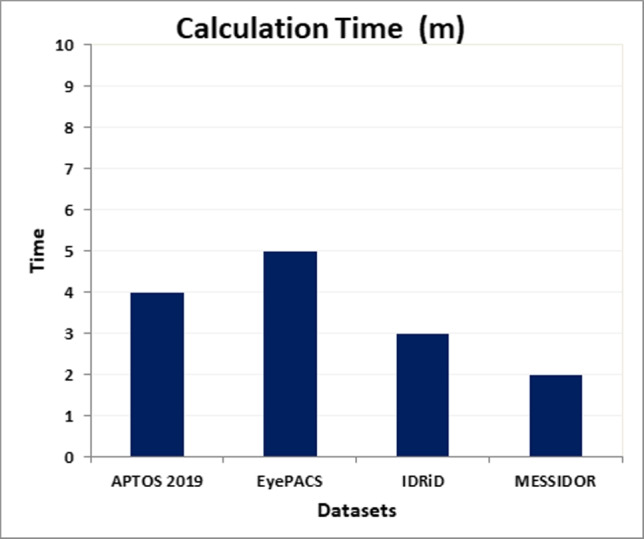
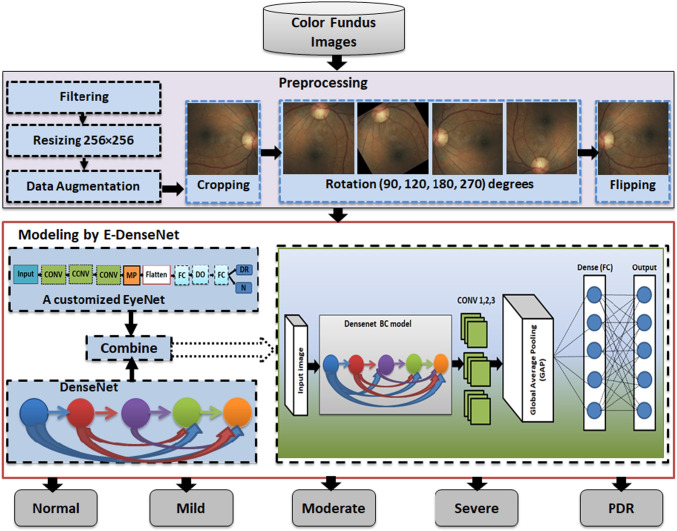
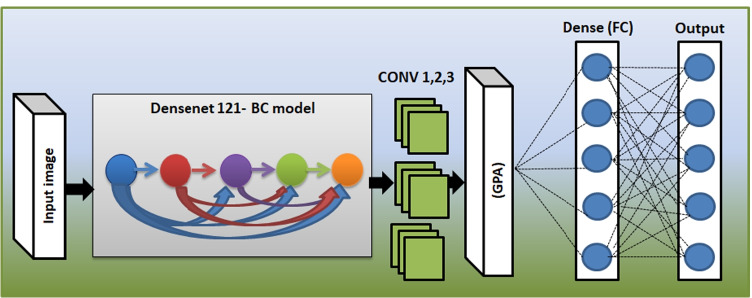
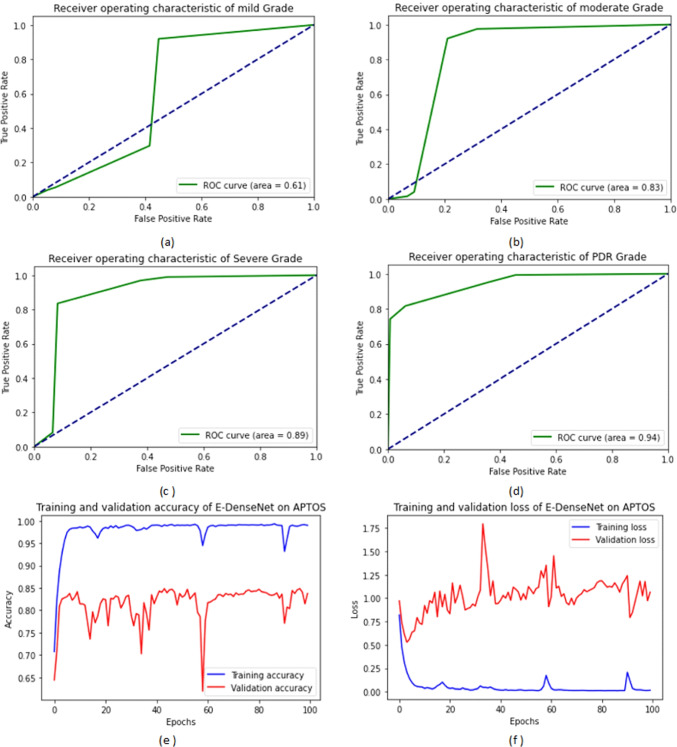
Diabetic retinopathy (DR) is a serious disease that may cause vision loss unawares without any alarm. Therefore, it is essential to scan and audit the DR progress continuously. In this respect, deep learning techniques achieved great success in medical image analysis. Deep convolution neural network (CNN) architectures are widely used in multi-label (ML) classification. It helps in diagnosing normal and various DR grades: mild, moderate, and severe non-proliferative DR (NPDR) and proliferative DR (PDR). DR grades are formulated by appearing multiple DR lesions simultaneously on the color retinal fundus images. Many lesion types have various features that are difficult to segment and distinguished by utilizing conventional and hand-crafted methods. Therefore, the practical solution is to utilize an effective CNN model. In this paper, we present a novel hybrid, deep learning technique, which is called E-DenseNet. We integrated EyeNet and DenseNet models based on transfer learning. We customized the traditional EyeNet by inserting the dense blocks and optimized the resulting hybrid E-DensNet model's hyperparameters. The proposed system based on the E-DenseNet model can accurately diagnose healthy and different DR grades from various small and large ML color fundus images. We trained and tested our model on four different datasets that were published from 2006 to 2019. The proposed system achieved an average accuracy (ACC), sensitivity (SEN), specificity (SPE), Dice similarity coefficient (DSC), the quadratic Kappa score (QKS), and the calculation time (T) in minutes (m) equal [Formula: see text], [Formula: see text], [Formula: see text], [Formula: see text], 0.883, and 3.5m respectively. The experiments show promising results as compared with other systems.
糖尿病视网膜病变(DR)是一种严重的疾病,可能会在不知不觉中导致视力丧失,而没有任何警报。因此,连续扫描和审核 DR 进展至关重要。在这方面,深度学习技术在医学图像分析中取得了巨大成功。深度卷积神经网络(CNN)架构广泛应用于多标签(ML)分类。它有助于诊断正常和各种 DR 等级:轻度、中度和重度非增生性 DR(NPDR)和增生性 DR(PDR)。DR 等级是通过在彩色眼底图像上同时出现多个 DR 病变来制定的。许多病变类型具有各种特征,这些特征很难利用传统和手工制作的方法进行分割和区分。因此,实际的解决方案是利用有效的 CNN 模型。在本文中,我们提出了一种新颖的混合深度学习技术,称为 E-DenseNet。我们基于迁移学习集成了 EyeNet 和 DenseNet 模型。我们通过插入密集块来定制传统的 EyeNet,并优化了由此产生的混合 E-DenseNet 模型的超参数。基于 E-DenseNet 模型的建议系统可以从各种大小的 ML 彩色眼底图像中准确诊断健康和不同的 DR 等级。我们在四个不同的数据集上进行了训练和测试,这些数据集是在 2006 年至 2019 年期间发布的。该系统的平均准确率(ACC)、灵敏度(SEN)、特异性(SPE)、Dice 相似系数(DSC)、二次 Kappa 评分(QKS)和计算时间(T)分别为[公式:见文本]、[公式:见文本]、[公式:见文本]、[公式:见文本]、0.883 和 3.5m。与其他系统相比,实验结果表明该系统具有良好的性能。