Zhu Yuwei, Xia Shuang, Yang Weihang, Shi Fengchao, Ji Hongjian
Department of Orthopedics, The Sixth Affiliated Hospital of Nantong University, Yancheng Third people's Hospital, Yancheng, Jiangsu, 224001, China.
Jiangsu Vocational College of Medicine, Yancheng, Jiangsu, 224005, China.
BMC Sports Sci Med Rehabil. 2023 Aug 8;15(1):97. doi: 10.1186/s13102-023-00704-5.
To investigate the early clinical efficacy of rehabilitation training after unilateral biportal endoscopy for lumbar disc herniation and to analyze the prognostic factors.
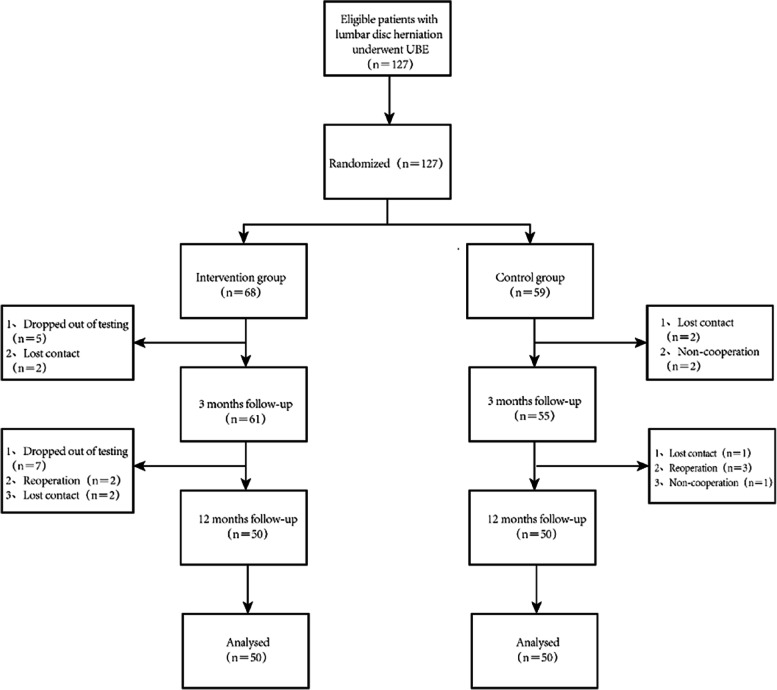
A total of 100 patients with lumbar disc herniation who underwent unilateral biportal endoscopy at The Sixth Affiliated Hospital of Nantong University from January 2019 to January 2021 were retrospectively analyzed. The control group was given a standard home-based exercise program, while the intervention group was given a substituted rehabilitation training opposed to a standard home-based exercise program. The early postoperative pain relief and quality of life values were compared between the two groups, and the independent risk factors affecting the prognosis of patients were analyzed.
There were no significant differences in sex, age, smoking, drinking, BMI, course of disease, type of disc herniation, preoperative VAS, ODI or SF-36 between the two groups (P > 0.05). There was no significant difference in preoperative and postoperative VAS and ODI scores at 3 months between the two groups (P > 0.05), yet there were significant differences in postoperative VAS and ODI at 12 months (P < 0.05). The SF-36 score of the intervention group was lower than that of the control group at 12 months, and the difference was statistically significant (P < 0.05). The excellent rate of the Macnab standard modification used in the intervention group was 88.00% at 12 months, and that in the control group was 62.00%. The difference between the two groups was considered to indicate a statistically significant (P < 0.05). The results of logistic multivariate regression model analysis showed that rehabilitation training (95% CI: 1.360-12.122, P = 0.012), the type of intervertebral disc (95% CI: 0.010-0.676, P = 0.020), and age (95% CI: 1.056-8.244, P = 0.039) were independent risk factors affecting the prognosis of patients.
Postoperative rehabilitation training can effectively relieve pain and improve quality of life; thus, it is highly recommended in the clinic. Postoperative rehabilitation training, intervertebral disc type and age are independent risk factors for the postoperative prognosis of lumbar intervertebral disc herniation.
探讨单侧双通道内镜下腰椎间盘突出症术后康复训练的早期临床疗效,并分析预后因素。
回顾性分析2019年1月至2021年1月在南通大学第六附属医院接受单侧双通道内镜手术的100例腰椎间盘突出症患者。对照组给予标准的家庭锻炼计划,干预组给予替代标准家庭锻炼计划的康复训练。比较两组术后早期疼痛缓解情况和生活质量值,并分析影响患者预后的独立危险因素。
两组患者在性别、年龄、吸烟、饮酒、BMI、病程、椎间盘突出类型、术前VAS、ODI或SF-36等方面差异无统计学意义(P>0.05)。两组患者术后3个月时VAS和ODI评分术前术后差异无统计学意义(P>0.05),但术后12个月时VAS和ODI差异有统计学意义(P<0.05)。干预组术后12个月时SF-36评分低于对照组,差异有统计学意义(P<0.05)。干预组12个月时采用Macnab标准改良的优良率为88.00%,对照组为62.00%。两组差异有统计学意义(P<0.05)。Logistic多因素回归模型分析结果显示,康复训练(95%CI:1.360-12.122,P=0.012)、椎间盘类型(95%CI:0.010-0.676,P=0.020)和年龄(95%CI:1.056-8.244,P=0.039)是影响患者预后的独立危险因素。
术后康复训练能有效缓解疼痛,提高生活质量,临床值得推广。术后康复训练、椎间盘类型和年龄是腰椎间盘突出症术后预后的独立危险因素。